TAG

#定期定額

45 articles · ← All tags

Wealth Awakening

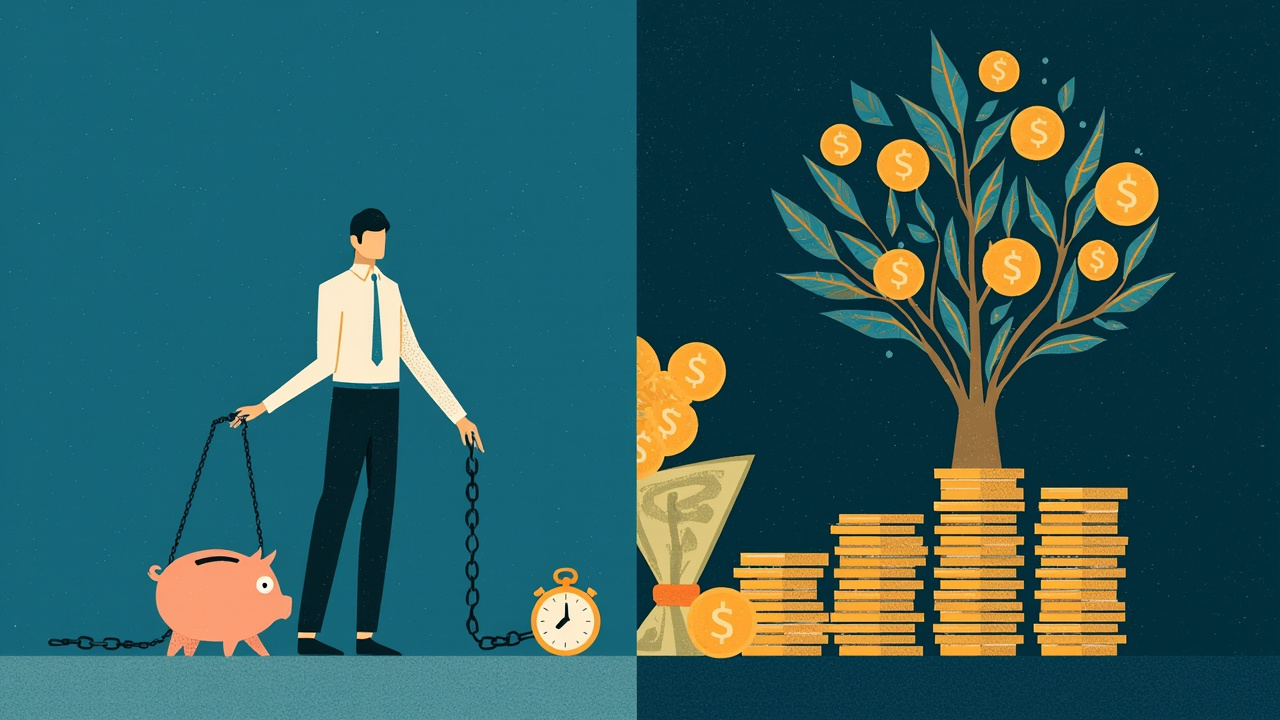
Inflation Erodes Savings: Why Skipping Investments Can Lead to Financial Fragility in Retirement

Taiwan has seen consumer prices roughly double over the past decade, with fried-chicken lunch boxes climbing from NT$80 to around NT$150 and bubble tea from NT$35 to NT$80. This article uses a fictional 38-year-old office worker, Jia-hao, to illustrate the long-term gap between labor income and capital income, and outlines a practical, disciplined savings framework accessible to workers earning NT$30,000 to NT$40,000 per month.

9 min
Wealth Awakening

Sinking NT$3M Into S&P 500 for 15 Years: The Shocking Result That Silences Family Pressure

Still believe the old family script that renting equals paying your landlord's mortgage? This article runs a brutal 15-year simulation: drop a NT$3M down payment into the S&P 500 and watch it balloon to NT$20M in liquid wealth. Meanwhile, the buyer ends up stuck with a NT$25M paper fortune he can never touch. The hidden math behind liquidity, opportunity cost, and the mortgage trap everyone ignores.

11 min
Wealth Awakening

You Buy Because It "Feels" Like a Rally? The Brain Trap That Cost Retail Investors NT$5 Million

Why do you only feel the urge to buy right after the rally is already over? Dalbar data shows retail investors earned just 3.98% annualized over 30 years vs 10% for the S&P 500. We break down availability bias, herd behavior, and the structural media trap, then run the real numbers: NT$600K invested over 20 years delivers NT$3.9M if you follow your gut, but NT$8.92M if you automate. The gap is NT$5.02 million from the same money.

13 min
Wealth Awakening

Is DCA Actually a Trap? The 50/50 Golden Ratio That Retires You 10 Years Earlier

Scared to lump-sum into a crash, but DCA feels painfully slow? A century of Wall Street backtests reveals 90% of retail investors lose—not because the method is wrong, but because they lose to human nature. We expose the blind spots of lump-sum psychology and the cash-drag trap of DCA, then unlock the full Core-Satellite 50/50 Golden Ratio: 50% high-dividend core + 50% broad-market satellite. Pair it with a dual-account discipline and you sleep soundly through crashes, buy the dips, and retire a full decade earlier.

15 min
Wealth Awakening

Investment-Linked Insurance: The 60% Fee Black Hole and the Death Spiral That Devours Retirees

You think that monthly investment-linked insurance policy is giving you protection and growth at the same time? The ugly truth: up to 60% of your first-year premium vanishes into the insurer pocket, monthly admin fees and rising mortality charges keep draining the account, and a death spiral in old age can wipe the whole thing to zero. This is the three-layer trap agents will never warn you about.

8 min
Wealth Awakening

The Poor Chase Speed, the Rich Chase Stability: The Secret Path to Getting Rich Slowly, Understood by Only 1%

In Taiwan, only one in every three people who opens a brokerage account actually makes money over the long term. Same market, same tools, same time — yet the outcomes are completely opposite. A 25-year-old e-commerce customer-service rep in Taichung earning under NT$40,000 a month had enough for the down payment on a two-bedroom apartment three years later; a 30-year-old semiconductor equipment engineer in Hsinchu earning over NT$1 million a year lost the wedding fund his parents left him. The difference isn't luck — it's the fundamental understanding of "what a stock really is." This article uses the story of a 60-year-old goose-meat shop to fully unlock the essence of stocks, why most people treat stocks like gambling tools, and the slow-wealth secret path that only 1% understand.

7 min
Wealth Awakening

The Lazy Investor's Compounding Toolkit: A Cash-Flow Allocation That Beats 80% of Investors While Lying Flat

Open your phone, see someone else's investment statement showing a 30% annual return, tap in for three seconds, then quietly close it. Open the brokerage app, see ETFs, dollar-cost averaging, digital accounts—an avalanche of jargon—swipe a few times and decide it's all too much, then close it. You're not lazy—you're overwhelmed. If your savings are under NT$1.5 million, today we're cutting the fluff and skipping the theory: we'll tell you exactly where the money should sit first, what to buy first, and why. You don't have to be brilliant. You only have to do one thing: treat yourself like a smart ordinary person.

8 min
Wealth Awakening

TWSE Breaks 40,000 in H2 2026: Four Principles to Protect Your Principal from Getting Wiped Out

The TWSE is at 40,000 but your account is still losing money. This is not a joke, it is happening right now. The index hitting a new high and your account making money are two completely different things, and that is the biggest cognitive blind spot for 90% of Taiwan retail investors. This article uses the real recovery cycles of the 2008 financial crisis (TWSE fell nearly 60%, recovery over five years), the 2020 COVID crash (nearly 30% in a single month), and the 2022 rate-hike cycle (close to 32% drawdown) to show how the wrong capital allocation can lock your losses in. It also breaks down the cost gap between active funds charging 1.5% to 2.5% in annual management fees versus index ETFs like 0050 under 0.4%, and the hidden transaction-cost bill that can exceed NT$10,000 a year for an active retail trader. It then walks through four principles to protect your principal in a TWSE-40,000 high market: building a capital firewall, replacing lump-sum entry with dollar-cost averaging, setting written stop-loss and take-profit rules before entry, and rebalancing annually. It closes with four veto iron rules to keep you from adding at the worst possible moment.

12 min
Wealth Awakening

TWSE Drops 2,700 Points, Institutions Siphon Off NT$9 Trillion: The Underlying Logic of Harvesting Retail Investors Explained Once and For All

In April 2025, the TWSE plunged more than 2,700 points in just a few trading days, with market capitalization evaporating an estimated NT$9 trillion—equivalent to five full months of Taiwan's entire productive output. NT$9 trillion did not vanish into thin air; it simply moved from one pocket to another. This article does not tell you which stock to buy, nor does it try to forecast where the TWSE bottom is. Instead, it lays out the underlying logic of how retail investors get harvested: three market mechanics (structural information asymmetry, retail always being last in and last out, conflicts of interest in financial institutions), three sets of sobering accountings (including a NT$3.05 million hidden-cost gap over 30 years), a four-question decision framework, four iron rules, and two Taiwan-specific traps (ETF ex-dividend pitfalls and liquidity risk). The core lesson: in an information-asymmetric market, emotion is the retail investor's most expensive cost, and discipline is the only edge retail investors can actually control.

19 min
Wealth Awakening

Buying the Dip at TWSE 40,000? This Is the Real Reason Taiwanese Retail Investors Lose Money

Taiwan stocks have broken 40,000 points. You open your phone, look at your account, and wonder whether to add to the bottom—then a year later you are down NT$300,000. Taiwanese retail investors lose money not because they pick the wrong stocks or lack inside information, but because their understanding of bottom-fishing is fundamentally wrong from the start. This article breaks down 3 underlying rules (using the wrong timing cancels time compounding, Taiwan stock volatility exceeds psychological capacity, and the structural interest alignment of Taiwan's financial institutions), 3 sweat-inducing account scenarios (including a 20-year gap of NT$2.86M), a 4-question decision framework, 4 veto rules, 4 practical action steps, 2 overlooked Taiwan-specific traps (after-tax dividend income yield, and leveraged ETF daily reset decay), and an emergency plan for extreme markets. Core line: in Taiwan stocks, what makes you lose money is never the market, it is your misjudgment of yourself. Action hint: before your next impulse buy, run the 4 questions and check the veto rules.

18 min
Wealth Awakening

60% of Taiwanese Have Stock Accounts, Only 10% Make Money: The Truth About Stocks in 36 Minutes

Taiwan has over 12 million brokerage accounts—roughly 60% of all adults have entered the market—yet fewer than 10% achieve stable long-term profits. The shared fate of the other 90% is not bad luck or wrong picks, but treating speculation as investing and using an investor's mindset to deceive themselves. This article breaks down the structural disadvantage of short-term trading, the overconfidence bias from behavioral finance amplified by Taiwan's 2016–2024 bull run, three underlying iron rules (compounding cost erosion, low-buy-high-sell losses, and the liquidity trap of strong capital), four questions to ask before every order, a complete four-step action plan, three real account scenarios (5-year and 20-year horizons), two Taiwan-specific high-level traps (dividend tax plus NHI supplemental premium, and ETF tracking error plus premium/discount), and an emergency plan for extreme market conditions. Pain point: even in Taiwan's strongest bull run, most retail investors left with less than they started. Promise: a tested framework that turns stock decisions into a discipline, not a feeling.

11 min
Wealth Awakening

Complete 2026 Taiwan Stock Tax Guide: Day Trading Loses to Taxes, Not to the Market

You made 30 short-term trades this year, your paper gain was NT$80,000, but only NT$52,000 actually landed in your pocket. Have you seriously calculated where the missing NT$28,000 went? Taiwan's stock market's most invisible harvester is not a falling price, but securities transaction tax and brokerage fees quietly cutting money out of your pocket one knife at a time. This article fully breaks down the 2026 Taiwan stock transaction tax structure (securities transaction tax, commissions, dividend income with the 8.5% credit and 28% separate option), 3 real account comparisons including a 20-year compounding gap of NT$3.4M, 3 Taiwan-specific blind spots tailored to new, mid-level, and senior investors, 4 iron rules, and 4 full-cycle action steps. Pain point: many traders blame market direction when the real leak is taxes and fees. Promise: a complete cost-aware playbook that helps you keep more of every gain, including how to optimize your tax filing in May.

15 min
Wealth Awakening

From All-In on AI to Nothing Left: The 5 Endgame Blind Spots of Taiwan Stock Retail Investors

Three months after going all-in on concept stocks, your account is down to less than half—that is the real story of hundreds of thousands of Taiwanese retail investors last year. Long-term returns for Taiwan retail investors are systematically below the broader market, not because of stock-picking skill, but because of entry-timing bias compounded by hidden costs continuously eating away at returns. This article breaks down 3 underlying rules (behavioral cost as the real erosion, structural market asymmetry against retail investors, and the revenue logic of financial institutions that pushes you to trade more), 3 account-checking scenarios with hard numbers, 4 ironclad veto rules, 4 actionable steps, a four-question decision filter, and age-based application boundaries for fresh graduates, young families, middle-aged parents, and seniors. Pain point: you keep buying high and selling low and cannot explain why. Promise: a reusable framework that puts your trading decisions back in rational control, with concrete rules for each life stage.

15 min
Wealth Awakening

99% of People Buy S&P 500 Wrong: Building Income That Doesn't Require Going to Work

The S&P 500 index itself is fine; the problem is in how you buy it. Taiwanese investors holding it through mutual funds and bank-wrapped products face an average total expense ratio of 1.2% to 1.8%, but direct VOO is only 0.03% to 0.07%. On NT$1M over 20 years, that fee gap produces a final-asset difference of over NT$2M. This article breaks down the true cost of four packaging methods, four iron rules of investing, four action steps, and the US estate tax trap that 99% of Taiwanese investors don't know about. For a Taiwan worker earning NT$45K/month contributing NT$8,000 over 20 years: a 1.5% management fee offshore fund yields about NT$4.88M; direct VOO via sub-brokerage yields about NT$5.67M — an NT$800K gap just from fees. Add behavioral mistakes (stopping DCA during 2008, 2020, 2022 crashes) and the gap to NT$5.67M exceeds NT$2M. The US imposes up to 40% estate tax on US-listed ETF holdings above US$60,000 for non-US residents, and Taiwan has no estate tax treaty with the US. Possible alternatives include Irish-domiciled UCITS ETFs or Taiwan-listed S&P 500 ETFs. Includes specific packaging comparison: Yuanta S&P 500 (00646), Fubon S&P 500 (00650), VOO/IVV, mutual funds, and structured products.

12 min
Wealth Awakening

S&P 500 at 7,600 and Nasdaq at 27,000! The 3 Places the Wealthy Are Quietly Moving Money

S&P 500 at 7,600 and Nasdaq at 27,000 — your finger is already on the order page. This article breaks down the three places the wealthy move capital at market highs instead of chasing them (short-term Treasuries plus money market funds, relatively cheap defensive sectors, and emergency reserve top-ups), and runs three end-state scenarios comparing lump-sum NT$300K entry at the high vs DCA entry. It closes with three Taiwan-specific blind spots for local investors and a 4-step action plan. The S&P 500's current CAPE ratio is in a relatively elevated zone, meaning new entrants get less future return for the same dollar than three years ago. Recent data shows institutional flows into short-term Treasuries and money market funds have reached historic highs — these investors aren't bearish on stocks, they are simply preserving dry powder. For Taiwanese investors, similar positioning can be done via Taiwan-listed short-term Treasury ETFs, USD time deposits, or USD money market funds. Includes emergency reserve design (6 to 12 months of expenses), bullet allocation (20–30% in short-duration Treasuries), and FX cost transparency for the local market.

10 min
Wealth Awakening

The S&P 500 Hidden Loss Trap: Why DCA into US ETFs Isn't Risk-Free, and the Right Way to Retire Early

Using a Taiwan salary to DCA into S&P 500 ETFs looks like the world's strongest passive investment, but hides four loss traps that Taiwanese investors most often overlook. This article uses the 2008 financial crisis, the 2020 COVID crash, and the 2022 rate-hike cycle as examples to break down four blind spots — exchange rate, costs, timing, and emotion — and delivers the correct way for Taiwanese investors to buy US ETFs for early retirement, plus alternative routes. Many investors do not realize that from 2020 to 2021 USD/TWD dropped from 30 to 27.5, meaning a 50% S&P 500 gain translated to only about 30% in NTD. The Dalbar study shows average retail investors underperform their funds by 1.5% to 2% annually due to behavioral mistakes. Total fee differences between domestic and overseas S&P 500 ETFs can reach 0.3% to 0.8%, with another 0.1% to 0.2% hidden in FX hedging costs. Get a step-by-step guide covering tool selection, fixed DCA scheduling, FX management, and age-adjusted equity-bond allocation, and learn why psychological tolerance matters ten times more than index choice.

8 min
Wealth Awakening

Wiped Out by One Crash? The Same Mistake Every Taiwan Retail Investor Makes: The Sandpile Effect

You poured three years of savings in last month, and this month your account is halved. It's not bad luck or a bad stock pick; your portfolio was already sitting at an invisible tipping point, waiting to collapse. This is the fatal investment blind spot proven by physicists in the sandpile experiment: highly correlated assets fall together in a crash. This article breaks down 3底层 rules, 3 calculations, 4 iron rules, and a 4-step action plan to help you design a portfolio you can keep holding even in the worst moments. Over 60% of Taiwan retail investors concentrate holdings in the electronics sector, with TSMC alone accounting for over 30% of the weighted index. Many investors mistakenly believe buying 10 semiconductor supply chain stocks is diversification, but those 10 stocks have a correlation coefficient near 0.9. The article covers maximum drawdown as the psychological breaking point, the correlation trap that destroys diversification in crisis, the hidden value of rebalancing, and a true comparison showing how NT$1 million lost 59% in the 2008 crash and needed six years to recover. Get a portfolio that lets you survive the avalanche.

14 min
Wealth Awakening

Earning NT$40K But Still Broke? The Dark Formula of Taiwan's Top 3.5% Wealthy

In Taiwan, your salary sets your ceiling, but asset allocation decides whether you break through it. This article dissects the fundamental gap between Taiwan's top 3.5% wealthy and ordinary office workers, not return rates, but three底层 logics: making assets work for you, controlling true total cost, and building an emotion-free financial system. From the 100-minus-age stock-bond formula, savings insurance with 15-20% loading fees, ETF dividend traps, to Second Generation NHI supplemental premium tax tricks, you get an actionable plan to start today. Most Taiwanese salary earners lose 2-3% purchasing power annually to inflation by parking money in low-interest checking accounts. The Taiwan Securities Investment Trust and Consulting Association data shows the average DCA holding period is less than two years. This piece delivers a four-step action plan with four iron rules, two local hidden traps (Second Generation NHI 2.11% levy and dividend-from-capital ETF schemes), and emergency scenario playbooks, helping you build the system that separates the top 3.5% from everyone else.

13 min
Wealth Awakening

Earning NT$30K–50K But Can't Save? Quit These 5 Expenses First and Save an Extra Month's Salary

Payday looks decent, but by month's end only NT$3,000 is left. The problem isn't low income — it's a spending structure that systematically evaporates wealth. This article breaks down the 5 spending traps Taiwanese office workers fall into most: forgotten subscriptions averaging NT$1,500/month across five services, savings insurance treated as high-rate time deposits when its actual annualized return after fees is just 1%–2%, hidden-interest credit card installments at 7%–15% annualized rates, expired bulk-buy sale hoarding (the Taiwan Consumers' Foundation estimates average household food waste exceeds NT$10,000 a year), and anxiety spending disguised as self-investment. Conservative estimates put the total annual evaporation at NT$40,000–65,000 — about 1.5 months of a NT$40,000 salary — and that's money you didn't even feel leaving. Redirected into DCA at 4%–6% annualized returns, the 20-year compounding gap is in the NT$1 million range. Includes 4 iron rules, a 4-step action plan starting with a 20% auto-transfer on payday, and 2 overlooked Taiwan-specific tax-saving tools including Labor Pension voluntary contributions that can save roughly NT$1,400 a year in tax at the 5% bracket.

14 min
Wealth Awakening

Save NT$3,000/Month Into 0050, Roll Into NT$5.5 Million in 30 Years: The Most Reliable Path for Ordinary People

Park your money in a bank savings account and your real purchasing power erodes every year — Taiwan savings rates of 0.1% to 0.2% can't keep up with DGBAS's 2% to 3% 5-year inflation average, which hit 3.05% in 2022. NT$3,000 per month parked in a 1.5% time deposit for 30 years yields about NT$1.3 million nominally, but in real purchasing power equals only NT$700,000 of today's money. This article uses three real calculations to break down 0050's compounding path: at a conservative 7% annualized return, NT$3,000 monthly DCA grows to NT$3.6 million; at 8%, NT$4.3 million; at 9%, approaching NT$5.5 million — but also lays out the brutal truth that 0050 fell nearly 58% in 2008 and 30% in 2020. You'll get 4 iron thresholds every beginner must clear before opening an account, including the 30%/50% drawdown emotional rule that must be written down before emotions kick in, plus 4 actionable steps and advanced reminders about broker fee differences that compound into a non-trivial cost over 30 years.

8 min
Wealth Awakening

Waiting for a Taiwan Stock Crash Before Buying? Retail Timing's Fatal Trap — Missing the Rally Is Worse Than Losing Money

You waited three whole years, Taiwan stocks never dropped, you never got in — and your wealth shrank anyway. Not because you lost money, but because you never earned any. The hidden cost of missing a rally is far worse than paper losses — but you won't see it on a balance sheet. Taiwan's TAIEX has delivered roughly 7% to 8% annualized total return over the past 20 years, and waiting through a 50% run-up before entering means missing opportunity cost that can never be recovered. Three side-by-side calculations in this article show a NT$1 million to NT$1.4 million wealth gap after 20 years between a disciplined DCA investor and a wait-for-crash investor whose effective invested months are only 60% as many. You'll get 3 underlying rules explaining why timing the market is structurally doomed, 4 veto-proof iron rules including a 3 to 5 year minimum time horizon on invested money, and 4 actionable steps to set up automatic DCA on a mid-month trading day and close the app.

15 min
Wealth Awakening

The Jewish Secret to Generational Wealth: Pay Yourself First — The Order 90% of Taiwanese Get Wrong

Every payday your salary arrives and you immediately pay rent, the credit card, and premiums — only then do you think about saving — and by month's end you stare at an empty account. You've earned millions in your lifetime, so why can't you accumulate wealth? It's not that you don't work hard or live frugally; the problem is that the wealth-distribution order passed down by Jewish tradition for thousands of years is the exact opposite of what you were taught. A side-by-side calculation reveals the gap: an NT$45,000 earner saving NT$3,000 a month from what's left for 35 years ends with about NT$1.3 million in a savings account, while the same earner who force-transfers 15% into a Taiwan 50 index fund on payday ends with NT$11–12 million over the same period — an 8 to 9x gap from a single sequencing change. This article breaks down 3 underlying rules including why time is the only free weapon ordinary people have, the 3-bucket principle for distributing every paycheck, 4 veto-proof iron rules such as never borrowing on credit card revolving interest at 15%, and a 4-step action plan to put it into practice starting today.

15 min
Wealth Awakening

Earning NT$38K But Living Like NT$100K? The NT$8,000 Trap of "Fancy Poverty"

You tap hearts on friends' omakase posts, then open your banking app and see NT$2,300 left. This isn't an isolated case — it's the lived reality of over a million young Taiwanese office workers. According to the Taiwan Financial Wisdom Education Promotion Association, the 25–35 age group has an average savings rate of just single digits, with nearly 40% unable to save anything each month, while over 60% still travel abroad every year. This article dissects the structural trap behind that behavior and the 15% credit card revolving interest that bleeds many of them dry, using a 30-year simulation of an extra NT$8,000 per month to show how 800 cups of coffee can become NT$8 million in retirement — or vanish entirely. You'll get 4 self-rescue rules including the 30-second and 72-hour spending tests, a 4-step action plan starting with a 20% auto-transfer on payday, and a framework for reclassifying spending into true experiences, daily small happiness, and impulse fancy poverty that must be cut entirely.

9 min
Wealth Awakening

Inflation Era: Holding Cash Means Getting Poorer — 3 Strategies the Wealthy Use to Beat Inflation

You deposit your salary into the bank every month, the number never shrinks, yet your money is quietly disappearing — not stolen, but evaporated bit by bit by inflation. Taiwan's inflation rate hit 3.15% in 2022 while savings accounts paid just 0.2%, meaning inflation eats your money 3 to 10 times faster than you can save it. In real terms, NT$1 million in savings only retains the purchasing power of NT$975,000 after a year of 2.5% inflation, and a young worker saving NT$5,000 a month for 10 years sees NT$140,000 of those savings silently stolen by rising prices. This article breaks down 3 underlying strategies the wealthy use to fight inflation: the dual-bucket structure that splits life-saving money from money-at-work money, dollar-cost averaging into the 0050 ETF, and Taiwan Labor Pension voluntary contributions of 6% for tax savings that can save roughly NT$3,500 a year in tax for a 12% bracket earner. You'll also get 4 non-negotiable iron rules, 4 concrete action steps you can take today, and an emergency protocol to follow when markets crash 30% or more.

15 min
Wealth Awakening

NT$500K Is the Threshold That Changes Your Fate — Save It, Then You Get to Say No

NT$500,000 isn't a number — it's the first time an ordinary person can say no to a bad job, an abusive client, or an exhausting relationship. 90% of Taiwan office workers save for five or ten years and still don't have NT$500,000, not because their salary is too low, but because they got the order wrong, the insurance premiums are too heavy, and they never turned on Labor Pension voluntary contribution. This article breaks down three underlying rules, three calculation sets showing the wrong/right/20-year gap, four veto iron rules, four action steps, and differentiated strategies for fresh grads, working families, midlife parents, and pre-retirees — to help you walk from zero to your first NT$500,000. Using 2023 Ministry of Labor data (average monthly wage NT$45,000), DGBAS inflation (CPI 3.05% in 2022, 2%+ in 2023, 100万 in 30 years shrinks to NT$550,000 in real terms), and the fact that 2.11% second-generation NHI premiums quietly drain high-dividend ETF income, you will see why paying yourself first beats spending yourself broke. The article also shows how to consolidate multiple savings-insurance policies (NT$7,000/month of which is illiquid savings) into a low-cost index ETF (0.5% expense ratio, 7% annualized) to gain over NT$1.8 million over 20 years, while keeping your emergency reserve intact. By the end you will have a step-by-step roadmap to build the financial backbone that gives you the right to say no — starting with opening that separate account today.


8 min
Wealth Awakening

Park NT$500K This Way, Collect NT$20K/Month — 94% Don't Know

You have NT$500,000 in a savings account earning NT$4,000 a year in interest, but inflation eats NT$10,000 of purchasing power annually. Split the money into four layers — high-dividend ETFs (0056 or 00878), U.S. Treasury bond ETFs (00687B), inverse-hedge tools, and an emergency reserve — combine that with dividend reinvestment and disciplined monthly saving, and within three years your passive income can exceed your monthly salary. This article breaks down the actual allocation ratios, year-by-year compounding projections from year one to year three, and explains why banks, RMs, and investment-guru teachers will never teach you this playbook. You will see how 0056/00878 high-dividend ETFs at 6–7% yield and 00687B U.S. Treasury bond ETFs at 4–5% generate a baseline NT$1,500–1,800 of monthly passive income in year one, growing to NT$3,000+ in year three and over NT$60,000/year in year five. The article also covers the structural fee and interest-spread game banks play, the 2.11% second-generation NHI surcharge on dividends above NT$20,000, and why daily-rebalancing inverse ETFs erode over time and should only be used as short-term hedges. By the end you will have a concrete, executable NT$500K-to-financial-freedom plan that takes the next 1,095 days to unfold.

7 min
Wealth Awakening

Goldman Sees S&P 8000 — 3 Fatal Mistakes Taiwan Retail Will Make

Goldman just lifted its S&P 500 target above 6,500 with some analysts seeing 8,000, calling for an 18-to-24-month super-bull market. Taiwan retail investors are most likely to make three fatal mistakes in the heated sentiment: treating behavioral costs as returns, choosing the wrong channel that hides fees, and being led by financial institutions' commercial interests. Using Taiwan Stock Exchange data on retail trading frequency versus institutions, FSC disclosure on offshore-fund expense ratios, and the U.S. estate-tax exposure of NT$60,000 / 40% bracket for non-citizens, this article breaks down three underlying rules, three calculation sets, four veto iron rules, and a four-step action plan to help you preserve wealth before the bull market actually ends. You will learn why the gap between 4% and 8% annualized over 20 years amounts to over NT$2.2 million, how to check the total expense ratio of any Taiwan-listed U.S.-equity ETF via SITCA, and why inheritance-tax and currency-hedging costs are two Taiwan-local advanced traps hidden in plain sight. By the end you will know whether your current allocation can survive a 30% drawdown — and whether you should even add right now.

16 min
Wealth Awakening

Buy High, Sell Low: The 4 Stages How Institutions Harvest Retail

Buy and get trapped, sell and watch it rip — it isn't bad luck, it's you acting out the script institutions wrote for you. Institutional harvesting of retail investors runs through four stages: accumulation, markup, distribution, and markdown, each with its corresponding emotional trap. This article dissects the chip-flow logic behind every stage and your emotional reactions, from FOMO psychology to your biggest weakness — impatience — then gives you four unbreakable rules and four immediate action steps so you stop being the bag-holder at the top. You will see why you always buy high (because by the time you commit, the news, friend tips, LINE group "insider calls," and YouTube gurus have all confirmed the move, after the price has already run), why the boring sideways range is actually the most dangerous trap for impatient retail, and why the one big bullish candle near the top is the final escape wave — not a breakout. Closing with how to audit your broker statement, list your positions with their original thesis, unsubscribe from all tip channels, and ask three questions before every buy. By the end you will know that the few who make money in the market aren't smarter — they are simply calmer, and that working against the crowd is the only survival skill that matters.

11 min
Wealth Awakening

Age 40 Isn't Halftime — It's Your Last Real Financial Turnaround

Many 40-year-old office workers assume their salary has peaked, expenses bottomed out, and it's too late to save. But the real enemies were never low income — they are inflation quietly dissolving purchasing power, fee compounding devouring returns, and emergencies forcing you to exit at the worst possible moment. This article lays out three underlying rules (fight inflation, suppress fees, execute with discipline), pairs them with practical moves (Labor Pension voluntary contribution at 6%, annual rebalancing), and compares the real gap between parking NT$1 million in a time deposit versus phased investment in a Taiwan-listed low-cost index ETF (0050 or global equivalents) over 20 years. Using Taiwan's public data — weighted index total return annualized 7–9% from 2003–2023, SITCA's fee-and-holding-period research, and Ministry of Labor Labor Pension returns — the article shows that 0.5% versus 2% expense ratio over 20 years can carve out nearly NT$900,000 of retirement corpus. You will also see why Taiwan's three local blind spots catch 1st-year, 1-to-3-year, and 5-plus-year investors differently, and how 2008-style drawdowns of 50%+ require an emergency reserve cushion before any investing begins. The closing four-step plan can be executed today, before your last turnaround window closes.

9 min
Wealth Awakening

Earning NT$70K but Still Broke: Taiwan's Fake Middle-Class Trap

You earn NT$70,000 a month in Taiwan, outpacing 60% of earners, yet your bank balance hovers at four digits. You drive a financed import car, carry a 30-year mortgage, and finance branded goods on installment — a so-called middle-class professional who is, in reality, a debt specialist dressed up as success. This article breaks down the three harvesting rules — installment trap, social-pressure consumption, and pseudo-assets — that quietly drain your wealth, then lays out four iron rules and a four-step turnaround plan. Using real math on a NT$1.5 million import car and a NT$15 million apartment, you will see exactly how monthly cash flow leaks NT$24,000 per month on the car alone while you sleep. You will also learn how to consolidate high-interest revolving credit, build a six-month emergency reserve, and start disciplined ETF dollar-cost averaging with as little as NT$5,000 per month. The piece closes with a stark contrast: those who look rich and those who actually are. By the end you will understand why fake richness is more dangerous than honest poverty and how to start your ten-year real turnaround today.
12 min
Wealth Awakening

Is Dollar-Cost Averaging a Trap? If You Have Idle Cash, Stop Blindly DCA-ing: Lump Sum Can Retire You 10 Years Earlier

More than 3 million people in Taiwan use DCA, but 9 out of 10 of them don't know what they're doing. U.S. research spanning 30 years confirms that lump-sum investing beats DCA 66% of the time, and the same NT$600,000 over 20 years ends up differing by NT$8 million. This article breaks down the 3 underlying rules, 4 iron thresholds, and a 4-step action plan, explaining why blindly DCA-ing your idle cash is the most expensive habit of your life. DCA is not a poison — it is just used in the wrong place. If you are a fresh graduate whose salary after rent and living expenses leaves only NT$5,000, of course you should DCA — you have no idle cash to lump-sum. But if you have been working 5–10 years and have NT$200,000, NT$500,000, or even NT$1 million saved, continuing to DCA is wasting your own money.

8 min
Wealth Awakening

Can Day-Trading Make You Rich for Free? Taiwan Retail Investors Must See the Broker Harvesting Trap

You enter a day-trade 5 minutes before the open and end the day down NT$30,000. This isn't bad luck — it is a systematic trap that no one told you about, harvesting hundreds of thousands of Taiwan retail investors every day. This article dissects the day-trading harvesting structure in three layers — the cost hell, retail's structural disadvantage against institutional and algorithmic trading, and the antagonistic nature of the broker's business model. Also included: three real calculations, two advanced traps (misunderstanding the tax rate, settlement default legal risk), four iron rules, and a four-step action plan, ending with a contingency plan for extreme losses. Day-trading is not a zero-capital business — it is a system that uses your time, capital, and emotions to subsidize the profits of brokers and market makers. TWSE data shows that the share of consistently profitable day-traders among Taiwan retail is extremely low, and the share of algorithmic trading continues to climb into double digits.

14 min
Wealth Awakening

The More You Day-Trade, the More You Lose: The Real Cost the Rich Never Pay for Short-Term Trading

You stare at the screen all day, buying and selling, but the account keeps getting thinner. Using Taiwan Stock Exchange rules — brokerage cap of 1.425‰ and day-trade transaction tax of 1.5‰ — this article calculates the real cost of churning a NT$1 million position in and out daily as a NT$68,000 monthly loss before you even make a single profitable trade. It then uses the Taiwan 50's 7%–9% annualized return over the past 20 years to contrast the 20-year gap between 'day-trade every day' and 'just hold and forget.' Also included: four day-trading iron rules and a four-step action plan. TWSE data shows day-trade volumes exceeded 40% of total trading at the peak around 2021, but the share of consistently profitable day-traders is extremely low and still falling. Even with a 55% win rate, academic simulations show that after costs, the long-term net return converges to zero or negative.

11 min
Wealth Awakening

Retail Investors Fear Crashes, the Wealthy Wait for Them: The Underlying Logic of 5 Things That Make the Rich Richer in a Crash

The market is limit-down, your phone screen is full of red, and your first reaction is to sell and run — but have you considered that at the very same second, the truly wealthy are doing the exact opposite? Retail investors fear crashes, the wealthy wait for them. The gap is not capital, not information, it is mindset. This article breaks down the five things the wealthy do in a crash: hold cash, buy core assets, execute rebalancing, understand cycles, and use the crash for tax and cost optimization. You also get four iron rules, a four-step action plan, and a contingency plan for extreme drawdowns. TWSE data confirms: during major corrections, retail investors' net selling ratio is far higher than institutions' — they sell into the dip, then chase the rally. SITCA also shows institutional cash positions at market highs are typically more than double those of retail.

14 min
Wealth Awakening

It's Not Compound Interest That Fooled You — You Got the Reinvestment Order Wrong

Compound interest itself is not the problem — from Einstein to Buffett, they all point to the same logic. The problem is that you got the order of execution wrong from the very start. You buy at the high and stop contributing at the low; the average Taiwanese fund investor holds for only about two years, while compound interest needs 10 years to double — and you pull out long before it can do its work. This article breaks down the three underlying rules, four non-negotiable iron rules, and a three-question decision framework, paired with three real calculations and Taiwan-specific advanced traps around second-generation NHI supplementary premiums and voluntary labor pension contributions. You will see the real cost of switching funds every two years and what 'cost basis' actually means in dollar-cost-averaging.

17 min
Wealth Awakening

Selling at 20% Profit Is Why You Never Build Wealth: 3 Iron Rules of Compounding to Multiply Your Gains

When a stock goes up 20%, you press sell immediately — and then you miss the next 40% to 60% of the move. This article breaks down the three most fatal rules Taiwan retail investors ignore (the compounding time axis, the real meaning of profit-taking, and asset allocation) using a side-by-side 10-year comparison of a NT$300,000 position held with annual 20% profit-taking versus held untouched. You will see the true cost of constant trading. Also included: four operational iron rules, blind spots in labor pension allocation, and a dividend tax calculator. Taiwan's TWSE historical data and academic research show the average retail investor's annualized return persistently lags the broad market, and most are even in the red — the reason is not bad stock picking, it is the constant trading-in, trading-out, and the act of cutting the compounding time axis yourself.

12 min
Wealth Awakening

Why Are You Still Losing Money on ETFs? 4 Fatal Mistakes That Make 20 Years Pointless

You are buying the S&P500 and the Nasdaq 100, but your account stays in the red. The problem is not the ETFs — it is the four operational mistakes Taiwanese investors make most often: turning dollar-cost averaging into a market-timing tool, ignoring the cost structure, ignoring currency, and panic-stopping contributions at the worst moment. Perfect execution over 20 years builds roughly NT$3.5 million; after mistakes it is only about NT$2.7 million — how exactly does a million NTD walk out of your pocket? This article walks through the arithmetic, exposes the fee and currency traps, and gives you four pre-written emotional rules that protect your compounding when discipline breaks down. If you are about to give up on ETFs, read this first — the answer is rarely to stop, and almost always to fix how you buy.

9 min
Wealth Awakening

99% of S&P500 Buyers Won't Save Enough for Retirement: The Real Logic Behind Correct DCA

Everyone around you says buying the S&P500 is the right move, but fewer than 1% of investors actually complete a 20-year accumulation plan. The problem is not the S&P500 itself, but how you execute dollar-cost averaging. This article uses a real 2020 COVID-crash account gap and a 20-year compounding shortfall of over NT$1 million to break down the chronic trap of "saving less the longer you DCA." You will get a three-step retirement plan tailored to four life stages and four iron rules that turn this tool into real wealth. Stop blaming the market. The leak is in your behavior. Read on and fix your execution starting today.
9 min
Wealth Awakening

Compound Interest for the Lazy: Turn $5,000/Month Into $6.1M

Open your phone, see someone else post a 30% annual return, then quietly close the app? This is for anyone with under $1.5M in savings. Learn the digital account migration method, automatic investing in market-cap ETFs, slashing fixed expenses, and labor pension voluntary contributions — all without watching the market daily. After 30 years, the gap isn't about money, it's about the choices you make today.

12 min