
You waited three whole years, Taiwan stocks never dropped, you never got in. And your wealth shrank anyway — not because you lost money, but because you never earned any. Both feel the same, but one is more deadly, and it’s something you may never admit until you die: the cost of missing the rally is far greater than the cost of losing.
Does this sound familiar? Taiwan stocks hit 20,000 points and you say “too expensive, wait”; then they climb to 22,000 and you say “even more expensive, keep waiting”; they hit 24,000 and you start doubting your judgment. Then one day they suddenly drop 1,000 points and you feel a secret thrill of “finally” — only to bounce back the next day, and you don’t move. Does this loop feel super familiar?
This isn’t your problem — it’s the human brain’s prediction mode, called loss aversion. While you wait, your brain keeps telling you “safer to wait for a lower entry,” but it doesn’t tell you this: the wait itself is the biggest source of loss.
Core one-liner: Those who try to time Taiwan’s market lose to time; those who use time can beat inflation.
The Real Cost of Missing the Rally: Calculated with Taiwan Market Numbers
Historical data from the Taiwan Stock Exchange shows that on a total-return basis, Taiwan stocks have delivered roughly 7% to 8% annualized returns over the past 20 years, with some research institutions calculating closer to 9% when dividends are reinvested.
That number doesn’t sound like much, but plug it into the time compounding machine and the gap after 20 years for an office worker saving only NT$10,000 a month is bigger than you can imagine.
Calculation Set 1: The Real Cost of Waiting to Enter
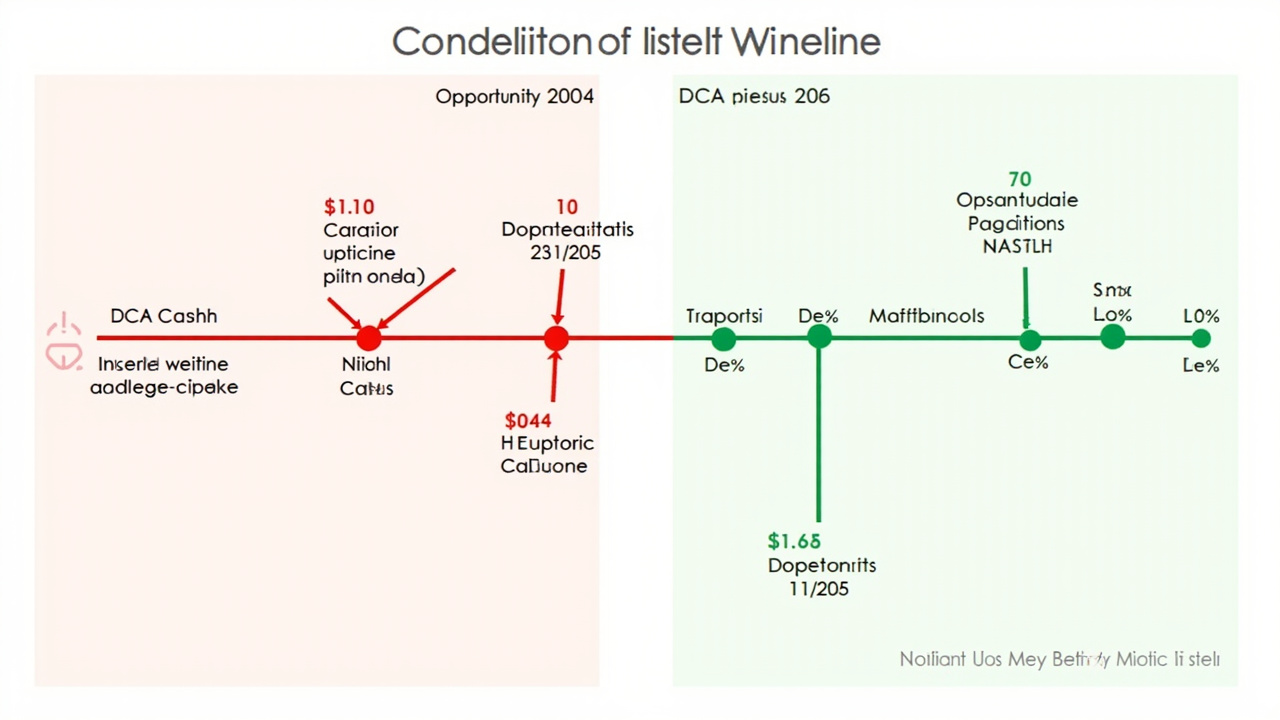
Suppose you start saving NT$10,000 per month from 2004, and you keep waiting for a big drop before entering. You wait three years and finally enter at the end of 2007 — right into the 2008 Global Financial Crisis, when the TAIEX fell from over 9,000 to 3,955 points, a maximum drawdown exceeding 58%. This is one of the worst black swan events in Taiwan over the past 20 years. You bought near the top and your paper losses exceeded half.
But if you’d started DCA from 2004, fixed amounts every month regardless of highs and lows, your paper losses in 2008 would also be real, with maximum drawdown roughly 30% to 35%. But your average cost would be much lower than someone who entered at the top, because you’d been accumulating much earlier. When the market recovered, you broke even nearly two years faster than the wait-and-enter investor.
More critically, during those three years of waiting, where did you park the money? In a bank time deposit at roughly 1.5% to 2% — three years and your money barely grew. Meanwhile Taiwan stocks climbed from around 6,000 to over 9,000 points in those three years, nearly a 50% gain.
You didn’t lose money, but your wealth shrank in relative terms. That is the hidden cost of missing the rally — you can’t see it, but it really exists.
Underlying Rule 1: Missing the rally isn’t free — it’s losing money in an invisible way. Opportunity cost is the retail investor’s biggest wealth killer, not that red number on your screen.
Retail Investors Fail at Timing Not Because They’re Stupid — It’s Structurally Doomed
SITCA’s annual fund investor behavior survey keeps showing a brutal fact: retail investors’ entry and exit timing is strongly negatively correlated with market performance.
In other words, the more confident you feel at the top and rush in, the more panicked you are at the bottom and rush out. Your actual return is always lower than the headline return of the fund or ETF you bought — sometimes less than half.
This isn’t scolding you — it’s how the human brain is wired. Richard Thaler, the University of Chicago Nobel laureate, and a large body of behavioral finance literature have validated: humans feel losses about twice as painfully as equivalent gains. This is called loss aversion; it makes you feel fear disproportionate to the actual risk when the market falls, leading to the worst decision — selling at the bottom.
Taiwan’s market has a very concrete example: in March 2020 when COVID hit, the TAIEX crashed from 12,000 to 8,523 in 30 days, a drop of nearly 30%. What did you feel at that moment? Most retail investors felt “it’s over, get out, wait for the bottom.”
But in the next 12 months Taiwan stocks rallied from 8,500 to 18,000 points, a gain exceeding 110%. Those who sold at the worst moment didn’t catch the bottom; they locked in losses and watched the market climb without daring to chase, missing the rally a second time. Those who did nothing and kept DCAing more than doubled their money in the following year.
Underlying Rule 2: Retail investors fail at timing not because they don’t try hard enough, but because the moment of maximum panic is when you are least capable of making the right decision, and the moment of maximum euphoria is when you are most likely to make the wrong one. These two moments are mirror opposites, so retail investors who try to time the market almost inevitably underperform over time.
Waiting for a Crash Sounds Reasonable in Theory — It’s Almost Impossible in Practice
Many people say: “I know I should hold for the long term, but how do I know whether now is a reasonable time to enter? I’m not trying to catch the exact bottom; I just don’t want to buy at the top and be stuck for years.”
That’s a great question — and there’s a core blind spot that 90% of Taiwanese finance bloggers haven’t seriously unpacked.
Many people think waiting for a big drop is a conservative, prudent strategy — this is the most common beginner misconception. The real question is: how do you define a big drop? Is 10% a big drop? 20%? 30%?
According to Taiwan Stock Exchange historical data, corrections exceeding 20% in Taiwan stocks have occurred on average every four to five years from 1990 to now, but each occurrence’s timing, magnitude, and duration is completely unpredictable.
More importantly, while waiting for a big drop, the upside you miss usually far exceeds the buying opportunity the eventual drop provides. There’s an academically validated number: if you missed the 20 best trading days in Taiwan stocks over the past 20 years, your annualized return drops from 7%–8% to below 3% — straight halving. And more than half of those top 20 best days occurred during moments of maximum panic, when the most people didn’t dare enter.
Underlying Rule 3: Waiting for a crash sounds reasonable in theory, but in practice it requires you to do two nearly impossible things simultaneously — accurately judge how deep is “deep enough” to buy, and have the courage to actually buy when panic is at its worst. Ordinary retail investors almost never manage both at the same time, so for most people, waiting for a crash actually produces worse results than plain DCA.
3 Sets of Real-World Calculation Comparisons
Calculation Set 2: Real Results from the Right Approach
Assume you’re a 30-year-old office worker earning NT5,000 per month for DCA into Taiwan stock ETFs — pick a mainstream ETF tracking the Taiwan 50. From 2004 to 2024, you buy a fixed amount every month regardless of highs and lows. In an ideal scenario, on a total-return basis, annualized return is about 7% to 8%, after 20 years your total principal is NT2.7 million to NT$3 million — the compounding effect is very visible.
But there’s a prerequisite you must actually meet: 20 years without quitting mid-way — including during the 2008 Global Financial Crisis when your paper losses exceeded 30%, during the 2020 COVID crash with 30% drop, and during the 2022 rate-hike cycle when Taiwan stocks fell from 18,000 to over 12,600 points, you didn’t waver and kept DCAing.
That prerequisite sounds simple, but for the vast majority it’s the hardest part. If you stopped DCA or redeemed near the 2008 bottom, then waited until 2010 when the market recovered to re-enter, your actual return would be 20% to 30% lower than the person who held continuously. That’s not a small number — that’s years of compounding wasted.
Worst case: if you happened to lump-sum a large amount near Taiwan’s all-time high — say NT300,000 paper loss, with break-even taking 2–3 years. That’s the worst scenario you must be psychologically prepared for.
That’s why DCA’s meaning for ordinary people isn’t just about returns — it uses time-spreading to dramatically reduce your chance of buying at the top while keeping the maximum psychological pressure you must endure within a tolerable range.
Calculation Set 3: The Long-Term Wealth Gap Between Two Choices
Same NT$5,000 monthly investment starting at age 30 — one person chooses uninterrupted DCA for 20 years, the other chooses to wait for crashes and only enters then. The wait-and-enter person waits an average of 2–3 years each time, and every time the market drops they panic and stop DCA. Effectively their invested months are only about 60% of the DCA person’s.
- After 20 years the uninterrupted DCA person, with dividends reinvested, has an annualized return of roughly 7% to 8% and assets around NT3 million.
- The wait-and-crash person, with 40% fewer effective invested months plus entry/exit timing drag, may only achieve 3% to 4% annualized return; after 20 years assets are around NT1.9 million.
The gap is NT1.4 million. That’s not small change — it’s a house down payment, your kid’s college plus overseas study, or an extra decade of living costs after retirement.
In an extreme scenario, if you lump-sum invested NT900,000 in paper losses. The psychological pressure is intense and break-even takes 2–3 years. But if you’d spread the same NT$3 million across DCA over 2019 to 2021, your average cost would be far below the top, the 2022 correction’s impact on your paper portfolio would only be around 15% to 20%, and your psychological pressure would be far less than the lump-sum investor.
That’s why for ordinary people, spreading entry over time isn’t because it makes you more money — it’s because it lets you keep going in the worst-case scenario without quitting. That’s its real core value.
4 Iron Rules
- Your emergency fund must be in place first, equal to at least 3–6 months of living expenses — for Taiwan’s Greater Taipei area that’s roughly NT300,000. This money cannot sit in the stock market; it must be in instantly accessible savings or short-term time deposits. This is your most important guarantee that you won’t be forced to sell at a market bottom — entering without an emergency fund means at the worst possible moment you’re most likely to be forced to sell at the lowest point.
- The money you put into stocks must be idle funds you won’t touch for 3–5+ years. If you’re buying a home next year, getting married the year after, or sending a kid to college in two years, those time-tagged funds don’t belong in a volatile stock ETF.
- You must honestly assess your risk tolerance — not a paper questionnaire, but really thinking through whether you can keep DCAing untouched if your paper loss hits 30%, meaning NT700,000. If the answer is “I’m not sure,” you must lower your single-entry and monthly DCA amounts to a level where in the worst case you can still sleep at night.
- Your picks must be compliant ETFs with sufficient liquidity and clear index tracking — not individual stocks, not thematic high-volatility ETFs, not leveraged products. FSC-approved broad-based index ETFs are the most executable long-term tool for ordinary investors.
4 Steps to Take Today
- Open your banking or brokerage app and confirm whether your savings account holds 3–6 months of living expenses. If not, fill the gap first — that’s more important than any investment. This takes less than 5 minutes.
- Calculate the true idle amount you can put into long-term investment each month. The method is simple: monthly income minus all fixed expenses, minus the monthly emergency fund contribution; whatever’s left, take 30% to 50% as the amount you may consider for DCA. Don’t be greedy — sustainability beats size.
- Choose a compliant ETF tracking a Taiwan broad-based index — the most commonly discussed include ETFs tracking the Taiwan 50 or the TAIEX. Pick a specific one yourself by checking three indicators: expense ratio, liquidity, and tracking error.
- Set up automatic DCA deductions, choose a fixed date each month for the system to execute, then close that account’s app and don’t check it every day — a semi-annual or annual review is enough.
2 Taiwan-Specific Advanced Pitfalls to Avoid
First: a small detail about debit date. Taiwan stocks tend to be more volatile around the start and end of the month due to institutional settlements and ex-dividend timing, while mid-month trading days are more stable. Although the long-term impact is small, for beginners, choosing a mid-month trading day for the DCA debit keeps psychological pressure lower, making long-term execution easier. That’s a low-cost psychological engineering optimization, not some magic formula.
Second: tax details. Since Taiwan’s 2018 tax reform, dividend income tax can be filed combined or separately; for investors below a certain income level, combined filing with the dividend credit may be more favorable than separate calculation. But the calculation depends on your personal income situation — it’s not a one-size-fits-all answer. If your annual dividend income is at a meaningful scale, each May before filing use the Ministry of Finance calculator or consult a properly licensed tax advisor to confirm your optimal choice.
Emergency Protocol for Extreme Markets
If during DCA execution Taiwan stocks drop 20% to 30%, your only correct action is: keep going, do nothing. At this moment your monthly DCA buys more units than usual — that’s exactly the core logic of DCA at work; you don’t need to make any extra judgment calls.
If you have idle cash beyond the emergency fund, you may consider adding one or two extra months when drawdowns exceed 30% — but with one prerequisite: the additional capital must be funds you absolutely don’t need, and you must have decided before adding that you won’t regret it even if it keeps dropping, because after a 30% drop the market can absolutely go to 50%. Taiwan’s history shows this happened — 2008 is the example.
Final Words
Those who try to time Taiwan’s market lose to time; those who use time can beat inflation. The full meaning of this sentence is: assuming you have enough emergency fund, the invested money is idle for 3–5 years, and you’ve chosen a compliant broad-based index ETF — all three prerequisites met — long-term uninterrupted DCA without market timing is the strategy ordinary Taiwanese office workers can most consistently execute in the stock market, the one that best matches human weaknesses.
It doesn’t guarantee you’ll make money, and it isn’t risk-free, but it’s the most reliable way to let time and compounding work for you without staring at screens every day and guessing market direction.
The wait itself is the biggest risk — not because the market must rise, but because the cost of waiting is far more expensive than you imagine.
This article is for financial education purposes only and does not constitute any investment advice. The Taiwan stock market carries risk; all investments may lose money, and past performance does not guarantee future results. Please make all investment decisions based on your own financial situation and risk tolerance, or consult a properly licensed Taiwan financial advisor and tax professional.
Disclaimer: This article shares investment and financial concepts and information; it does not constitute any specific investment, tax, or legal advice. Markets carry risk; invest with caution. Please make independent judgments based on your own risk tolerance and consult professional advisors.
Tags
Cost of Missing Out, Market Timing Trap, DCA, 0050, Opportunity Cost, Loss Aversion, Broad Market Index, Investment Psychology, Emergency Fund, Retirement Money, Asset Allocation, Investment Discipline
Comments