
You enter a day-trade 5 minutes before the open, and by the close your account is down NT$30,000.
This is not bad luck — it is a systematic trap no one has ever told you about, harvesting hundreds of thousands of Taiwan retail investors every day.
You see friends saying they made money day-trading, you see screenshots online of NT100,000 daily profits, and you start to itch. You think day-trading has a low barrier, no overnight risk, in and out the same day, easy money — like a zero-capital business.
You even start to calculate: ‘If I make two or three thousand a day, that’s NT$60,000 a month — better than a salary.’
Then you enter the market. Then you start losing money. Then you tell yourself you just need more technical skill, and keep practicing.
The harsh truth is: Official TWSE statistics show that the share of consistently profitable day-traders in the Taiwan market is extremely low, and among retail investors it is even rarer.
You think you’re practicing your skills, but you’re paying tuition in real cash — funding a harvesting machine you don’t understand.
This article will help you do three things:
- See the real cost structure of day-trading clearly — the numbers brokers will never proactively tell you.
- Give you a decision framework to judge whether you’re fit for day-trading at all.
- Tell you, if you really want to participate in the Taiwan stock market, which methods better fit your reality than blindly day-trading.
One: Layer 1 — Transaction Cost Hell
The first reason many people enter the day-trading market is the rumor that day-trading can use margin offsets, as if you don’t need full capital to operate — a feeling of free leverage.
This perception is the first source of your losses.
Taiwan’s day-trade (same-day offset) mechanism, under TWSE rules, means that for the same stock, an investor can buy and then sell, or sell short and then buy, within the same trading day, and as long as both sides are closed out on the same day, only the price difference is settled. Sounds great, right?
But have you calculated, for every day-trade you make, regardless of win or loss, how much cost you pay?
Precise Round-Trip Cost Calculation
- Brokerage: Taiwan stock trades are charged brokerage on both buy and sell. The standard rate is 1.425‰, with some discount brokers as low as 30% off or lower. Assuming 60% off, that’s 0.855‰, and a round-trip is about 1.71‰.
- Day-trade transaction tax: On the sell side, you also pay the securities transaction tax, with the day-trade rate at 1.5‰ (lower than the 3‰ for regular trades — a government incentive to encourage market liquidity). But you still have to pay it.
Every complete day-trade, just from brokerage plus transaction tax, eats about 3.2‰ of your trade value (depending on your broker’s discount).
You think 3.2‰ is small? Let me run the numbers for you:
With NT1 million and sell NT3,200**. Three times a day, the cost alone is nearly NT200,000**.
These NT$200,000 are dollars you’ve already committed to pay out — before you’ve made a single profitable trade.
This is why day-trading is a transaction-cost hell for high-frequency traders. You aren’t betting on whether you can make money — you’re betting on whether you can make more than your costs. And most retail investors haven’t even done this basic math before they enter the market.
Two: Layer 2 — You’re Not Facing Another Retail Investor
There is a truth you rarely hear on Taiwan’s financial education channels about the day-trading ecosystem:
In the day-trading market, retail investors don’t face other retail investors — they face institutional and algorithmic traders with systems, information advantages, and speed advantages.
TWSE data shows that the share of algorithmic trading in Taiwan’s market has continued to climb in recent years. High-frequency trading systems can quote, execute, and cancel orders in milliseconds — by the time you tap your phone app, they’ve already done a dozen trades.
The candlesticks you see, the order book you see, are often what they want you to see, not the real supply and demand of the market.
This isn’t a conspiracy theory — it’s the structural reality of Taiwan’s financial market:
- Institutional players have faster and legal information channels.
- Lower transaction costs.
- More complete risk control systems.
Retail investors, on the other hand, use delayed quotes, relatively higher brokerage, and — most fatally — emotion.
Have you ever had the experience: you buy, and the stock immediately drops; you sell, and it immediately rises? You think you’re just unlucky, but behind this is a harsh reality — retail order flow itself is information.
Institutional players can watch the order book to gauge where retail stop-losses are clustered, then precisely push the price to that level, triggering your stops, and then scoop the stock back up. This is colloquially called ‘shake-out’ (洗盤) in the industry.
This is especially common in small and mid-cap Taiwan stocks. Your day-trades are often not a bet on the market’s direction — they’re a bet on whether your stop-loss has been seen through.
This is why many people find day-trading more and more frustrating — they learn a pile of techniques and still keep losing. The problem isn’t the technique, it’s the structure. You’re bringing a fruit knife to a fight against someone’s armored vehicle.

Three: Layer 3 — The Broker’s Business Model Is Antagonistic to You
Many people think brokers are neutral trading platforms — tools that help you make money.
Wrong. Brokers’ revenue source is brokerage. The more frequently you trade, the more they make. Whether you make or lose money has no direct relation to their income.
So have you ever thought about:
- Why brokers aggressively promote day-trading?
- Why they offer day-trading courses, day-trading influencer livestreams, day-trading stock-picking tools?
Because day-trading is the fastest-fee-recovery model of all trading methods. A retail investor day-trading for a year may pay brokers more in fees than they would investing regular stocks for ten years.
This isn’t to say brokers are evil — it’s the nature of the business model. But you have to be clear — when you use the free tools and free courses brokers provide to learn day-trading, you’re actually being trained in a way that makes you trade more often, not in a way that makes your profits more stable.
Taiwan’s FSC has also continued to focus on the risks of day-trading in recent years, repeatedly reminding investors to pay attention to the high-risk nature of day-trading. The regulator’s stance itself already speaks to the seriousness of the problem.
Four: Three Real Calculations
Calculation 1: The Real Total Cost of Blind Day-Trading
Suppose you are an office worker, monthly salary NT300,000 to day-trade:
- Discount broker, brokerage 50% off: 0.7125‰
- Day-trade transaction tax: 1.5‰
- Round-trip cost: about 2.925‰
- Trading NT2,900 a day**
- Twenty trading days a month: cost alone is NT$58,000
Your capital is NT150,000.
This doesn’t count the losses from wrong-direction trades — this is just the transaction cost. How many retail investors are in this state, still trading, still telling themselves ‘as long as I get better, I can turn it around’?
Calculation 2: Same NT$300,000, Different Methods, Different Outcomes
Same NT$300,000, but instead of day-trading, you DCA into a Taiwan market ETF, for example 0050 tracking the Taiwan Weighted Index:
- According to TWSE and investment trust company historical data, the Taiwan Weighted Index’s annualized return over the past 20 years, on a long-term hold basis, is roughly 6% to 8%.
- Put the NT$300,000 in, don’t day-trade, don’t trade frequently, DCA add every year.
- The 10-year result and the ‘after 3 months of day-trading, half the capital is gone’ result differ by hundreds of thousands of NTD or more.
This isn’t to say ETFs always make money. It is to say that without a clear information edge and systematic edge, frequent day-trading has a negative expected return statistically.
Calculation 3: Extreme Black-Swan Scenario
In March 2020, the pandemic shock caused the Taiwan market to drop more than 30% from its high within weeks.
- Many day-trading retail investors during that period not only lost on the day-trade spreads
- But also, because of extreme volatility and a sudden drop in liquidity, experienced orders being filled at unexpected prices, with actual losses exceeding their estimated stop-loss.
Even worse — the March 2020 drawdown for long-term ETF holders was just a paper loss, and it all came back later. For day-traders, the losses during that period were realized — they were actually deducted from the account, and they didn’t come back.
This is the most fundamental risk difference between day-trading and long-term investing in extreme market conditions.
Five: Two Advanced Traps Most Taiwan Financial Shows Won’t Tell You
Advanced Trap 1: The Misunderstanding Trap of Day-Trade Tax Rates
Many people know the day-trade transaction tax is 1.5‰, lower than the 3‰ for regular trades, so they think day-trading has a tax advantage, and that day-trading is more cost-effective.
There’s a fundamental problem with this logic — your premise of comparison is wrong.
- An ordinary investor who buys and holds long-term is not selling every day, so the 3‰ transaction tax is paid only once, on the sell.
- Day-trading means you sell every day, and 1.5‰ is paid every day.
With 240 trading days a year and you day-trading every day, the total transaction tax you pay is hundreds of times what a long-term investor pays on a single sale.
A lower tax rate doesn’t mean you pay less tax. This cognitive trap has led many people to mistakenly think they pay less tax day-trading, and so they feel more comfortable trading more frequently — only to end up paying more.
Advanced Trap 2: Legal Risk of Day-Trade Settlement Default
This is something many new entrants have no idea about.
In Taiwan’s stock day-trading, if you buy first and then sell, the moment you buy, a settlement obligation is created. If you cannot sell that day, or if the sell price is insufficient to cover the buy, and your account doesn’t have enough cash, a settlement default occurs.
According to TWSE rules, a settlement default is a serious violation, which can result in a trading suspension and, in severe cases, legal proceedings.
Many new day-traders assume day-trading is just a buy-sell spread, that same-day offset means no full capital is needed — and then in a volatile market, they can’t sell at the expected price, the account cash can’t cover the settlement, and they directly trigger a default. This is a risk brokers don’t put in the most visible place when promoting day-trading.
Six: Four Iron Rules
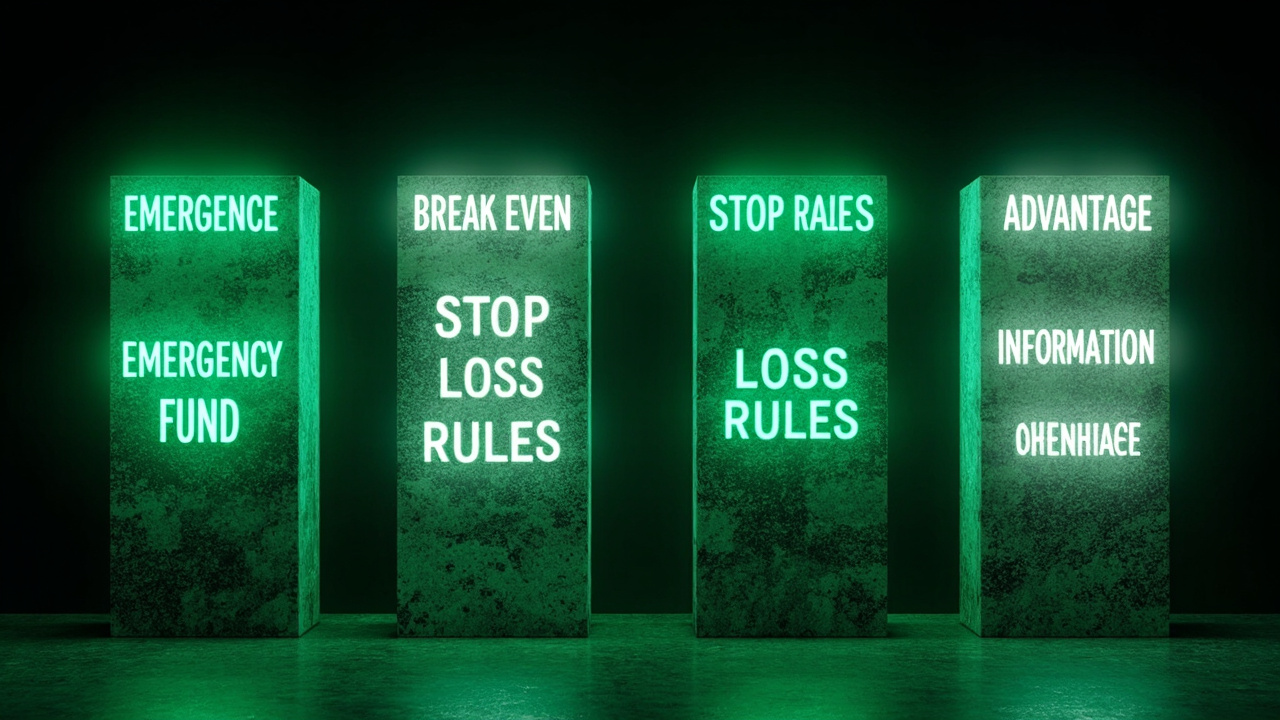
When it comes to day-trading, these four are your bottom line, and all four must be met.
- Your day-trading capital must be money you can completely afford to lose — not your emergency reserve, living expenses, or borrowed money. For fresh graduates, you shouldn’t touch day-trading at all until you have at least six months of emergency reserve. For middle-aged people with families, taking family money to day-trade is gambling with your family’s future, before your mortgage, kids’ education, and retirement planning are in place.
- Before you start, you must have a clear picture of your break-even point — how much brokerage, how much transaction tax, your daily trading volume in cost terms, and your monthly cost cap. If you can’t calculate this number, don’t enter. This is not optional, it is a prerequisite.
- You must set clear stop-loss rules, and they must be set before you enter the trade, not thought up while you’re losing money. The stop-loss level should be based on your capital ratio, not your emotional state.
- You must honestly assess whether you have a time advantage and an information advantage. If you are an office worker with meetings, phone calls, and work to handle during the trading day, you simply cannot be fully focused, and your trade decision quality will drop sharply.
If you can’t meet any one of these, don’t touch day-trading. This is not trying to scare you — it is telling you the reality.
Seven: Four Action Steps
Whether you are a complete stock market novice or have been day-trading for a while, you can do these four steps today.
Step 1: Open your broker app, export all your trading details from the past three months, and add up all the brokerage and transaction tax you paid — don’t estimate, calculate the real number. Many people, after calculating this number, finally feel the true weight of day-trading costs.
Step 2: Calculate your day-trading win rate and profit factor. Categorize every day-trade over the past three months into winners and losers, and compute your win rate, average win, and average loss. If your win rate is below 50%, or your average loss is greater than your average win, your day-trading strategy has a negative expected value statistically, and continuing will only keep losing.
Step 3: Based on your age, income, and family situation, reassess your risk tolerance:
- For students and fresh graduates, focus first on building emergency reserve and basic investment knowledge. Don’t rush into high-risk trading.
- For office workers with families, ensure the family financial foundation is solid first, then consider using a very small share of idle funds to try.
- For those close to retirement, capital preservation takes priority over chasing short-term gains.
Step 4: If after your assessment you decide to keep day-trading, set a maximum monthly loss cap — for example, 5% of your capital. Once that cap is hit, stop trading for the month, do a review, find the problem, and start again next month. The purpose of this mechanism is to prevent you from continuing to add to losses at your worst emotional moments, and to avoid a one-shot catastrophic loss.
Eight: Contingency Plan for Extreme Losses
If you’ve already lost a large sum day-trading, and your account drawdown exceeds 30%, what should you do right now?
- Stop trading immediately — not reduce trading, completely stop. Emotional decision-making in a loss state will, almost 100% of the time, expand the loss. This is human nature, not a willpower problem.
- Don’t try to recover losses by increasing position size — this is the most common fatal mistake retail investors make after losses. Increasing size in a loss state only makes your capital go to zero faster, it does not help you recover.
- If your loss has already affected your living money or family finances, face reality immediately and consider seeking professional financial advice. Taiwan has licensed financial advisors who can help you reassess your overall financial situation and find the best recovery path for you.
Nine: A Decision Framework You Can Use Long Term
Before you make any high-frequency or short-term trade, ask yourself three questions:
- Do I have an information advantage on this trade, or am I just guessing?
- Have I calculated my transaction costs? Where is my break-even point?
- If this trade goes to zero, will my life and financial plan be affected?
If the answer to the first question is ‘no,’ the second question is unanswerable, and the third question is ‘yes’ — you should not make this trade.
This framework is not just for day-trading — it applies to all your investment decisions.
Day-trading is not a zero-capital business — it is a system that uses your time, capital, and emotions to subsidize the profits of brokers and market makers. Before you figure out how this system works, every trade is just working for someone else.
This content, in accordance with relevant Taiwan FSC rules, is for financial education only and does not constitute any investment advice or recommendation. All investments carry risk, and past market performance is no guarantee of future results. Before making any investment decision, please carefully assess your own financial situation, risk tolerance, and investment objectives, and consult a Taiwan-licensed financial advisor and tax professional as needed.
Disclaimer: This article shares investment and financial concepts and compiled data only. It does not constitute any specific investment, tax, or legal advice. Markets carry risk, invest with caution, and please use your own judgment based on your personal risk tolerance and consult a professional advisor.
Tags
Day Trading Trap, Taiwan Retail Traders, Brokerage Commission, Day Trading Cost, Day Trade, Institutional Shakeout, Program Trading, Investment Discipline, Settlement Default, Emergency Reserve, DCA, TWSE
Comments