
Every month you faithfully route a portion of your salary in, and after five years the amount in the account is almost half of what you expected. Have you ever felt that? Others say compound interest is magical, time is the best friend, and as long as you persist, the snowball will roll. You believed it, you did it, you auto-debited on time every month without interruption, but the moment you open the statement, you feel a vague sense of heaviness — the number just doesn’t feel right.
The problem is not that compound interest fooled you — compound interest itself is fine. It is the most basic and solid concept in finance, talked about by everyone from Einstein to Buffett, and the logic is correct. But have you considered that you may have gotten the order of execution wrong from the start? You think compound interest is just automatically reinvesting your gains, but what you don’t know is that the timing, the target, and the structure of your reinvestment are what actually determine the final wealth gap.
Most Taiwanese have been brainwashed by financial-product advertising into believing that continuous investment is the same as compounding, but what they are actually doing sometimes is using the wrong order to dilute their own returns.
Your Real Situation: 5 Years of Real Return Was Only NT$20,000
Do you have a friend like this? Each month, with a salary just over NT8,000 to NT6,000 a month into a popular fund or ETF in Taiwan. They do this for five years, contributing a total of NT$360,000.
They open the account and see NT60,000 in profit, right? But did you calculate what Taiwan’s cumulative inflation was over those five years? According to the Directorate-General of Budget, Accounting and Statistics (DGBAS), from 2020 to 2024 Taiwan’s cumulative CPI rise has exceeded 11%. The real purchasing power of your NT40,000. Your paper profit of NT40,000 inflation loss leaves you with just NT20,000. You auto-debited religiously every month, and your real return over five years averaged only NT$33 a month.**
And that doesn’t include brokerage. Fund subscription fees in Taiwan are generally 1.5% to 3% through typical channels, and trust management fees are about 0.5% to 1.5% per year — these fees are eating your principal every year. Compounding rolls for you, and fees roll for the institutions.
First Underlying Rule: The Core Nature of What You Lose in Compounding Is Not a Low Return — It Is Investing at the Wrong Time
What many Taiwanese understand about compound interest is: I buy something, it earns a return every year, I reinvest the return, and that is compounding. The understanding itself is not wrong, but it misses the most critical thing — when you reinvest, that determines your cost basis.
The academic definition of compound interest, taken from Taiwanese finance textbooks and FSC-approved financial planning exam materials, is: compound interest is the mechanism by which the principal plus interest or returns generated in previous periods continue to earn returns in the next period. The keyword in that definition is ‘cost basis’ — when you invest, what your cost basis is directly determines from what starting point your next period’s return begins to roll.
The problem is that many Taiwanese DCA investors auto-debit at a fixed time each month regardless of whether the market is high or low. This approach itself is not wrong, but most people ignore one thing — when the market is high, they actually invest more aggressively (because the salary keeps coming in and the auto-debit keeps running), and when the market falls, they panic and some even stop contributing. This behavior pattern is the opposite of the core logic of compounding.
According to TWSE historical data, the Taiwan Weighted Index plunged nearly 28% in a single month in March 2020 due to the pandemic shock. At that moment many retail investors stopped contributing, because seeing the paper loss was unbearable. But that was precisely when your cost basis was lowest and reinvestment was most effective. You buy at the high with a high cost, you stop contributing at the low and miss the low-cost reinvestment window — once you get the order wrong, your compound interest never gets rolling.
Taiwan’s inflation reality makes this problem even worse. DGBAS data shows Taiwan’s inflation rate hit 3.1% in 2022, the highest in nearly 14 years. Your salary growth can’t keep up with inflation, your real purchasing power is shrinking, but your reinvestment strategy has not adjusted for this reality. While your money is being eaten by inflation, you are still reinvesting on a fixed schedule that ignores market cycles — that is the core reason your wealth gap keeps widening.
Remember this sentence: The power of compound interest is not in how much you invest, it is in what cost basis you start rolling from.
Second Underlying Rule: Taiwan’s Market Has a Century-Old Iron Rule — Your Reinvestment Structure Decides Whether You Actually Benefit
SITCA publishes fund market statistics every year. According to the 2023 SITCA annual report, the total AUM of domestic Taiwan funds is NT$6 trillion, but the same data also shows that the average holding period for Taiwanese fund investors is only about two years.
Two years. What does that mean? Compound interest needs time to actually deliver its power. According to the standard compound interest formula, a sum of money at 7% annualized return takes about 10 years to double. But the average Taiwanese investor holds for just two years, meaning most people pull out their money long before compound interest even starts working.
Why? Because Taiwan’s financial institutions have a very mature marketing machine — when your fund account shows a certain level of profit, your relationship manager or the app’s push notification starts telling you ‘now might be a good time to take profits,’ or ‘switch to another more promising target.’ This kind of marketing interrupts your compounding cycle, forcing your cost basis to be recalculated at the high every time.
Third Underlying Rule: The Hidden Cost of ‘Switching Targets’ for Taiwanese
Many people assume switching funds or ETFs is free, but in reality every redemption and subscription incurs a fee (redemption fee 0.3% to 1%, subscription fee 1.5% to 3%). Even if you switch to a better target, this fee noticeably shrinks your net return. Worse, the ‘better target’ you switch to is often a decision made under marketing pressure or market hype, and its long-term return may not even be as good as the original one you were holding.
Three Calculations Showing the Cost of Getting the Order Wrong
Calculation 1 (the real cost of the wrong approach): Monthly salary NT8,000 a month, over 10 years. Because of frequent switching (every two years), plus the cumulative subscription/redemption fees on every switch, assume an average total fee ratio of 1.8% to 2% (including brokerage and management fees), assets after 10 years are about NT100,000 to NT100,000 to NT45,000 a month.**
Calculation 2 (the right approach and its prerequisites): Same person, same NT1.28 to 1.35 million — NT250,000 more than the wrong-approach result. But this result has one very important prerequisite: you must not break down mentally during a 20% to 30% market drop, must not stop contributing, and ideally must add — and that prerequisite is the hardest part for most Taiwanese retail investors. So I’ll also give you a normal-person, fault-tolerant version: if you can’t bring yourself to add during a big drop, at least don’t stop contributing — as long as you don’t stop, your compounding cycle won’t be broken.
Calculation 3 (20-year gap and extreme black-swan scenarios): Taiwan’s market has had two very serious extreme events in the past 20 years. The first was the 2008 global financial crisis, when the Taiwan Weighted Index fell more than 58% from peak to trough. The second was the 2020 pandemic shock, with a single-month drop of nearly 28%, but the recovery was very fast — back to the prior high in about eight months.
If you started DCA-ing NT300,000 to NT$400,000, depending on when the stop happened and the subsequent execution. This is something that actually happened in Taiwan’s market — not a theoretical assumption.
The extreme worst case you should also know: if you started at the end of 2007, and at the absolute bottom of the 2008 crisis, instead of just stopping, you redeemed all your holdings, your paper loss was about 40% to 50%. Then you parked the money in time deposits until you felt the market was safe and re-entered — but by then the market had already recovered, and your entry cost was back at the high. This approach is the most common mistake Taiwanese retail investors make in extreme conditions, and it is the fastest way to completely zero out the compounding effect. The worst outcome is not the market falling — it is you making the worst decision at the bottom.
The Three-Question Decision Framework: Ask Yourself These Before Every Investment Decision
Question 1: Will this action change my cost basis? Is the direction of the change favorable or harmful to me?
Question 2: Will this action interrupt my compounding cycle? If so, what is the cost of the interruption?
Question 3: Is this action because my financial plan calls for it, or because market sentiment and marketing have made me think I need it?
Only move on the action when you can answer all three questions clearly — if you can’t, hold still. This framework applies to every investment decision, whether you are a fresh graduate just entering the workforce or a senior close to retirement.
Boundary Conditions for Different Groups
Students or fresh graduates: The core task is not chasing the highest return, it is building a compounding base that won’t be broken. Risk tolerance is high (time horizon is long), but mental resilience may not yet have been tested by the market. Start with the lowest-fee Taiwan-domiciled ETFs, invest no more than 70% of investable funds each month, and keep the rest as an emergency reserve. The strategy-failure scenario is mentally breaking during a market crash and stopping contributions or fully redeeming — that drastically shrinks the long-term compounding effect.
Small-capital families: Monthly cash flow is under pressure, so the contribution amount should be more conservative — recommended at no more than 20% to 30% of monthly disposable income, and you must first confirm you have at least six months of living expenses in an emergency fund. The core risk is not market volatility, it is being forced to redeem at the bottom exactly when you need the money most.
Middle-aged parents with kids: The strategy shifts from accumulation to defense and allocation. Children’s education funds and your own retirement preparation should be in separate accounts, planned separately. The high-risk asset share should decrease with age.
Four Non-Negotiable Iron Rules
Rule 1: Don’t start investing until you have three to six months of living expenses in an emergency fund. This reserve must sit in a savings account or money market fund, available at any time — without it, you will be forced to exit at the worst moment.
Rule 2: Monthly investment cannot exceed 30% of disposable income. A plan you can’t sustain will be abandoned early.
Rule 3: Any money you invest must be one you will not need for at least five years. If you can’t meet this, it should not go into the market.
Rule 4: Before you start investing, you must understand what you are buying. If you don’t even know the underlying index, the fee ratio, and the maximum drawdown, don’t buy.
Four Action Steps to Implement
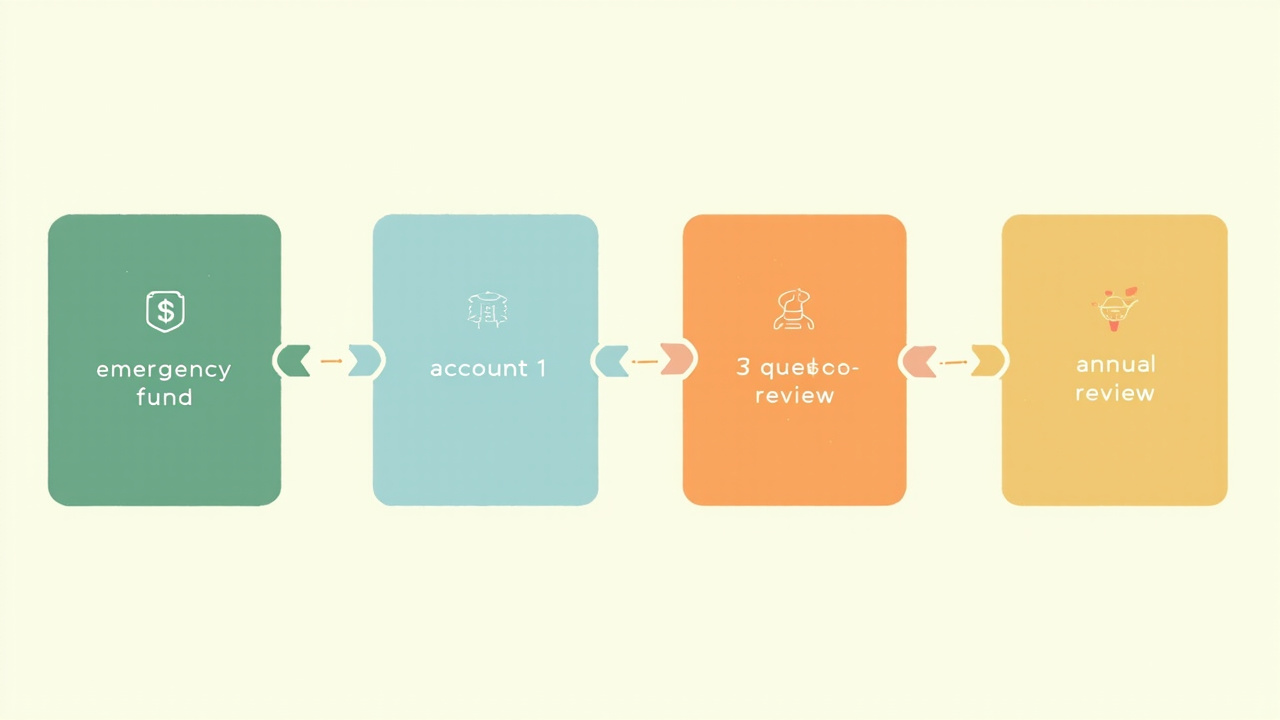
Step 1: Today, open your online banking app, list all your financial assets and monthly expenses, and calculate your emergency fund gap (essential expenses × 6). If that money is not yet fully saved, pause excess investing and top up the reserve first.
Step 2: Open a dedicated investment account, separate from your everyday spending account. On salary day, auto-transfer to this account first — save first, spend second.
Step 3: Re-examine every existing investment decision with the three-question framework. Run every position through the three questions — is the cost basis right? Is the fee structure eating into compounding? Is the reason for holding based on your financial plan or on marketing?
Step 4: Set a fixed annual review time — January or your birth month is recommended. Once a year, do a full financial health check — is the emergency fund still adequate, have the fee structures of your holdings changed, has the asset allocation drifted from the target because of market moves, have there been any major changes in income or expenses. This annual review is not meant for frequent rebalancing — it is to confirm that your compounding cycle is still on the right track. There are many free financial planning tools in Taiwan, including the FSC’s financial check-up platform, and you can use these tools as aids.
Two Taiwan-Specific Advanced Traps
The first: Second-Generation NHI Supplementary Premium. According to the rules of the National Health Insurance Administration under the Ministry of Health and Welfare, in Taiwan, dividend income exceeding NT20,000 incurs this supplementary premium, deducted from the distribution itself.** That is, the amount you reinvest from your gains is 2.11% less than you think.
More importantly, Taiwan introduced the new income tax system in 2018, where you can choose combined or separate taxation. Which is more favorable depends on your comprehensive income tax rate. If your tax rate is below 28%, combined taxation with the dividend tax credit may be better; if above 28%, separate taxation at 28% may be better. This choice directly affects your after-tax real return, which in turn affects the amount available for compounding reinvestment.
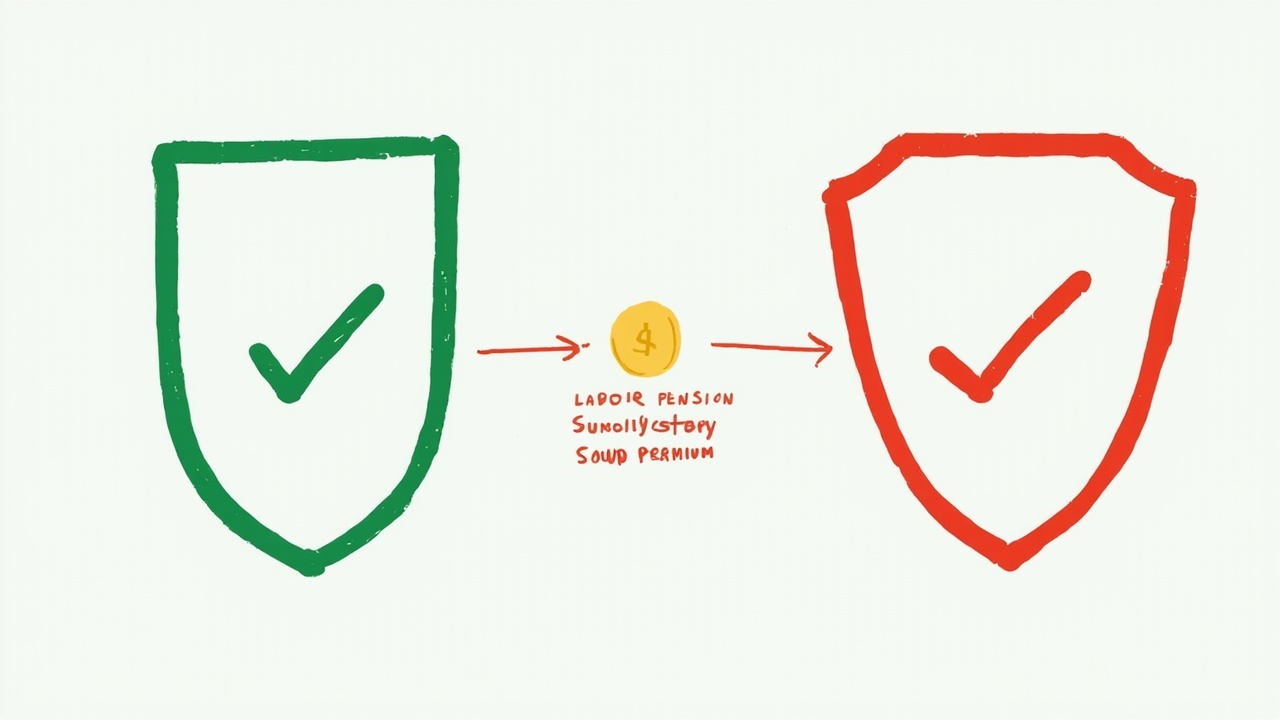
The second: Taiwan’s voluntary labor pension contribution is a severely underestimated compounding tool. According to the Ministry of Labor, the Labor Pension Act allows workers to voluntarily contribute up to an additional 6% of their salary into their personal labor pension account on top of the employer’s contribution. This voluntary contribution is fully deductible from your comprehensive income tax.
Suppose your monthly salary is NT2,700, to your labor pension account — that NT324 a month in income tax, equivalent to the government subsidizing 12% of your investment cost. And the Labor Pension Fund is managed by professional institutions commissioned by the Ministry of Labor, with a government-guaranteed minimum return (no lower than the local two-year time deposit rate). According to 2023 Ministry of Labor statistics, the voluntary contribution rate among Taiwanese workers is only about 13% — meaning nearly 87% of Taiwan’s office workers are not using this tax-advantaged compounding tool at all.
Extreme-Scenario Contingency Plan
If the Taiwan market drops more than 30% in the short term — for example, an extreme shock like the 2008 global financial crisis or the early-2020 pandemic:
First, confirm the emergency fund is intact. If it is fully funded and daily life does not require touching the investment account, the first action is to do nothing — keep contributing, keep holding. When the market falls, every DCA contribution has a lower cost basis, and this is when your compounding is most efficiently accumulating low-cost positions.
Second, if you have idle funds outside the emergency reserve, consider a one-time top-up. But the amount should be conservative — staged entries are recommended (e.g., three to four tranches, one to two months apart) to diversify your entry timing.
Third, never stop contributing or redeem. TWSE historical data shows that the Taiwan market’s recovery after the 2008 crisis and the 2020 pandemic both prove that as long as you can keep holding through extreme lows, the long-term compounding effect is significant. But if you redeem at the bottom, you lock in the loss, and you are very likely to re-enter after the market has already substantially recovered, putting your cost basis right back at the high.
Fourth, if you really cannot hold because your mental state has broken down, at least set a discipline — do not redeem more than 20% of your total position. Keep at least some of the position so that when the market recovers, you still have enough exposure to enjoy the rebound’s compounding effect.
The only core principle of the extreme-scenario contingency plan: protect your compounding cycle from being completely broken.
“Compounding on the right target in the right order is real compounding. Doing anything in the wrong order is just rolling money for someone else.” This sounds simple, but your understanding of it will be completely different — compounding is not automatic, it requires you to execute in the right order. The market will go up and down, and you can’t control that; the only things you can control are the timing of your reinvestment, the target you reinvest into, the structure of your reinvestment, and your own behavior when the market falls.
This article is for financial education only and does not constitute any investment advice. Data cited is from public sources including the Taiwan Stock Exchange, SITCA, DGBAS, the Ministry of Labor, the Ministry of Health and Welfare, the Ministry of Finance, and the FSC, for reference only. Investors should evaluate based on their personal financial situation and risk tolerance, and are advised to consult a Taiwan-licensed financial advisor and tax professional. All investments carry risk, past performance is no guarantee of future returns, and investors may lose part or all of their principal.
Disclaimer: This article shares investment and financial concepts and compiled data only. It does not constitute any specific investment, tax, or legal advice. Markets carry risk, invest with caution, and please use your own judgment based on your personal risk tolerance and consult a professional advisor.
Tags
Compound Order, Cost Basis, DCA, Inflation Hedge, Investment-Linked Policy, Expense Ratio, 6% Voluntary Pension, Three Questions Framework, Reinvestment Strategy, Investment Psychology, Taiwan ETF, 0050
Comments