Your stock account gets limit-downed again today. Your phone screen is all green, and NT$9 trillion has simply disappeared from the TWSE numbers.
You are probably asking the same question: Why is it that every time the market falls I take the hit, but when it rises I never quite catch up, and when it falls I bear every bit of the loss without missing a single point?
Let me give you the answer first—because you have never been a participant in the market. You are the market’s raw material.
This is not an insult. It is the underlying reality of how the TWSE operates.
In April 2025, the TWSE plunged more than 2,700 points in just a few trading days, marking one of the steepest single-week drops in recent years. **Market capitalization evaporated an estimated NT22 trillion. This single drop wiped out the equivalent of five full months of Taiwan’s productive output, gone in just a handful of trading sessions.
But do you know what is most ironic? That NT$9 trillion did not vanish into thin air—money never actually disappears; it just moves from one pocket to another.
This article does something that 90% of Taiwan’s finance channels have never done. It does not tell you which stock to buy, does not give you technical analysis, and does not try to predict where the TWSE bottom is. What it does is lay out the underlying logic of how retail investors get harvested in one pass, so you finally understand:
- How the big players make money off you
- Why retail investors are always the last to know
- What you think you are doing when you invest
In an information-asymmetric market, emotion is the retail investor’s most expensive cost. Discipline is the only edge retail investors can actually control.
1. The Most Real Training Story of a Taiwan Retail Investor
Xiao Chen is an office worker in Taipei, earning NT500,000. Watching the TWSE hit fresh highs through late 2024 and hearing colleagues rave about how strong TSMC was and how powerful the AI concept stocks had become, he could not resist any longer and threw NT$400,000 into the market.
After buying in, the market rallied for a while and his paper profit climbed to NT60,000. He felt smug and figured he had finally figured things out.
Then came the brutal April 2025 plunge, and his paper profit of NT120,000 loss. He could not hold on, and sold near the bottom.
This story is not Xiao Chen’s alone. It is the script that hundreds of thousands of Taiwan retail investors replay in every bull-bear cycle.
Where is the problem? It is not that he picked the wrong stock, and it is not that he read the direction wrong. It is that he had no idea he was playing a game with severe information asymmetry, and every one of his emotional reactions perfectly synchronized with the big players’ operating rhythm.
2. First Underlying Rule: Taiwan’s Information Asymmetry Is Not a Conspiracy Theory, It Is a Structural Fact
Public data from the Taiwan Stock Exchange shows that the institutional holdings ratio in Taiwan (including foreign investors, investment trusts, and proprietary traders) has long exceeded 70% in heavyweight stocks such as TSMC.
What does this mean? It means that on the most important names in Taiwan, retail investors cannot even mobilize 30% of the capital.
You compete with them in the same market, but your information speed, research resources, transaction costs, and risk tolerance are all on completely different levels:
- Foreign institutions have dedicated research analysts tracking the supply chain around the clock
- They have direct channels to meet with corporate management
- They have a global macro view
- Their transaction costs are lower than yours
- Their capital scale lets them diversify in ways you cannot
What about you? You get home from work, open a finance news app on your phone, skim PTT’s stock board, and then make a decision.
This is not to put you down. It is to state a reality—you are all playing the same game, but the rules are simply not fair to you.
But here is a critical point: many people get the direction wrong. Information asymmetry does not mean retail investors must lose, and it does not mean the big players must win. Taiwan’s financial market has clear regulations. Insider trading is illegal. Market manipulation is illegal. The FSC (Financial Supervisory Commission) has supervisory mechanisms in place.
What really makes retail investors lose is not that the big players are breaking rules, but that retail investors are participating in a game that is biased against them in the wrong way.
3. Second Underlying Rule: Retail Investors Are Always the Last to Enter and the Last to Exit
The TWSE’s bull-bear cycle has an iron rule—looking back over more than 30 years of Taiwan stock market history, every major decline shares one common feature: retail investors are the last batch to enter and the last batch to exit.
This is not a criticism of retail investors. It is an inevitable consequence of the market structure.
According to TWSE statistics, retail investors’ trading behavior shows a very obvious pattern—in the late stages of a bull market (when the index has already risen for a long stretch), retail account openings and trading volume spike noticeably. This phenomenon was clearly visible during the 2020–2021 Taiwan bull market and the 2023–2024 AI concept-stock rally.
Why does this happen? Because retail investors’ entry signal is media coverage and the chatter of friends around them.
- When you start seeing TWSE new-high coverage on TV news
- When your colleagues start discussing in the office how much they made on a stock
At that point the market has already run a long way. Institutions have long since positioned themselves. They are waiting for retail capital to flood in, push the last leg higher, and then start shipping out.
Institutions have shareholding disclosure obligations. You can check major shareholder changes on the Market Observation Post System, and you can look at the buy-sell data of the three major institutional investor categories. All of this is public. The issue is that by the time retail investors look at this data, it is usually already too late.
According to data from the Securities Investment Trust & Consulting Association of the Republic of China (SITCA), the average holding period for Taiwan retail investors is far shorter than that of institutional investors. Retail investors tend to trade in and out quickly—and this behavioral pattern, statistically, significantly underperforms long-term-hold strategies.
Retail investors always get information later than the market, and that time gap is the cost of being harvested.
4. Third Underlying Rule: Taiwan Financial Institutions and Media Have Structural Conflicts of Interest With Your Wallet
Let me be clear—this is not to say all financial institutions are cheating you. The FSC strictly regulates Taiwan’s market, and compliant financial institutions operate within the legal framework.
But compliance does not equal aligned interests.
You walk into a bank. A relationship manager recommends a fund to you. What is on his performance scorecard? Is it your investment return? No—it’s sales volume. The more product he sells, the bigger his bonus.
This is not his fault; it is built into the structure of his job. But you need to understand that in that conversation, his interests and yours are not fully aligned.
The Compounding Effect of Hidden Costs
For Taiwan-domiciled mutual funds, the combined management fee and custodian fee runs roughly 1% to 2% per year, and some actively managed funds charge even more. This number may sound small, but the power of compounding makes it dramatically significant.
Let’s run the math:
If you invest NT11.35 million.**
But if you pay an extra 1.5% in fees per year, dropping your annualized return from 7% to 5.5%, under the same conditions, after 30 years your assets would be roughly NT$8.30 million.
What is the gap? NT$3.05 million.
That NT3.05 million gap over 30 years.** That is the true power of hidden costs, and most Taiwan retail investors have never seriously calculated this.
The Emotional Hijack by Media
Going one step further—Taiwan’s financial media business model runs on advertising and traffic. What kind of headline attracts the most clicks? “TWSE crashes,” “Big players dump,” “Retail investors get slaughtered,” “XYZ stock is about to rally”—these headlines manufacture anxiety, anxiety drives clicks, clicks drive ad revenue.
The media’s interest is in your emotions, not your wealth. This is not to say the media are all bad people. It is to say that when you consume financial information you should apply a basic filter: Is this information helping me make better decisions, or is it triggering my emotions so I act rashly?
Your emotional reactions are part of financial institutions’ business model. In an information-asymmetric market, emotion is the retail investor’s most expensive cost. Discipline is the only edge retail investors can actually control.
5. Three Accountings: The Real Gap Between Different Choices
Accounting 1: The True Total Cost of the Wrong Approach
Back to Xiao Chen. He put NT120,000. He sold near the bottom, locking in the NT$120,000 loss.
Then he regretted it. After the TWSE rebounded for a while, he went back in. This time more cautiously, but with his mindset already damaged, he bailed out after a small bounce, making less than NT$20,000.
What is his total cost?
- NT$120,000 paper loss
- Plus brokerage fees from two round trips
- Plus the rebound he missed
- Plus countless hours of watching screens, anxiety, and lost sleep
- Plus the opportunity cost: if the market kept rebounding after he sold at the bottom, he didn’t participate in any of it
His total cost is far more than NT$120,000 on paper.
Accounting 2: The Counterfactual of the Right Approach
Same NT$300,000. If you operate with discipline—only buying an ETF that tracks the Taiwan 50 Index, using dollar-cost averaging, holding for the long term, looking at your system rather than your account number when emotions flare up—over the past 30 years the annualized total return has roughly fallen between 7% and 10% (this is the historical range of the Taiwan TAIEX, not a future guarantee).
The NT$3.05 million gap is not the result of any single year. It accumulates bit by bit, in every market swing, between disciplined investors and emotional investors.
6. Four-Question Decision Framework
Before making any investment decision, ask yourself these four questions:
- Is this decision based on a rule I preset, or on what I am feeling right now?
- If this position drops another 30%, will my life be fundamentally affected?
- Is the capital I am deploying truly idle money I will not need for the next 3 to 5 years?
- How long am I prepared to hold this? Does that time horizon match my financial goal?
If you cannot answer these four questions, what you are doing right now is not investing. It is speculating.
7. Four Iron Rules
Rule 1: Strictly control the expense ratio—the total expense ratio (management fee + custodian fee + transaction fee) of every financial product you choose must be below 1%. This is because under long-term compounding, fees are the largest cost you can actually control.
Rule 2: Your emergency reserve must always live outside your investment account—6 months of living expenses must sit in a demand deposit or money market fund, completely outside your investment account. This is your basic protection so that you are not forced to sell stocks to cover an emergency when the market drops.
Rule 3: Never use margin, never use leverage—unless you are a professional trader, the risk-reward of margin is always negative for retail investors. The history of the 2008 financial crisis tells us that margin-call retail investors never waited to break even.
Rule 4: Never sell out of panic—if your holding is a fundamentally backed index ETF, selling in panic means turning your fear into someone else’s profit.
8. Four-Step Action Plan
Step 1: Check your expense ratio. Open all your investment accounts, look at the total expense ratio of every fund or ETF you hold. If any exceeds 1%, consider gradually switching to a cheaper index ETF on your next DCA purchase.
Step 2: Top up your emergency reserve. If you do not yet have 6 months of living expenses set aside, this is your first priority. Today, move that money from your investment account or time deposit into a separate demand deposit account. This is not being conservative; this is the basic protection that keeps you from having to sell stocks to cover an emergency when the market drops.
Step 3: Set up your DCA plan. If you do not yet have one, set it up today. Major Taiwan brokerages (Fubon, Cathay, Yuanta, Sinopac, etc.) all offer DCA services, with minimums as low as NT$1,000. Pick a low-cost Taiwan-market ETF (such as one tracking the Taiwan 50 Index), set a monthly auto-debit, pick a date after payday, set it up and don’t touch it.
Step 4: Build an annual review mechanism. Set a recurring event on your phone calendar for the first weekend of January every year to do an annual investment review. It covers three things:
- Has your asset allocation drifted from target? Does it need rebalancing?
- Did you make any non-disciplined decisions driven by emotion this past year? What were the outcomes?
- Have your investment goals changed (for example, are you about to buy a home, or did you have a child)?
This annual review is the key mechanism that keeps your investment strategy aligned with your life stage.
9. Two Overlooked Taiwan-Specific Traps
Trap 1: The Ex-Dividend Trap in High-Dividend ETFs
Many Taiwan high-dividend ETF investors share a common misconception—that the higher the payout, the better, because payouts mean money earned.
But have you thought about where the ETF’s money actually comes from? It comes from your net asset value (NAV). When an ETF pays a dividend, the per-unit NAV drops in sync by the same amount. This is called ex-dividend. After the ex-dividend, your total account assets are theoretically unchanged—it has just moved from the ETF’s NAV into your cash account.
So a payout itself is not extra return; it is your own assets moving from your left pocket to your right pocket. What really matters is filling the dividend—that is, whether the ETF’s NAV can climb back to the pre-ex-dividend level after the dividend is paid. If it fills, your total return is positive. If it doesn’t, you’ve just swapped assets for cash while also paying dividend income tax and the Second-Generation NHI supplementary premium.
In recent years some Taiwan high-dividend ETFs have shown long stretches where the dividend never gets filled during market downturns. This is not to say these ETFs are bad. It means that when you pick a high-dividend ETF, you must also assess its ability to fill the dividend, not just look at the payout rate.
You can assess dividend-fill capability by looking at the underlying holdings’ quality, earnings stability, and how long it took to fill after past ex-dividend events—this data is available on all major financial sites and asset management company websites. No insider access required.
Trap 2: Liquidity Risk in Taiwan Stocks
Taiwan stocks have a daily price-limit rule of 10%. Under normal market conditions this mechanism protects stability. But under extreme conditions (such as the recent plunge), some individual stocks or smaller ETFs can hit liquidity crunches—when you want to sell, there are no buyers, or you can only transact at prices far below your expectations.
This risk is relatively small on Taiwan’s heavyweight stocks or large ETFs like the Yuanta High Dividend ETF, because their trading volume is high and liquidity is plentiful. But on some smaller thematic ETFs or thinly traded stocks, the risk is real.
The fix is simple: when picking investments, include average daily trading volume as one of your evaluation criteria. The TWSE website lists historical volume for every security. A common rule of thumb: if your position exceeds 1% of the security’s average daily trading volume, you need to factor in liquidity risk—because when you need to exit, you may not get the price you expect.
10. Emergency Protocol for Extreme Market Conditions
If your account is already in the red, the first thing to do: stop. Don’t rush into any action.
Panic-selling turns paper losses into realized losses. Unless you have a clear reason to believe the fundamentals of your holding have fundamentally changed, selling into a sharp drop is statistically the worst timing decision.
- Reconfirm that your emergency reserve is intact. If your living expenses, mortgage, and children’s tuition are all backed by ample liquid funds, you have the ability to wait for the market to recover. If your living capital and investment capital are mixed, you do not have the luxury of waiting.
- If your DCA plan is still running, do not stop it. When the market drops sharply, your DCA buys more units and your average cost is pulled down. This is the long-term investor’s edge, not your disaster. Stopping DCA and waiting for the market to stabilize before resuming will statistically cause you to miss the best buying window.
- But there is one important prerequisite: all of the above responses assume you are deploying truly idle money, and you have picked fundamentally backed index ETFs, not individual stocks or thematic ETFs. If you deployed money you will need within three years, or you picked names whose fundamentals are already deteriorating, these responses do not apply. You need to consult a Taiwan-licensed financial advisor based on your specific situation.
11. Strategies for Different Groups
- Young professionals just entering the workforce: the amount in your account is small, so this drop has the smallest impact on you because your time horizon is the longest. The most important thing is to make sure your emergency reserve is intact, then keep DCA-ing. Do not let one drawdown shake your faith in long-term investing.
- Young families with mortgages: you have a mortgage and children’s tuition. Your top priority is keeping the household cash flow stable; do not let investment paper losses disrupt daily life. If your investment position keeps you up at night, that is usually a signal that your exposure exceeds your risk tolerance.
- Pre-retirees and seniors: this sharp drop hits you hardest because you do not have much time to wait for a recovery. If a meaningful share of your retirement assets is in the stock market and you need to start drawing on them within five years, you need to seriously consider trimming equity exposure and shifting more into fixed-income assets.
12. The Core Decision Framework
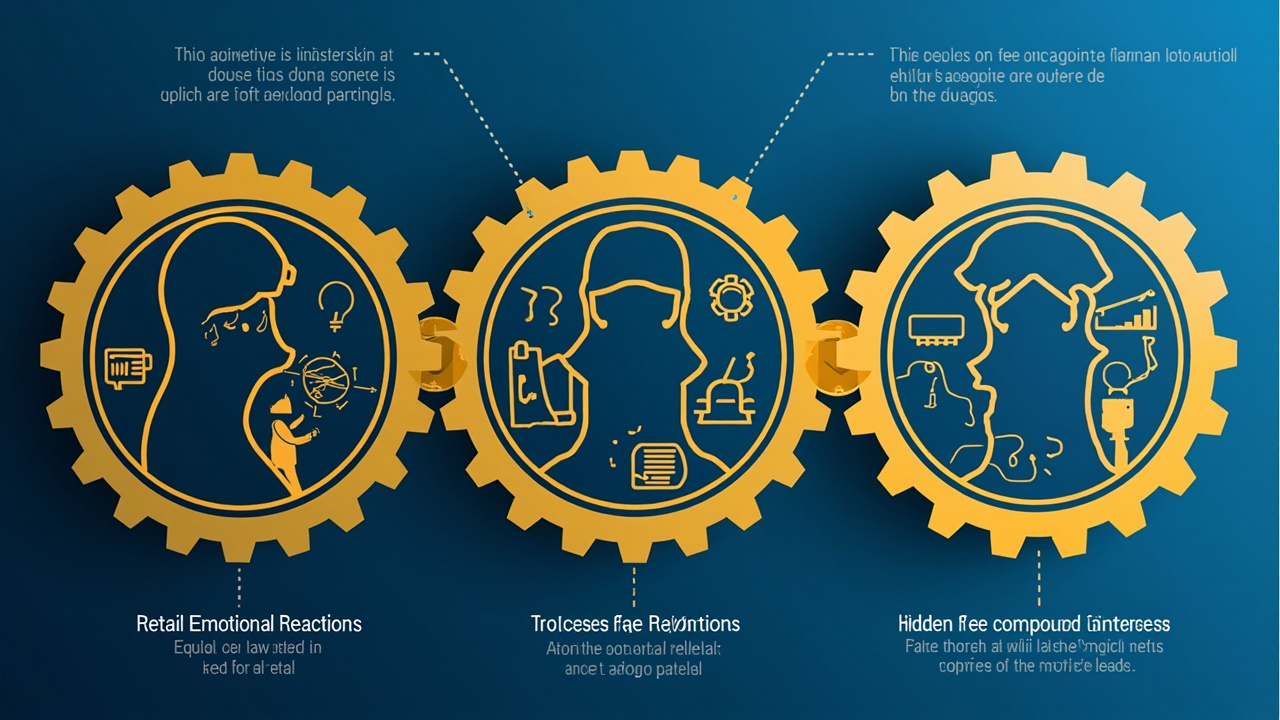
Behind this sharp TWSE drop there is no mysterious conspiracy by the big players. There are three clearly understandable market mechanics:
- Information asymmetry causes retail investors to always lag the market
- Retail investors’ emotional responses perfectly synchronize with the market’s highs and lows
- Hidden costs, under the long-term compounding effect, erode wealth far more than you imagine
The way to respond to these three mechanics is not to find a better news source, not to learn sharper technical analysis. It is to build a disciplined investment system that does not depend on emotions—lower your cost base, lengthen your holding horizon, and let compounding work for you.
This system does not guarantee you beat the index every year, and it does not guarantee you avoid paper losses. But it puts you on the more favorable side of the long-term probability game.
Do not ask how the market will move next. Ask what your system can deliver under any condition. You cannot control the market’s direction. You can only control your own system, your own costs, your own discipline.
Focus your energy on what you can control—that is the smartest response available to retail investors in an information-asymmetric market.
This article is for financial education purposes only and does not constitute any investment advice or any recommendation or solicitation for any financial product. All historical data and return references in the article come from public sources. Past performance does not guarantee future results. All investing carries risk, including the possibility of principal loss. The historical maximum drawdown of the Taiwan stock market is explicitly disclosed in this article. Investors should fully understand their own risk tolerance. All investment decisions should be carefully evaluated based on your personal financial situation, investment objectives, and risk tolerance. It is advisable to consult Taiwan-licensed financial advisors and tax professionals approved by the FSC for personalized professional advice. This article does not constitute discretionary account management or any form of financial entrustment relationship.
Disclaimer: This article shares investment and financial concepts and compiled information. It does not constitute any specific investment advice, tax advice, or legal opinion. Markets carry risk; invest with caution. Please make independent judgments based on your own risk tolerance and consult professional advisors.
Tags
Harvesting Logic, Institutional Manipulation, Retail Emotion Trap, Information Asymmetry, Institutional Holdings, Hidden Cost Compounding, ETF Ex-Dividend, Liquidity Risk, DCA, Investment Discipline, Emergency Reserve, Cognitive Upgrade
Comments