
You poured three years of savings in last month, and this month your account is halved. It’s not bad luck or a bad stock pick — you never understood one thing: your portfolio was already sitting at an invisible tipping point, waiting to collapse.
Every year, batches of Taiwan retail investors lose 5 or 10 years of savings in a market correction. You think they picked the wrong stock or read the trend wrong? No. There is only one root cause: they put all their eggs in one basket and thought they were diversified.
This is the core we will dissect today — a fatal investment blind spot proven by physicists in the sandpile experiment, called the critical collapse effect.
One core sentence: Risk is not how much you lose, but how much you have left to keep going at the worst moment.
What the sandpile experiment reveals as your fatal blind spot
In 1987, physicists Bak, Tang, and Wiesenfeld ran a study: they dropped sand grain by grain onto the same spot. The pile looked stable, but at some completely unpredictable moment, the added internal force triggered a chain collapse of the entire pile, with the scale of the collapse entirely out of proportion — that one grain brought down the whole mountain.
Your investment portfolio is that sandpile. You buy every month, add positions, feel diversified, but you never asked yourself: “How correlated are my assets? When the market really crashes, will they fall together?”
The most common mistake of Taiwan retail investors is not putting all money into one stock — it is buying 10 stocks that are all semiconductor supply chains related to TSMC. You think you are diversified, but the correlation coefficient among these 10 stocks is close to 0.9. When TSMC drops 20%, your entire portfolio drops nearly 20% in sync. This isn’t diversification; this is putting the same egg in ten baskets.
According to TWSE data, the stock holding concentration of Taiwan retail investors has long been high — over 60% concentrate in the electronics sector, with semiconductor-related names overwhelmingly dominant. TSMC alone accounts for over 30% of the weighted index, so when you buy a Taiwan 50 ETF plus a few semiconductor stocks, you think you’re diversified, but you’re really just placing a bigger bet in the same direction.
Bottom Rule 1: Maximum drawdown is the boundary of psychological collapse
Under Taiwan financial regulation’s standard definition of investment risk, maximum drawdown refers to the largest drop from a peak to a trough of a portfolio over a specific time window. This number is not just a paper figure — it is the psychological boundary of whether you can keep holding through the worst moment.
According to behavioral finance research, the pain of human loss is approximately 2 times the pleasure of gain. This is not theory; it is the real reaction you have when your account is down — you can’t sleep, you want to sell everything.
Long-term tracking of retail investor behavior by SITCA shows that when Taiwan’s market drops more than 15%, the proportion of retail investors who stop-loss and exit rises sharply. Many people sell near the bottom, then buy back when the market recovers, only to lose on both ends.
This is the core of the sandpile effect: the higher your portfolio concentration, the larger your maximum drawdown, the smaller your capacity to bear psychological pressure, the higher the chance you make a wrong decision at the worst moment. It’s not a willpower issue — your portfolio design pushed you into a position where mistakes were inevitable from the start.
The truly best portfolio is not one that earns the most in a bull market, but one that lets you keep holding in the most panicked moments.
Bottom Rule 2: The correlation trap in Taiwan’s market
Many Taiwanese mistakenly believe that as long as they buy different stocks or ETFs, they are diversified. This belief is the biggest misconception left by financial industry marketing.
The core logic of asset allocation is clearly defined in Taiwan’s academic finance literature and FSC documents, called asset correlation: the closer the correlation coefficient is to 1, the more two assets move in the same direction and the worse the diversification; the closer to -1, the more one rises when the other falls, which is true diversification.
The most common Taiwan retail allocation: Taiwan equity ETFs plus a few Taiwan stocks. The internal correlation of this combo looks okay in a bull market, but in a bear market correlation rises sharply, and almost all Taiwan equity assets fall together.
This phenomenon is called crisis correlation in academic finance: a portfolio that looks diversified in normal times loses its diversification exactly when you need it most.
March 2020 in Taiwan was the best example: during that period Taiwan stocks, Taiwan REITs, and Taiwan high-dividend ETFs all dropped nearly in sync. The only assets showing diversification were USD-denominated assets and some bond products, because their correlation with Taiwan equities was relatively low.
One important clarification: the correlation between bonds and stocks varies across market environments. In an inflationary environment stocks and bonds may fall together, as happened in 2022. So any single diversification strategy has its failure scenarios.
Bottom Rule 3: The hidden value of rebalancing and its execution deadlock
The academic definition of rebalancing is the periodic adjustment of a portfolio back to its target allocation ratio. It sounds simple, but almost no Taiwan retail investor actually does it, because rebalancing is psychologically deeply counter-intuitive.
Why? Because rebalancing requires you to sell what has done well and buy what has done poorly. In a bull market, you have to sell TSMC to buy bonds. Can you do it? Most people can’t, because selling a winner feels like giving up profit, and buying a loser feels like catching a falling knife.
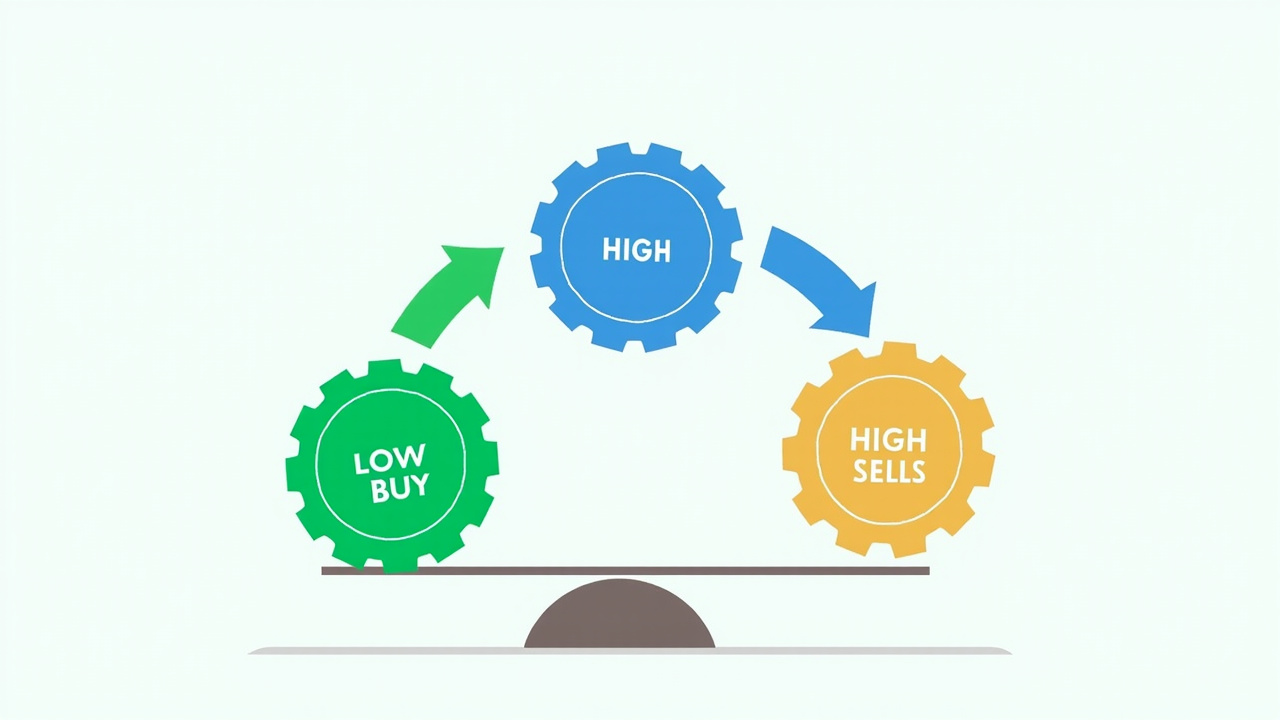
But according to long-term tracking by SITCA and multiple academic studies, portfolios that execute rebalancing consistently deliver superior risk-adjusted returns over time compared to those that don’t. The reason is simple: rebalancing forces you to buy low and sell high in a systematic way that doesn’t rely on emotional judgment.
Taiwan retail investors hit two common rebalancing deadlocks:
- First, frequency too high: adjusting every month, with transaction fees and tax costs eating the returns
- Second, never adjusting: letting the portfolio drift with the market, so by the next crash the defensive asset allocation has already been eroded away
A reasonable rebalancing frequency for most Taiwan office workers is once a year, or triggered when any asset class deviates from its target by a certain percentage. The specific trigger percentage depends on your asset size and transaction costs; there is no single number that fits everyone.
Taiwan’s securities transaction tax and income tax rules affect the real cost of rebalancing; please consult a qualified financial advisor or tax professional before executing.
A systematic cognitive tool: a system matters more than market calls, because your calls are swayed by emotion, but a system isn’t.
Three calculations: the real gap of NT$1 million in 2008
Calculation 1: the retail concentrated-allocation real loss
Suppose you are a Taiwan office worker, earning NT1,000,000 of investable capital. At the end of 2019 you put the entire NT$1,000,000 into Taiwan Weighted Index ETFs and individual stocks, concentrated in electronics because TSMC had been on a tear for years and you felt confident about that direction.
When COVID hit in March 2020, the Taiwan Weighted Index fell from 12,197 to a low of 8,523, a drop of nearly 30%. Your NT700,000 — three years of savings evaporated by NT$300,000.
But that’s not the worst case. During the 2008 financial crisis, the Taiwan Weighted Index fell from 9,859 to 3,955, a drop of over 59%. If you had gone all-in at the end of 2007, by the end of 2008 your account would have been worth only NT$410,000, and you would have needed until 2014 — a full six years — to get back to your original principal. Six years: your salary kept growing, inflation kept running, but your investment principal stood still.
This is the true cost of concentrated allocation. It’s not that you picked the wrong stock; it’s that your portfolio had no buffer mechanism.
Calculation 2: the gap from proper allocation
Same NT$1,000,000, same end-of-2007 entry: one retail investor all-in on Taiwan stocks; another made a basic global allocation: 40% Taiwan ETF, 30% global equity ETF, 20% bond ETF, 10% cash.
In the 2008 crisis, the all-in investor’s account was down to NT650,000**. And because of the bond and cash positions, they had dry powder to keep buying at the bottom, and by 2011 to 2012 they were already near their principal again.
The gap is not just about the numbers on paper — the gap is whether you can stay in the market at the most panicked moments. Those who stay get to see the rebound.
Calculation 3: the 30-year wealth gap
Suppose you are a 30-year-old Taiwan office worker, contributing NT$10,000 per month for 30 years until age 60.
Scenario 1: all-in on Taiwan equity ETFs, no rebalancing, no bonds or other assets. The Taiwan Weighted Index’s 20-year annualized return is roughly 7% to 8%, but this assumes you hold through every low without selling. In reality, retail investors’ returns are 3% to 5% lower than the index itself because of bad-timing entries and exits.
Scenario 2: basic global allocation plus annual rebalancing, with portfolio volatility reduced so you can hold through market crashes. Assume your actual annualized return is 2% higher than scenario 1 because fewer behavioral mistakes.
Over 30 years, contributing NT2,000,000. That is not a small number — that is more than ten years of additional living expenses after retirement. But to be clear: this assumes you keep executing and don’t sell at the bottom. Real outcomes vary with entry and exit timing, actual asset class weights, and prevailing market conditions.
4 iron rules: the minimum底线 of portfolio design
- You must have at least 3 months of living expenses in emergency reserve before considering high-volatility assets
- The funds you invest must be idle money confirmed not needed within 5 years
- Your monthly investment amount must not exceed 50% of what’s left after all fixed expenses
- You must be able to accept a 30% or more short-term paper shrinkage without making a panic-sell decision
4-step action plan
- Open your online banking or broker APP, list every investment position you currently hold, and calculate your real P&L. If you have losses, first assess whether your portfolio is overly concentrated in a single asset class
- Set your target asset allocation based on your age and risk tolerance. A simple reference: equity assets can use 110 minus your age as an upper bound
- Set rebalancing trigger conditions: the simplest approach is once every six months or once a year, executing when any class deviates from target by a certain percentage (e.g., 5-10 percentage points)
- Build a crash-buying reserve: outside your emergency reserve, save a dedicated pool for buying on big market corrections. Park this money in highly liquid instruments (e.g., Taiwan money market funds or savings accounts), then deploy in 3 to 5 batches over one to two months when the market corrects more than 20%; do not go all-in at once
3 age-segmented application boundaries
Fresh graduates (around NT$30K salary): your priority right now is not picking which ETF, but first saving 3 months of living expenses as emergency reserve, then making good use of Taiwan Labor Pension voluntary contributions, and starting DCA with whatever’s left of your investable monthly amount. Amount doesn’t matter; habit matters most.
30 to 40-year-old established middle class: your core task is making sure your portfolio won’t force you to sell at the bottom when you most need cash. Down payment plans, child education expenses, parents’ medical reserve — money that may be needed within 5 years should not sit in high-volatility equity assets.
40 to 50-year-old middle-aged with children: your risk tolerance is not what it was 20 years ago; your portfolio should gradually increase defensive assets because you have less time to wait out the next major crash’s recovery.
Pre-retirees: your core goal has shifted from asset accumulation to asset preservation. Portfolio volatility must stay within your acceptable range, because in retirement you need regular withdrawals — forced selling in a drawdown will accelerate your asset depletion.
A final word for you
Don’t touch what you can’t watch stay still, don’t bet what you can’t hold through, what lets you sleep at night is your true correct allocation.
Your portfolio is not a tool to maximize bull-market gains; it is a system that lets you survive the worst markets. A sandpile doesn’t collapse because of the first grain; it collapses because at some invisible tipping point the structure has become so fragile that it takes only one more grain.
Risk is not how much you lose, but how much you have left to keep going at the worst moment. Repeat this line to yourself, because most Taiwan retail investors have never thought about investing from this angle.
This article is for financial education purposes only and does not constitute investment advice or any recommendation or solicitation of any financial product. All investments carry risk, and past performance does not guarantee future results. All investment decisions should be evaluated carefully based on your own financial situation, risk tolerance, and investment goals, with consultation of Taiwan-licensed financial advisors and tax professionals when necessary. All data cited in this article comes from public sources such as TWSE, SITCA, and the Ministry of Labor, and is for reference only.
Disclaimer: This article shares investment and financial concepts and information, and does not constitute any specific investment, tax, or legal advice. Markets carry risk; invest with caution and make independent judgments based on your own risk tolerance, consulting professional advisors as needed.
Tags
Sandpile Effect, Asset Allocation, Correlation, Rebalancing, Emergency Fund, Concentration Risk, Investment Psychology, Max Drawdown, Retirement Money, DCA, Taiwan Stock Investing, Allocation Discipline
Comments