You dutifully contribute every month, but your account stays in the red. You are buying the S&P500 and the Nasdaq 100. The experts say these are the most stable passive investments. You are doing exactly what they said. Yet the numbers stay negative. You start doubting ETFs — even start suspecting the whole thing is a scam.
The ETFs are fine. The problem is that the way you buy them has been wrong from the start. This is not a small mistake; it is the kind that makes you look back after 10 years and realize you wasted everything — or worse, you would have been better off not buying at all. Buying ETFs is not hard. The hard part is shutting up your own human nature.
Perfect Execution vs Real Retail Investors: The True 20-Year Arithmetic
Assume you are a Taiwanese working professional with a NT5,000 each month to DCA into an S&P500 ETF. This is a very normal setup. If you started in 2003 and DCA-ed NT1.2 million over 20 years. If you never touched it and kept contributing faithfully, given an annualized S&P500 return of roughly 9% to 10% over those 20 years, your assets would have grown to roughly NT3.8 million.
But in reality? According to U.S. research firm DALBAR, the average retail investor’s actual return is 1.5% to over 2% lower than the underlying fund’s own return. SITCA reports in Taiwan have made similar observations — retail investors’ entry and exit timing is consistently poor. If your actual annualized return drops from 9% to 7% because of these operational mistakes, after 20 years your assets are roughly NT800,000 to NT$1.1 million. That is not a small number — it is money you failed to earn, money your operational mistakes pulled straight out of your pocket.
Look at the extreme case: in the 2008 financial crisis, the S&P500 fell nearly 57% from its high. If you started DCA at the end of 2007 and continued through the March 2009 bottom, your paper loss exceeded 40%. Many people stopped contributing — or even redeemed — at that point. But if you held on and kept contributing through 2013, you not only broke even, you started making money. Those who redeemed at the bottom locked in their losses and missed the largest rally that followed.

Mistake 1: Treating DCA as a “Buy-the-Dip” Tool
Under Taiwan’s financial regulation, DCA is defined as investing a fixed amount at a fixed time, buying continuously regardless of market ups and downs. Its core advantage is the dollar-cost averaging effect: by contributing regularly over the long term, you automatically buy more units at lower prices and fewer at higher prices, lowering your overall average cost.
But many Taiwanese investors misuse the tool. They reason: if I buy more units when the market dips, I should add more on dips and skip on rallies. The fatal premise of this logic is that you must be able to accurately judge whether the market is deeply down or still has further to fall. The Nasdaq 100 dropped 33% in 2012 — you thought it was a dip-buying opportunity, but it kept falling, eventually down more than 35%, and your “dip-buy” landed halfway up the cliff.
More seriously, once you start selectively contributing, you have transformed from a passive investor into an active market-timer — you are doing exactly what you thought you would never do, the very thing you originally wanted to avoid. The right approach is simple: set up DCA, contribute a fixed amount at a fixed time each month regardless of moves, no extra buying, no stopping, no redemption. If you genuinely have spare cash you want to add, set up a separate DCA plan, but never break the original rhythm.
Mistake 2: Buying ETFs Without Knowing What You Are Paying
Many Taiwanese investors pick ETFs based purely on the index tracked, completely ignoring the cost structure. Let’s break the costs apart:
In Taiwan, there are two main paths to buying U.S. equity ETFs:
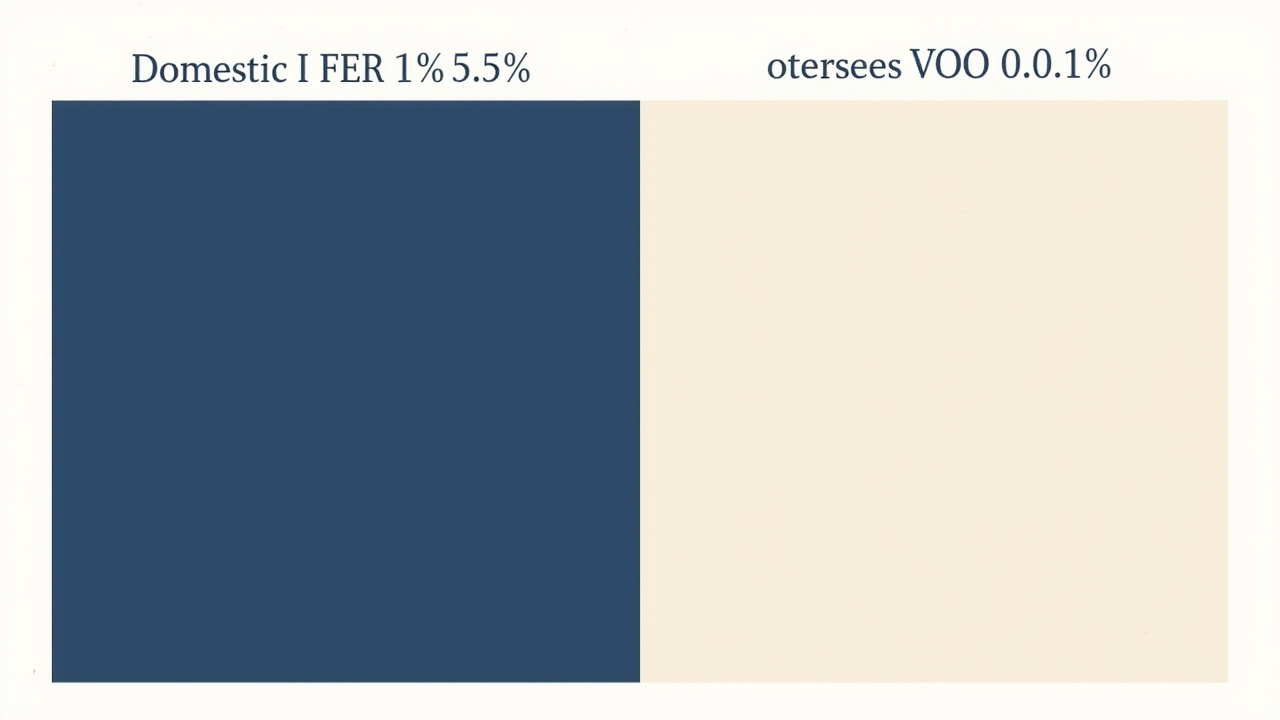
- Domestic ETFs issued by Taiwanese investment trusts (e.g., Yuanta S&P500): include currency hedging, easy for small DCA contributions, but with higher built-in fees — total expense ratio (TER) usually between 0.4% and 0.9%
- Overseas ETFs issued directly in the U.S. (e.g., VOO, VTI): very low management fees (VOO’s ongoing figure is 0.03%), small tracking error, but you need a sub-brokerage or overseas broker, and most do not actively hedge currency
The total fee gap between domestic and overseas can reach 0.3% to 0.8%, which over 20 years of compounding becomes striking. Many people also overlook the “currency hedging cost” — most domestic ETFs carry currency hedging, which quietly eats another 0.1% to 0.2%. This fee is not a transaction charge; it is hidden in the NAV and deducted slowly.
Small investors choosing a path cannot look only at the per-trade commission; they must pull up the total expense ratio (TER) and look at the cumulative impact over 20 years.
Mistake 3: Ignoring the TWD Exchange Rate — The Hidden Variable
You earn in U.S. dollars, but your cost and expenses are in Taiwan dollars. When the TWD appreciates against the USD (USD weakens), your USD assets shrink when converted back to TWD; when the TWD weakens (USD strengthens), your USD assets gain an extra layer of FX profit.
From 2020 to 2021, USD/TWD dropped from 30 to 27.5, and over that period your S&P500 rose 50%, but converted back to TWD it left you with only about 30%. This is the most common blind spot for Taiwanese investors buying U.S. equity ETFs — you watch U.S. stocks soar, but when you open your TWD-denominated account you have not earned nearly as much.
The right mindset is to never try to predict FX, but at least to understand that more than half of your return may come from — or be eaten by — currency. Over the long term, USD assets and TWD assets have low correlation, which is itself a layer of risk diversification. The most dangerous thing is not knowing this and assuming that when U.S. stocks rise, you are making money.
Mistake 4: Emotional Collapse Is Where the Loss Begins
In the 2022 rate-hike storm, the Nasdaq 100 fell 33% for the year and the S&P500 fell 19%. In one year your account shrinks by one-fifth to one-third. The feeling is: you faithfully put in NT$6,000 every month, yet the account bleeds more each month than you put in. That feeling drives many people to stop contributing — or sell — at the worst moment, killing the entire long-term compounding advantage.
The psychological threshold is 10x more important than the choice of index. Picking an index you cannot emotionally withstand is like buying a plane ticket you are afraid to board — at the first sign of turbulence you jump out, and of course you never reach the destination. FSC data shows that the average holding period of Taiwanese fund investors is short; many redeem at the first big market drop — and that behavior alone destroys the entire long-term compounding advantage.
How to Fix These 4 Mistakes
Fix Mistake 1: Replace “Selective Contributions” with “Extra Buys That Do Not Interrupt the Main Rhythm”
Once you set up DCA, leave it alone. If you really want to add more on dips, use a separate pool of funds to do “variable-amount DCA,” but the original rhythm must never be interrupted. This is how to keep the psychology and the logic cleanly separated.
Fix Mistake 2: Decide on 20-Year Total Cost, Not Per-Trade Commission
Pull up the total expense ratios (TER) of your candidate ETFs and compound the 20-year cumulative cost difference. For example, with the same NT300,000 to NT$500,000 in terminal value.
Fix Mistake 3: Treat Currency as a Background Variable
Do not try to catch a low in the FX market to buy USD — in the long run you will find timing currencies is just as hard as timing the stock market. The right mindset is to accept that FX is part of long-term investing — it will help you in some years and hurt you in others, but on average holding USD assets over time is itself a tool for diversifying TWD risk.
Fix Mistake 4: Write the Rules Down When You Are Calm
On the day you start contributing, write down your 4 rules and stick them next to your screen:
- If the market drops 30%, do not stop contributing.
- If the market drops 50%, do not redeem.
- Look at your statement once a year.
- Sleep on every major decision before acting.
These 4 rules, written when you are calm, will save you when the account looks the ugliest.
Why Taiwanese Investors Are Especially Prone to These 4 Mistakes
90% of ETF introductions in Taiwan tell you “U.S. stocks rise over the long term,” “DCA is the retail investor’s best friend,” “the S&P500 is the most stable index” — all of that is true, but it completely ignores the structural fact that Taiwanese investors use Taiwan dollars to buy U.S. equities, and the emotional fragility of retail investors during volatility.
You think you are buying U.S. economic growth; in reality you are buying the product of three variables — “U.S. economic growth × USD/TWD exchange rate × how many years you can endure” multiplied together. When you only see the first variable, the seeds of your loss are already planted.
This article is for financial education only and does not constitute any investment advice. All investing carries risk; past performance does not guarantee future returns, and actual results may differ materially from the calculations in this article due to market movements, exchange-rate volatility, and personal execution. Before making any investment decision, please carefully evaluate your personal financial situation and risk tolerance, and consult a Taiwan-licensed financial advisor or accountant.
Disclaimer: This article shares investing concepts and compiled reference material. It does not constitute any specific investment, tax, or legal advice. Markets carry risk and investing requires caution; please make independent judgments based on your own risk tolerance and consult a professional advisor.
Tags
ETF, S&P500, Nasdaq 100, DCA, Average Cost, Total Expense Ratio, Currency Hedging, Investment Psychology, Panic Selling, Dollar-Cost Averaging, 0050, Retirement Investing
Comments