
Each month NT$70,000 lands in your account, yet your bank balance stays stuck in the four digits. You drive a financed import car, wear installment-purchased luxury goods, and live in a small apartment carrying a 30-year mortgage. You look glossy on social media, but late at night you lie in bed anxious and sleepless, staring at your credit-card statement on your phone. You clearly earn a lot, so why does every month feel like walking a tightrope at the edge of a cliff?
You think you’re middle class — actually you’re a bottom-of-the-pyramid pauper dressed up as a successful professional debt specialist. Even worse, those around you who look richer than you are probably worse off — they just have bigger debt numbers.
This isn’t because you don’t work hard enough — it’s because someone has designed an entire rulebook waiting to harvest people exactly like you.
What is Taiwan’s biggest scam today? Not fraud rings, not pyramid schemes — it’s the consumerist brainwashing script called “you deserve a better life.” The moment you open your eyes every day, from MRT ad panels to YouTube sponsored segments to small-talk with coworkers, everything tells you one thing: your current life isn’t good enough; you should upgrade. You should switch to a new phone — your old one’s already two years old. You should get a gym membership — body management is important. You should buy a designer bag to reward yourself — isn’t working hard about enjoying life?
Every sentence sounds reasonable, but have you noticed? When you follow this logic, your savings always hit zero, your debt always grows, and the people selling to you are counting cash with both hands.
Run the Most Basic Numbers
You earn NT20,000 (this is a conservative estimate; in Taipei you might start at NT12,000; family support or allowance another NT5,000; insurance NT51,000 gone, leaving NT100, lunch NT150 — NT10,500 a month — you’re left with NT$500. And we haven’t counted gatherings, clothes, haircuts, movies, or the occasional bubble tea.
Tell me where the money to save is. Where’s the money to invest? Where’s the capital to call yourself middle class? And that’s the most ideal scenario, assuming you don’t splurge, don’t swipe your card, don’t buy on installments.
Harvesting Rule #1: The Installment Slow-Boil
What’s the reality? Last month you saw a coworker switch to a new iPhone and suddenly felt yours was a bit old — even though it worked fine, there was this nagging feeling of being left behind. **You swipe a card and split it over 12 months, an extra NT3,000 set menu at a restaurant and buy a NT18,000 self-pay — not going would be unsociable, swipe it. Watch your NT$8,500 buffer shrink, then you start dipping into revolving interest, start borrowing, start telling yourself “I’ll cut back next month” — but next month always brings a new excuse.
You think zero-interest installment is a deal? Wrong. That’s the merchant’s cleverest trick, because they know human nature: small monthly amounts feel painless. Paying NT2,500 a month feels like nothing. But when you have five installments running at once, that’s NT$12,500 in fixed monthly outflow — and it doesn’t hurt, because it isn’t deducted all at once; it’s a slow bleed.
Worse, installment destroys your sense of price. You originally thought NT2,500/month it suddenly feels acceptable, so you buy a bunch of things you couldn’t have afforded otherwise. Eventually you find that just installments alone eat over NT2,000-plus" — and slide straight into debt hell.**
Harvesting Rule #2: Socially-Bondage Consumption
Have you noticed that a lot of your spending isn’t because you actually need it, but because everyone else does? Coworkers invite you for after-work drinks at NT8,000 — not going kills the mood. Cousin’s wedding: NT3,600; aunt’s birthday dinner split: NT18,000 because all your coworkers train there — not signing up means you look unambitious. Buying a car not because you need one, but because at 30 taking the MRT feels a bit uncool. Switching phones not because it broke, but because pulling out an Android somehow makes you look lesser.
You think you’re maintaining social bonds, but you’re using money to buy a false sense of class identity. Worse, this spending becomes a vicious cycle because your friend group is doing the same thing — everyone compares, everyone stimulates each other, forming a little circle of collective debt. You all look glossy, but each one goes home worrying how to pay the bills. Nobody dares admit they can’t hold on, because the moment you admit it, you admit you’re a loser. So everyone keeps pretending, keeps swiping cards, keeps posting carefully curated peace-and-quiet illusions on social media.
Harvesting Rule #3: The Wealth Illusion of Pseudo-Assets
You bought a NT300,000 down payment borrowed from your family, NT24,000 a month. You think you own an asset worth NT24,000 of cash flow per month and depreciates relentlessly.** That car loses NT1.2 million; three years NT700,000. But you paid NT2 million for something worth NT$700,000 after five years. You call that an asset? That’s burning money.

But you don’t see it that way, because you drive it every day, you feel it gives you face, you feel like you’re in the car-owning class — you live inside a wealth illusion you built yourself. Even worse, housing. You gritted your teeth and bought a NT3 million down payment wiped out you and your parents’ savings, NT$12 million mortgage over 30 years. How much do you pay every month? Have you done the math?
Cars are liabilities, luxury goods are liabilities, installment purchases are liabilities — the things you thought were assets are all secretly eating your cash flow. What truly helps you build wealth are the things quietly making money for you every month — low-cost, stable-yield, inflation-resistant assets.
Four Iron Rules You Can’t Afford to Break
Rule 1: Before buying anything, calculate how much cash flow it drains from you each month. A NT24,000 a month; a NT1,000 a month from your future (counted as opportunity cost). Once you start viewing consumption through cash flow, you’ll find many things simply aren’t worth buying.
Rule 2: Reject zero-interest installments. Zero interest doesn’t mean free — merchants have already baked the cost into the price. More importantly, installment numbs your money sense, forcing your future self to pay for your present impulse. Learn to pay in full or simply not buy — that’s the real money management.
Rule 3: If your social circle requires money to maintain, it’s the wrong social circle. People who truly care about you won’t distance themselves just because you skip that NT$1,500 dinner. People who do distance themselves were never your friends to begin with — you don’t need to spend money maintaining fake relationships.
Rule 4: Any investment or purchase decision must first calculate ROI. You want a NT1.5 million invested could generate NT10,000 per month of passive income. **Would you trade NT50,000 bag? Think about how that NT108,000. Would you trade NT$108,000 ten years from now for a bag today?
Once you start thinking in opportunity cost, you’ll find a lot of things just aren’t worth buying.
Four Action Steps You Can Execute Today
Step 1: Pull out your phone and open a budgeting app — if you don’t have one, download one, and starting today, log every expense. No matter how small, log it. Budgeting isn’t to make you suffer — it’s to make you see clearly where the money goes. You might think you don’t splurge, but after a month of tracking you’ll be shocked: turns out bubble tea alone cost NT2,000; all those “just a little” items are terrifying in aggregate. Seeing the truth is the only way you can change.
Step 2: List every liability and installment you currently have — car loan, mortgage, student loan, personal loan, credit-card debt — write them all down, calculate the total monthly payment, remaining years, and total interest. Then sort by interest rate and prioritize paying off the highest-rate ones first (usually credit-card revolving interest and personal loans). If you have multiple card debts, consider consolidating into a lower-rate personal loan — but only on the condition that you vow to stop swiping, or consolidation just buries you deeper. Aim to clear all high-interest debts within two years and at least get back to zero.
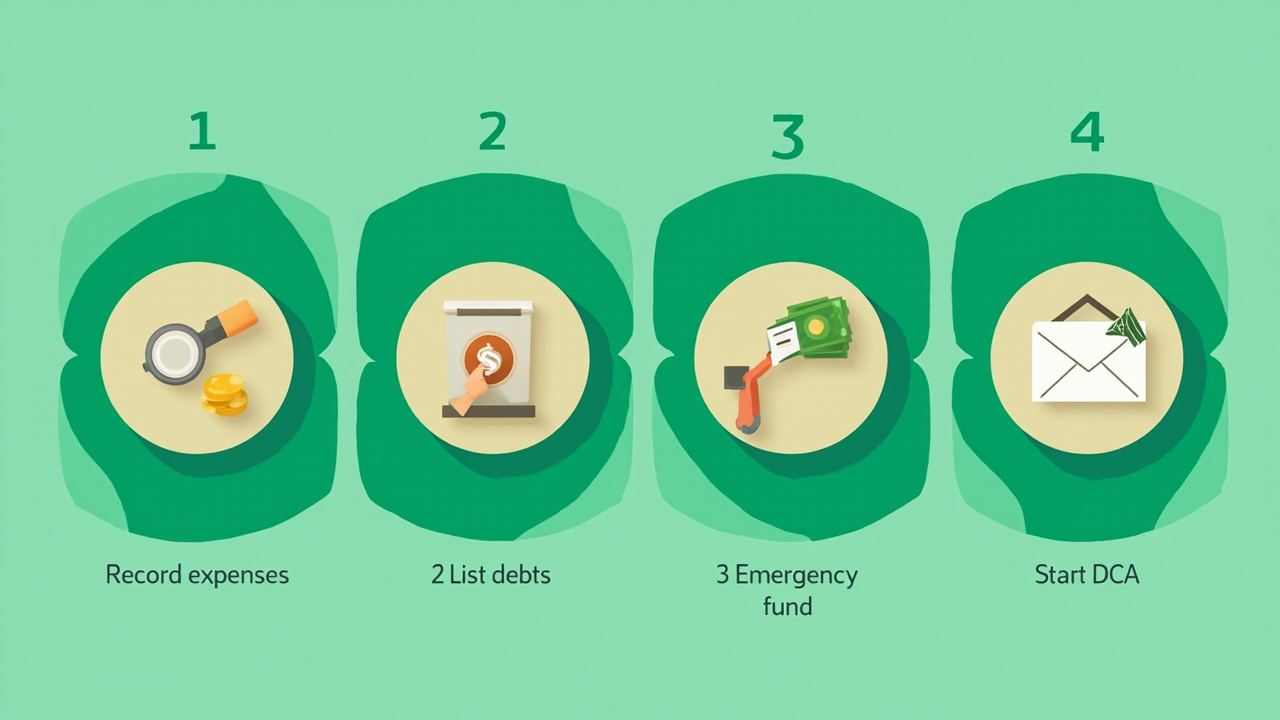
Step 3: Build your emergency reserve. After clearing high-interest debt, start saving your emergency reserve — target six months of living expenses. If your basic monthly expense is NT240,000. This money isn’t for investing — it sits in instantly accessible demand or time deposits. The goal: if you suddenly lose your job, fall ill, or face a family emergency, you don’t immediately fall into crisis and aren’t forced to borrow at high rates. With this cushion you have real security, you can say no at work, you have negotiation leverage.
Step 4: Start dollar-cost averaging. Once you have the emergency reserve, the rest of the money starts to invest. Don’t wait until you’ve saved a big lump sum — you’ll never feel you have enough. The beauty of DCA is forced saving: on payday each month, money is automatically debited to buy ETFs. You don’t see it so you won’t spend it. Choose broad-market ETFs such as 0050 or 0056. Don’t follow brand names, don’t buy individual stocks, don’t fantasize about getting rich overnight. Steady monthly investing lets time and compounding work for you. Even NT2.95 million — that’s the power of time.
Remember this line: Poverty isn’t scary — what’s scary is being poor with class. You drive a financed car, live in a financed house, wear installment-purchased designer labels, look like a somebody — but you’re actually a paper house that could collapse at any gust of wind.
What’s truly scary isn’t that you have no money — it’s that you think you do. You live in a bubble of self-deception until the day it bursts and you realize you’ve always been standing at the edge of a cliff. You know what truly rich people do? They drive ten-year-old domestic cars, wear clothes from the night market, live in old apartments — but their investment accounts have eight figures, their passive income is multiples of your monthly salary, and they don’t need to prove anything to anyone, because they’re actually rich.
Taiwan’s biggest problem today isn’t low wages — it’s too many fake rich people. A bunch of folks earning under NT200,000/month, then complain they can’t save, blaming the government, the boss, the times — but never examining whether they’re living far beyond their means. You don’t need NT$1 million a year to achieve financial freedom — you just need to learn delayed gratification and persistent investing. In ten years you’ll thank your present self. But if you keep your current lifestyle, ten years from now you’ll hate your present self, because you’ll find yourself in the same place — or worse, because you’re older but just as broke.
The choice is in your hands. You can keep being a fake rich person, keep posting your curated life on social media, keep worrying at midnight about how to pay the bills, keep being an ATM for banks and merchants. Or you can wake up right now, tear off the fake face, admit you’re not as rich as you pretend, start living within your means, start saving and investing, and actually turn your life around in ten years. This isn’t telling you to live miserably — it’s about putting money where it actually matters: in places that appreciate, instead of places that feel good for a moment and keep you broke for a lifetime.
This article is for financial education only and does not contain personalized investment advice. Figures cited are general scenario projections for illustration only. Investors should evaluate based on personal financial situation and risk tolerance and are advised to consult a Taiwan-licensed financial advisor. Debt consolidation involves personal credit and rate conditions; actual solutions must be negotiated with financial institutions. ETFs and return assumptions mentioned in this article are long-term averages; past performance does not guarantee future returns.
Disclaimer: This article is for the purpose of sharing investment and financial-planning concepts and compiled data, and does not constitute any specific investment, tax, or legal advice. Markets carry risk; invest prudently. Make your own judgment based on your personal risk tolerance and consult a professional advisor.
Tags
Fake Middle Class, Installment Trap, Social Pressure Spending, Fake Assets, Auto and Home Loans, Emergency Reserve, High-Interest Debt Consolidation, DCA, 0050, Opportunity Cost, Return on Investment, Budgeting App
Comments