Every payday your salary lands and you immediately pay rent, the credit card, and premiums — only then do you think about saving. By month’s end you stare at an empty account and feel a jolt — you’ve earned millions over your lifetime, so why can’t you accumulate wealth?
Here’s a fact that stuns many people the moment they hear it: Jewish families have been wealthy for generations not because they earn more than you, not because they’re smarter, and not because they have any mysterious investment technique. The real key is that the wealth-distribution order passed down over thousands of years is the exact opposite of what you were taught growing up.
You were taught “spend first, save later”; they were taught “save first, spend later.” It sounds simple, but this single sequencing gap, projected over 30 years, produces two completely different lives.
Core one-liner: Until you have stable wealth-distribution discipline, earning more money will only make you lose faster.
How Your Money Flows Every Month Now
Salary comes in — first pay rent or mortgage, then utilities, then credit cards, then phone bills, then food, then the occasional treat for yourself, and finally whatever’s left is what you save. That’s the money flow path for most Taiwanese office workers.
You think it’s normal because everyone around you does it. Your parents did it, your colleagues do it, your friends do it. But that’s exactly the problem — this spend-first, save-later logic means your money is always working for other people.
Landlords, banks, telecoms, supermarkets, convenience stores — each of them takes their cut from your salary the moment it lands. What you end up with is always the smallest slice.
Taiwan’s education system, from elementary school through university, has not a single class that teaches you how to manage money. The Ministry of Labor’s 2023 survey shows the average monthly salary for Taiwanese employees is about NT$45,000, but according to DGBAS’s Survey of Family Income and Expenditure, although Taiwan’s household savings rate is relatively high in Asia, a meaningful share of households can only accumulate very limited real wealth after subtracting consumption from disposable income.
You earn a lot but save little — the reason is the order is reversed.
Underlying Rule 1: The Core of Wealth Accumulation Isn’t How Much You Earn, It’s How Much You Keep for Yourself the Instant You Earn It
This isn’t about not consuming or living like an ascetic — it’s one simple action: the day your salary arrives, first force a fixed percentage into an account you don’t normally touch; whatever’s left is what you can spend this month.
This action is the Jewish wealth principle passed down over thousands of years — pay yourself first.
You might say: “I already save every month!” But what you save is “whatever’s left” — not “what’s set aside first.” These two look the same but produce completely different results. What’s set aside first is a promise to yourself; what’s left over is a handout to yourself.
A calculation to show you how much you’ve lost in your lifetime by getting the order wrong:
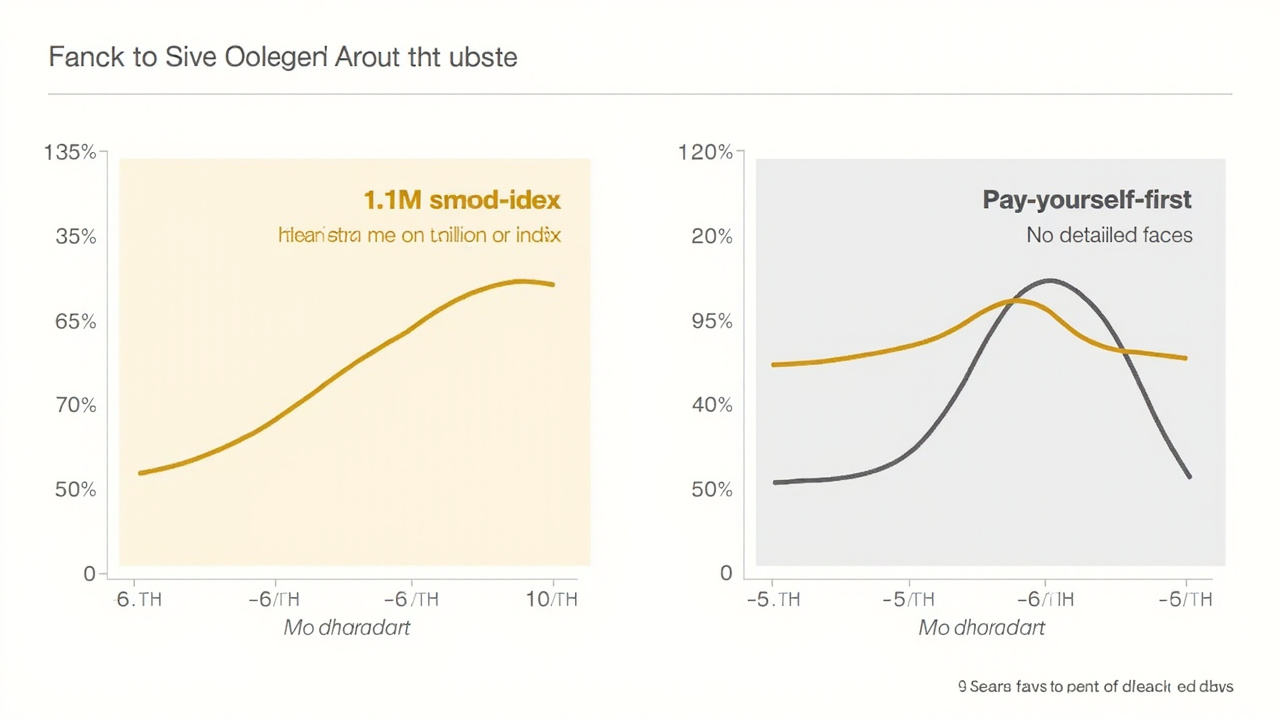
Assume you’re 30 years old, earning NT3,000 per month from what’s left, parked in a regular savings account earning 0.8% to 1%. Saving until age 65 — 35 years — how much have you saved? Principal: 3,000 × 12 × 35 = **roughly NT1.3 million. Is that enough for retirement?
Now flip the scenario: same NT6,750 — into an account that regularly invests in a Taiwan 50 index fund; the remaining NT6,750 per month for 35 years yields roughly NT12 million.
NT11 million — that’s an 8 to 9x gap. And this assumes your salary grows over time.
But I need to tell you right away that this simulation has prerequisites you must know:
- A 7% annualized return is a historical average, not a guaranteed yearly rate. Taiwan 50 dropped over 60% at its worst during the 2008 Global Financial Crisis, and over 30% during the March 2020 COVID shock. You must be psychologically prepared for years of paper losses.
- This simulation assumes you don’t stop for 35 years, but in reality many people break the streak by switching jobs, illness, buying cars or homes, and withdrawing the money mid-way.
- Inflation erodes purchasing power — NT11 million today.
The correct framing is: long-term disciplined investing in Taiwan domestic index funds has historically been one of the most accessible compliant tools for ordinary Taiwanese to beat inflation, but it’s not a principal-preservation tool — it has volatility, drawdowns, and psychological pressure you must endure.
Underlying Rule 2: Time Is the Only Free Weapon an Ordinary Person Has
Taiwan’s financial markets have an iron rule you must know — time is the only free weapon an ordinary person has, but the vast majority can’t use it, because they waste time waiting for the perfect entry point.
SITCA data shows the average holding period for Taiwan fund investors is very short; many people redeem at the first sign of paper losses. This behavioral pattern means the vast majority never capture the compounding effect that long-term investing should deliver.
You aren’t losing to the market — you’re losing to your own short-term thinking.
In Jewish wealth tradition there’s a concept: money should be put to work, not sit there waiting for you. This doesn’t mean you should trade stocks or buy high-risk products — it means when you let money lie in a savings account, it’s working for the bank, not for you.
Taiwan’s savings account interest rates run around 0.8% to 1%, while Taiwan’s CPI year-over-year growth, per DGBAS, averaged roughly 2% to 3% from 2021 to 2023. That means parking money in a savings account is effectively losing money, not saving. This is the biggest cognitive blind spot for 90% of Taiwanese beginners — they think keeping money in the bank is safe, but in reality they’re slowly losing purchasing power.
Underlying Rule 3: Wealth Tools Must Be Used in the Right Place
Taiwan’s banks and insurers spend huge marketing budgets every year telling you to start investing early, that the power of compounding is amazing, that you need a complete financial plan. The statement itself isn’t wrong, but the products they then recommend often run in the opposite direction.
Have you ever been pitched investment-linked insurance, distribution-paying funds, or structured products by a bank RM? These products share one common feature: on the surface they look attractive — fixed payouts, principal protection, complex protection structures — but in reality their fee structures are often very unfavorable to retail investors.
Per FSC regulations, investment-linked insurance must disclose relevant fees, but many consumers have no idea what they’re actually paying before signing up. The upfront fees, insurance rider fees, and fund management fees of investment-linked insurance, stacked together, can total 3% to 5% or more per year. You think you’re investing, but a meaningful slice of your returns is actually paying those fees.
To be clear, this doesn’t mean all insurance is bad — insurance has its rightful function as risk transfer; you need life insurance, health insurance, accident insurance — those are legitimate risk management tools. But if you use insurance as an investment vehicle and use investment-linked insurance as your main wealth accumulation method, you’re using the wrong tool and paying unnecessary costs.

The Three-Bucket Wealth Distribution Principle
You can use this framework for life, whether you currently earn NT100,000 per month — but the ratios must adjust based on your life stage.
Bucket 1: Emergency Fund. This is your safety net; the goal is 3–6 months of living expenses. Park it where you can access instantly — Taiwan money-market funds or short-term time deposits. This money isn’t for investing; its function is to prevent you from having to liquidate long-term investments in an emergency. Until this bucket is built, you shouldn’t deploy large sums into high-volatility assets.
Bucket 2: Long-Term Asset Accumulation. This is where you put money to work. The easiest entry for Taiwanese is a Taiwan domestic index fund offered by investment trust companies, or FSC-compliant overseas ETFs — invest via DCA over the long term. This isn’t asking you to pick stocks or do short-term trading — it’s the lowest decision cost way to participate in Taiwan’s and the global market’s long-term growth. The core logic of this bucket is time and discipline, not stock-picking skill.
Bucket 3: Lifestyle Fund. This is what you can spend this month — rent, food, transport, entertainment, education. The cap on this bucket is whatever’s left after the first two. You must live within that cap, not borrow on credit cards to exceed it.
The core of this framework isn’t the numbers — it’s the order: fill Bucket 1 first, then Bucket 2, then Bucket 3. That’s the exact opposite of what you’re doing now.
Adjust the ratios at different life stages:
- Fresh graduates: salary isn’t high; step one is to build the emergency fund, which may take 6–12 months; during that period the long-term investment ratio can be low but shouldn’t be zero.
- Working professionals with mortgages: include the mortgage as a fixed expense, then distribute what’s left between the other two buckets.
- Middle-aged parents: include children’s education costs in the plan; don’t let education expenses erode your long-term asset accumulation.
- Pre-retirees: gradually shift Bucket 2’s allocation, reducing high-volatility exposure and adding more stable components.
4 Veto-Proof Iron Rules
- Until your emergency fund reaches 3 months of living expenses, don’t deploy any money into high-volatility investments. This applies to everyone, no exceptions. Without a safety net, your investment decisions get driven by emotion; the moment the market drops you panic-sell and destroy the long-term advantage entirely.
- Total monthly fixed debt payments (mortgage, car loan, credit card installments) shouldn’t exceed 40% of monthly income. This is a relatively conservative standard. Above that ratio your financial flexibility is very low; the moment income wobbles you fall into passivity.
- Don’t buy any financial product whose fee structure you don’t understand. It sounds simple, but do you know how many people bought investment-linked insurance, structured products, or distribution-paying funds without understanding the fees? Per FSC regulations, financial institutions must disclose product fees and risks to consumers; you have the right to demand a complete fee disclosure before buying — if you don’t understand it, don’t buy. That’s your basic right to protect yourself.
- Don’t use credit card revolving interest to pay for daily consumption. Taiwan’s credit card revolving interest can run as high as 15% annual rate, the FSC-set ceiling. Living on revolving interest means every dollar you spend is effectively borrowed from the bank at up to 15% per year. That cost is enough to wipe out all your investment returns and then some. Credit cards are payment tools, not borrowing tools; paying the full balance each month is the correct usage.
4 Steps to Take Today
- Today, open your internet banking and set up a dedicated sub-account specifically for the emergency fund. Set up an auto-transfer so that the day after each salary lands, a fixed amount goes into this account automatically. How to compute the amount? First figure out your monthly essential living expenses times 3 — that’s your emergency fund target. Until you hit that target, transfer at least 10% of your salary each month.
- Check the fees on all your existing financial products. If you have investment-linked insurance, call the insurer and ask for a complete fee disclosure — upfront fees, rider fees, fund management fees — add them up and calculate the annualized cost. If that number exceeds 2%, seriously evaluate whether the product fits your needs.
- Open an investment trust company fund account and set up a regular DCA into a Taiwan domestic index fund. Several Taiwan investment trust companies offer this; you can go through major banks or directly through trust company platforms, with minimums as low as NT$1,000. Set up auto-debit on a fixed date each month, with an amount equal to 10%–15% of your salary. The core of DCA is consistency, not market timing — don’t wait for lows; just deduct a fixed amount each month regardless of market moves.
- Schedule an annual financial check-up, ideally in January or February. Spend two hours on an annual review: check whether the emergency fund has hit target, whether the long-term investment allocation has drifted from your goal, whether fixed debt exceeds 40% of income, and whether any unnecessary expenses can be cut.
2 Taiwan-Specific Advanced Pitfalls to Avoid
First: Taiwan’s Labor Pension voluntary contribution system is a free benefit many office workers fail to use. Per the Labor Pension Act, workers may voluntarily contribute up to 6% of monthly salary into their individual pension account, and that contribution is fully deductible from current-year personal comprehensive income tax.
What does that mean? If your marginal tax rate is 20%, every NT2,000 government subsidy. This is a legitimate tax-saving tool Taiwan’s government provides to employees, and the money sits in your individual account at the Bureau of Labor Insurance, not with your employer — switching jobs doesn’t lose it. But per Ministry of Labor data, the share of Taiwanese workers who opt in is fairly low; many people don’t even know the system exists.
Second: Taiwan’s income tax deduction system has a detail many small investors miss. Taiwan’s personal comprehensive income tax offers itemized deductions vs. standard deduction — you can pick whichever is more favorable. Many people default to the standard deduction, but if you have mortgage interest, medical expenses, donations, or insurance premiums, itemized may be better. Per Ministry of Finance rules, self-use residential mortgage interest can be itemized up to NT$300,000. Each year before filing, use the Ministry of Finance e-filing system’s calculator to compare the two filing methods.
Final Words
Wealth isn’t earned — it’s distributed. Every monthly salary is a once-a-month chance to re-choose your wealth path.
The Jewish wealth wisdom passed down over thousands of years isn’t some mysterious investment technique — it’s “pay yourself first, let time and discipline work for you, and use the right tool in the right place.” It’s not hard; the hard part is whether you’re willing to flip the order starting today.
Wealth gaps don’t start from which stock you picked — they start from the moment your salary lands and which direction the money flows.
This article is for financial education purposes only and does not constitute any investment advice or recommendation. All investments carry risk, including possible loss of principal; past market returns do not guarantee future performance. Historical return data for Taiwan 50 and various index funds are for reference only; actual returns vary depending on entry point and market conditions. Before making any investment or financial decision, please carefully assess your own financial situation, risk tolerance, and investment goals, and consult a properly licensed Taiwan financial advisor, tax professional, or relevant professional institution. Labor Pension voluntary contribution and tax filing rules should follow the latest announcements from the Bureau of Labor Insurance, Ministry of Labor, and the Ministry of Finance.
Disclaimer: This article shares investment and financial concepts and information; it does not constitute any specific investment, tax, or legal advice. Markets carry risk; invest with caution. Please make independent judgments based on your own risk tolerance and consult professional advisors.
Tags
Jewish Money, Pay Yourself First, Wealth Distribution Order, Emergency Fund, Investment-Linked Policy, DCA, 0050, Voluntary Pension Contribution, Credit Card Revolver, Itemized Deductions, Budget Rule, Taiwan Wages
Comments