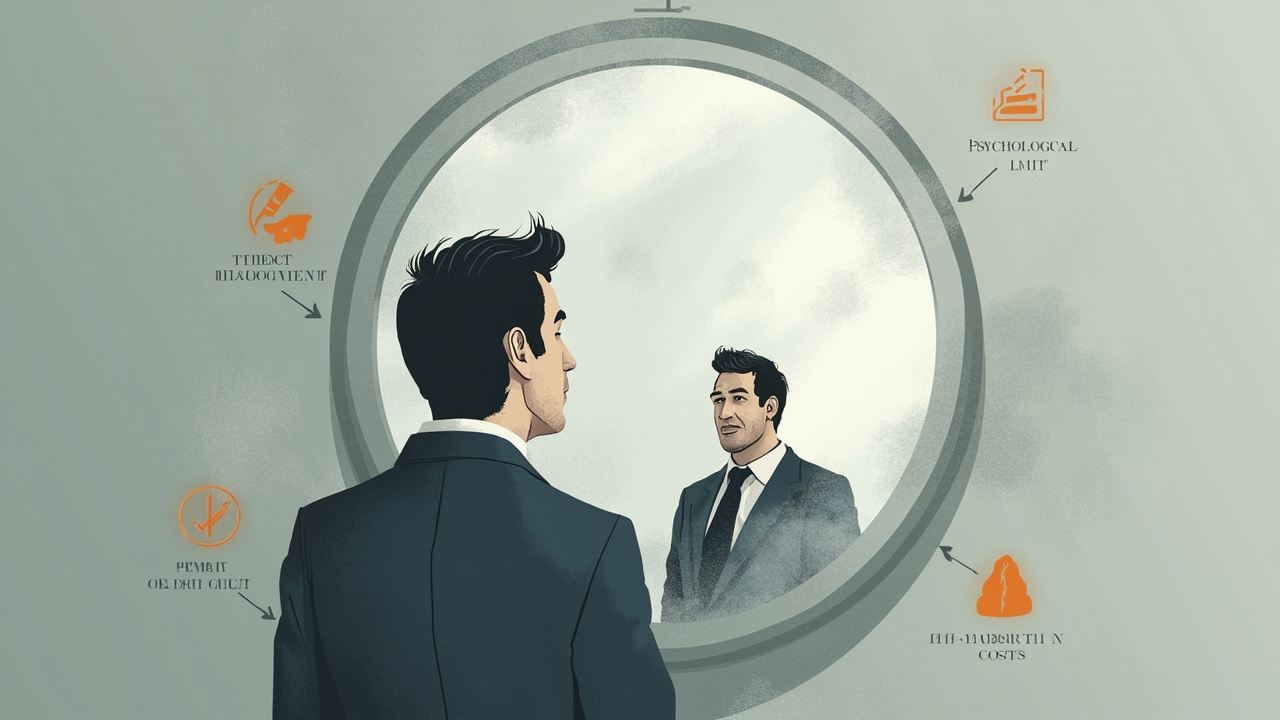
Buying the Dip at TWSE 40,000? This Is the Real Reason Taiwanese Retail Investors Lose Money
Taiwan stocks have broken 40,000 points. You open your phone, look at your account, and wonder whether to add to the bottom, only to lose NT$300,000 a year later.
This scene feels familiar, doesn’t it? You are not unlucky. You got the direction wrong from the very start.
Taiwan retail investors lose money not because they pick the wrong stocks or lack inside information, but because your understanding of bottom-fishing is fundamentally wrong from the start.
This article is not about textbook platitudes. It is about the real cost that Taiwanese retail investors pay every day, but that no one has ever clearly tallied up for you. After reading, you will have three things:
- A clear understanding of why Taiwan stocks keep rising, why you keep wanting to bottom-fish, and why you keep digging in deeper
- A set of sweat-inducing numbers from real Taiwan market events
- A reusable decision framework you can use regardless of whether Taiwan stocks are at 40,000 or 20,000—you will know what to do
In the Taiwan stock market, what makes you lose money is never the market; it is your misjudgment of yourself—not the market’s problem, but your misjudgment of yourself.
1. Taiwanese Retail Investors’ “Bottom-Fishing” Is Catching a Falling Knife
Taiwan stocks have rallied since the end of 2023, breaking 20,000, 30,000, then 40,000. Each time a new high is set, financial news starts talking about elevated P/E ratios, short-term overheating, and pullback risk.
Then you look at the stocks in your account, and the itch starts—you feel the current price is too expensive, wait for it to fall a bit before buying, that’s the smart move, that is bottom-fishing.
Now the question: what is bottom-fishing?
The standard definition in Taiwan financial academia: a strategy of building positions in batches when asset prices are relatively undervalued with clear fundamental support. Note these words:
- Clear fundamental support
- Building positions in batches
Not “I feel it has fallen enough,” not “it dropped 5% yesterday, that feels about right.”
But what are 90% of Taiwan’s retail investors doing? Bottom-fishing by feel—Taiwan stocks drop 3%, feels cheap, buy. Another 5% drop, feels even cheaper, buy again. Another 8% drop, panic sets in, cut losses. Then the next day it rebounds.
According to TWSE statistics, the average holding period for Taiwanese retail investors is less than three months, and more than 60% of retail investors end up with losses on any single stock—60%.
You think you are bottom-fishing. You are actually catching a falling knife.
2. The Human Blind Spot: Loss Aversion
The median monthly salary for Taiwanese office workers is around NT50,000 (Ministry of Labor statistics). You work hard for a month to save NT300,000? Twenty full months.
But in Taiwan stocks, 20 months of savings can vanish in three months because you bottom-fished halfway up the mountain.
Why do you still bottom-fish when you know the risk? Because the human brain has an instinctive impulse toward “cheap.”
Behavioral finance has a concept called “loss aversion”—research from Nobel laureate Kahneman, widely discussed in Taiwan’s financial education circles: the pain of loss is twice the pleasure of an equivalent gain.
What does this mean? When you see a stock drop, your brain is not calculating whether the price is worth buying; your brain is calculating “if I don’t buy, and it goes back up, I’ll have missed an opportunity.”
You are running from an imagined loss, not making a rational investment decision.
This is why at TWSE 40,000 people still say “wait until 38,000.” Then it really falls to 38,000, and you say “wait until 35,000.” Then it falls to 35,000, and you start doubting “maybe it’ll fall more.” Then it rebounds to 42,000 and you bought nothing. Or you bought at 35,000 and it keeps falling to 30,000, and you cut your loss.
This is not bad luck; this is human nature. And this problem is amplified many times over by something in Taiwan’s market environment—something called the rhetoric of media and brokers.
3. First Underlying Rule: The Core Reason Taiwanese Retail Investors Lose Money Is Not Picking the Wrong Stock, It Is Using the Wrong Time
Taiwan’s inflation rate, based on DGBAS data in recent years, averages around 2% to 3%, and spiked to over 3% in 2022.
Your money in a demand deposit earns about 0.1% to 0.2%—it can’t even beat inflation, and is shrinking in real terms every year. This is your starting point for investing—you are already racing against time.
But the operating pattern of Taiwanese retail investors is wasting huge amounts of time waiting for the lowest point.
According to research from Vanguard on global markets and SITCA’s analysis of Taiwan stocks, over the long term, the bulk of stock market gains is concentrated in just a few trading days. If you miss those days because you were waiting for a lower point, your long-term return drops dramatically.
This is not telling you not to stop losses. It is saying the cost of frequent trading is far higher than you imagine.
The Hidden Drain of Trading Costs
Taiwan’s stock transaction tax is 3‰. Add in commissions, and the total cost of one round trip for a typical retail investor is roughly between 3.5‰ and 4.5‰ (varies by broker).
Suppose you have NT300,000 × 4‰ × 24 (one-sided) = NT$24,000**.
That NT$24,000 is the cost you pay before you start making money, and that does not even count losses from frequent bad judgment.
The core reason you lose money in Taiwan stocks is not picking the wrong stock, but using frequent trading to wipe out the power of time compounding, and then piling on trading costs on top.
Account Scenario 1: A Day in the Life of a Retail Investor
Suppose at TWSE 38,000 points you thought the top was near and waited for a pullback before buying. Instead it rose to 42,000, and you could not resist chasing in, buying NT$300,000 of TSMC or Yuanta Taiwan 50. After buying, it pulled back to 38,000, a drop of roughly 9.5%.
- Your paper loss: NT28,500**
- Two trade transaction costs: roughly NT$2,400
- Real loss: NT$30,900
Then it rebounded to 45,000, and you watched without buying. In that one move, you not only lost NT$30,000, you missed the subsequent upside—that is retail investors’ true total cost, not just the paper loss but also the opportunity cost.
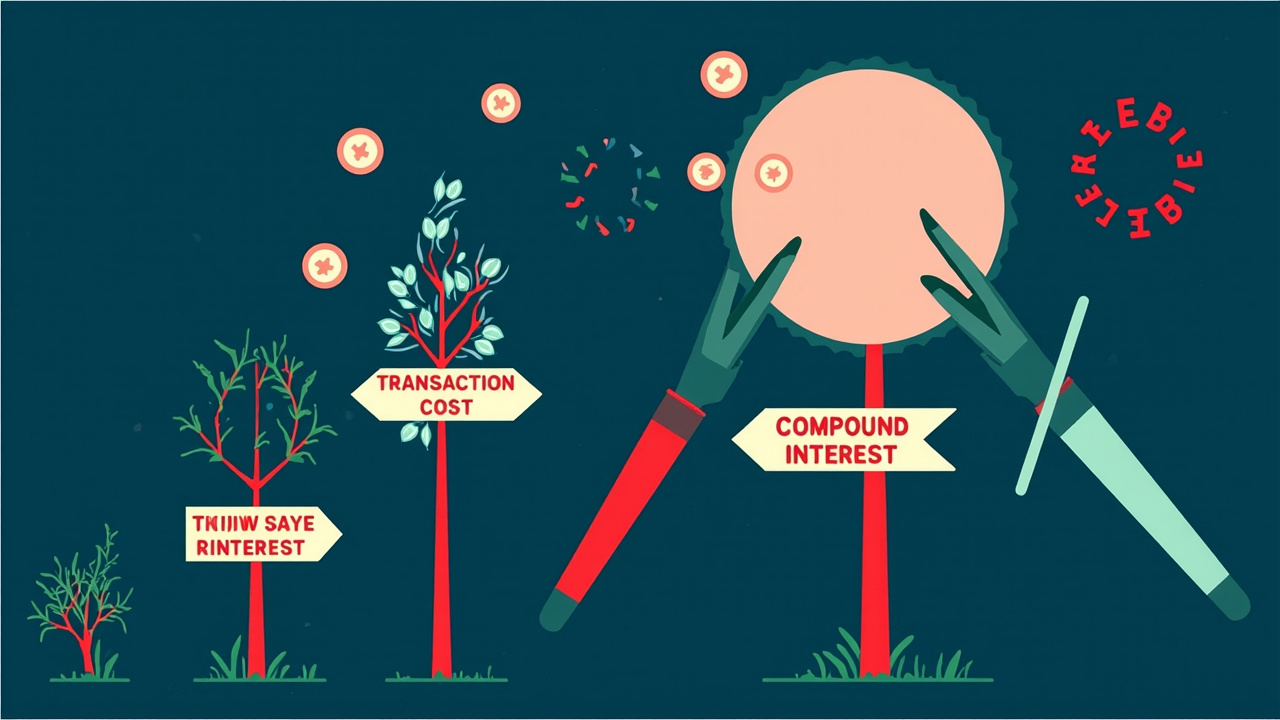
4. Second Underlying Rule: Taiwan Stock Volatility Far Exceeds Your Psychological Capacity
Taiwan’s stock market crashed from 12,000 in 1990 to 2,680, taking 3 years; fell from 9,859 in the 2008 financial crisis to 3,955, a drop of more than 59%, in just over a year; fell from 18,619 in 2022 to 12,629, a 32% drop, in about nine months.
These are all real records from Taiwan’s own market, not hypotheticals.
Do you know what happened to retail investors who tried to bottom-fish in these crashes? According to TWSE account-opening statistics, after every major drop, the number of new account openings spikes during the early rebound, then during the second dip the stop-loss selling from this group is also the largest. This is the real shape of bottom-fishing halfway up the mountain.
In the 2008 financial crisis, many people started bottom-fishing after a 30% drop, only to watch it fall another 42% from there. If you bought NT126,000—can you hold on?**
Most Taiwanese office workers cannot hold on, because that could be six months to a year of savings.
Taiwan stock market volatility far exceeds most retail investors’ psychological capacity—you think you can bottom-fish, but your financial and psychological state simply does not allow you to hold all the way to the real bottom.
5. Third Underlying Rule: Taiwan’s Financial Institutions Have a Revenue Model in Structural Conflict with Your Interests
What is the source of revenue for Taiwan’s brokers, banks, relationship managers, and fund companies? Commissions, management fees, subscription fees.
SITCA public data shows that the average management fee of Taiwan’s actively managed equity funds is about 1.5% to 2%, with subscription fees as high as 3%. The problem is not the fees themselves; it is that this business model creates an internal incentive structure:
For financial institutions, the more frequently you trade, the more they earn; the more high-fee active funds you hold, the more they earn.
This is not a conspiracy theory; it is a transparent interest structure—you can check any broker or investment trust’s annual report. But this interest structure is not aligned with your best interest.
For you, the best strategy might be to buy low-fee index ETFs and hold long-term, minimizing trade frequency. That gives you the lowest cost and the best long-term compounding. But doing that earns the financial institutions the least.
A large part of Taiwanese retail investors’ cognitive blind spot is shaped by this interest structure over time—you think bottom-fishing is an investment technique, but in the marketing language of financial institutions, it becomes a behavioral pattern that makes you trade frequently and keep paying fees.
6. 3 Account Scenarios: The 20-Year Long-Term Wealth Gap Is NT$2.86M
Account Scenario 1: The Real Result of Dollar-Cost Averaging (Including Preconditions)
With NT10,000 a month, continued for 10 years through 2024. According to TWSE and Yuanta’s public historical data, Yuanta Taiwan 50’s cumulative return over this period was substantial; including dividends reinvested, the annualized return is roughly 10% to 12%.
After 10 years, your contributed principal is NT1.8M to NT$2.0M**.
But I will tell you the preconditions:
- You must have not stopped your losses during the March 2020 COVID single-month 29% crash on Taiwan stocks
- You must have continued DCA through the full 32% drop of 2022, without pausing
- You must have been able to keep going when your paper loss exceeded NT$300,000
Can you meet these three preconditions? Most Taiwanese office workers cannot. Because at that point your account is in the red, and you may simultaneously be facing life pressure. That is why I say the strategy itself is not hard; the execution is hard.
Account Scenario 2: 20-Year Long-Term Gap Between Two Choices
- Option A (frequent-trading retail investor): trading costs plus operating mistakes hold the actual annualized return at only 2% (about the same as a Taiwan fixed deposit). After 20 years, your NT1.78M.
- Option B (disciplined DCA investor): annualized return of 7% (this is a relatively conservative estimate, below Taiwan’s historical average). After 20 years, your NT4.64M.
The gap is NT$2.86M—this is not a hypothetical, it is compounding math.
Account Scenario 3: Recovery Time in Extreme Scenarios
If you entered at the 2000 Taiwan bubble peak of 10,000 and it fell to 3,300, a 67% drop, your principal shrank by two-thirds:
- If you had lump-sum entered, you would need to wait until about 2006 to break even—6 years
- If you continued DCA during the drop, your recovery time would shorten to about 3 to 4 years (because you lowered your cost)
This is the real role of DCA in extreme markets—it does not eliminate risk, but it shortens the recovery cycle.
7. The 4-Question Decision Framework
Every time you want to bottom-fish, answer these 4 questions first:
- What are you buying? Is it an individual stock or an ETF? For an individual stock, have you read the financials? For an ETF, do you know what index it tracks? If you cannot even clearly say what you are buying, don’t buy.
- How much are you planning to invest? Is this money idle capital beyond your 3-month emergency reserve? If you might need this money within 6 months, don’t buy.
- What is your plan? How long do you plan to hold? At what drop will you cut losses? At what gain will you take profit? If you have no plan, don’t buy.
- Can you tolerate the worst case? If it keeps falling 30%, can you hold? If you can’t, your position should be sized down to what you can tolerate.
These 4 questions are a reusable decision framework in any market environment—usable at TWSE 40,000 or 20,000.
8. Four Veto Rules
If you fail any one of these four, you absolutely cannot enter the market by bottom-fishing, no matter what type of investor you are.
Rule 1: You must have at least a six-month emergency reserve, parked in a demand deposit or money market fund, completely untouched. This is the baseline for everyone.
Rule 2: The money you put into the stock market must be idle capital you will not need for 3 to 5 years. If you are buying a house next year or paying your child’s tuition the year after, that money cannot be tied up in short-term stock swings.
Rule 3: You must have a clear stop-loss plan, and it must be set before buying. Not decided on the fly after the loss. The stop-loss range is set according to your risk tolerance, not by feel.
Rule 4: Your single-stock position cannot exceed 20% of your total investable capital. If you only have NT60,000. This is not saying you cannot make big money; it is saying you must survive first to keep playing the market. TSMC is great, but it has also dropped more than 40% in a single year.
9. Four Practical Action Steps
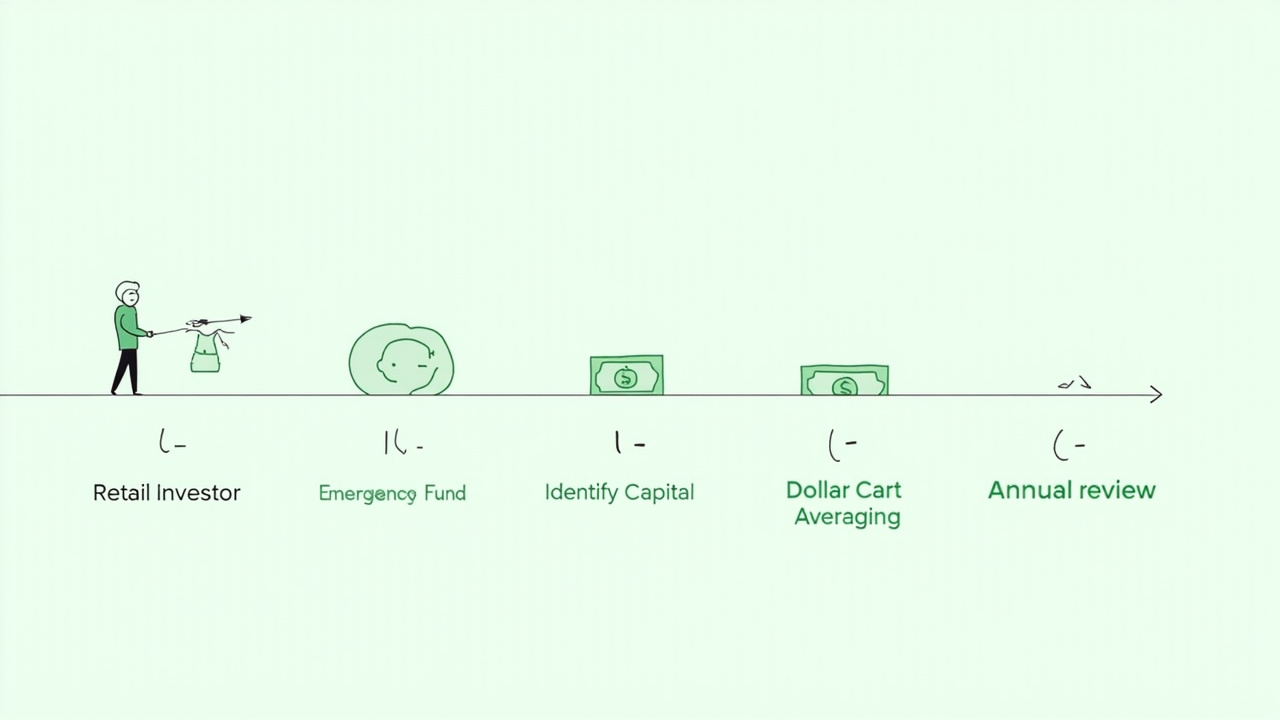
Step 1: Open your online banking (any of Bank of Taiwan, First Bank, Cathay United, etc.) and confirm whether you have at least six months of emergency reserve. If not, set aside excess funds into a separate demand account labeled “emergency reserve,” untouchable.
Step 2: Open your brokerage app (Fubon, Cathay, Yuanta, KGI, etc.) and look at your current holdings. For each holding, ask: “Is this idle capital I won’t need for three years?” If not, consider adjusting your position—this is not telling you to sell everything, but to clarify your capital structure.
Step 3: If you are a fresh graduate or a small saver (monthly salary NT$30,000–50,000), start by dollar-cost averaging into a Taiwan 50 or Taiwan high-dividend ETF, fixed monthly amount, executed regardless of whether the index is up or down. Set the amount at 10% to 20% of your monthly salary—something that does not hurt your quality of life but adds up significantly over the long term through compounding. DCA setup is available in all major brokers’ apps.
Step 4: Set your annual review time—suggested the first weekend of January each year. Open your account, look at your actual return, compare it to Taiwan 50’s return over the same period. If your return has consistently lagged the index, then your frequent trading is dragging down your performance. At that point, seriously consider switching to DCA.
10. Two Overlooked Taiwan-Specific Traps
Trap 1: The After-Tax Trap on Dividend Income
Taiwan’s dividend income is subject to consolidated income tax. If you bought before the ex-dividend date hoping to collect the dividend, and the price fills after ex-dividend, you made money—but do you know? According to the Ministry of Finance tax rate table, taxpayers with annual income above NT2.4M, it’s 30%.
That means on a NT7,000 to NT$8,000.
This is not saying you cannot receive dividends; it is that when calculating your investment return, you must use the after-tax return, not just look at the pre-ex-dividend dividend yield. This is a Taiwan-domestic rule.
Trap 2: Leveraged ETF Daily Reset Decay
Taiwan’s ETF market has expanded rapidly in recent years, with over 200 ETFs now listed. Not all ETFs are suitable for long-term holding.
One category is leveraged ETFs and inverse ETFs—they have a feature called “daily reset,” meaning they recalculate the leverage ratio every day. Long-term holding produces decay from the compounding effect, meaning even if the index returns to the starting point, the leveraged ETF may still be at a loss.
This is not a financial institution conspiracy; it is the math of leveraged products (although it is clearly disclosed in the product prospectus).
Taiwanese retail investors often buy inverse ETFs during big drops to hedge, but if you hold an inverse ETF long-term, you will almost certainly lose—because Taiwan stocks’ long-term trend is upward, and the daily reset decay adds on top. Many investors with three to five years of experience have fallen into this trap.
11. Emergency Plan for Extreme Markets
If Taiwan stocks experience an extreme crash of over 20% in a single month like in 2008 or 2020, what should you do?
- Do not panic-sell your entire position. Historical data shows Taiwan stocks have rebounded after every major drop, but rebound does not mean quick rebound—the 2000 bubble took 6 years to revisit its high. So your contingency plan is not “should I sell,” but “how long can I hold”.
- If your emergency reserve is sufficient, an extreme drop can actually be a moment to consider increasing your DCA amount—but only if your job is stable and your income has not been hit. This is not telling you to bottom-fish in panic, but to reasonably increase your regular investment within your plan framework.
- If your financial situation is hit during an extreme market (job instability, large expense), preserve your emergency reserve first, pause investing—that is a perfectly reasonable decision. Investing is for the long term, but your life cannot collapse because of investing.
12. Final Decision Aphorisms
In Taiwan stocks, what makes you lose money is never the market; it is your misjudgment of yourself—your misjudgment of your ability to call the bottom, of your psychological tolerance, of the real cost of frequent trading.
Taiwan stocks breaking 40,000 is not your signal to bottom-fish, nor your signal to run, it is your chance to revisit your decision framework.
Whether you are a fresh graduate just entering the workforce, a small saver setting aside NT$10,000 a month, a middle-aged household with mortgage and children, or a senior approaching retirement, you can use the 4 questions and 4 rules from today to recalibrate your next investment decision.
You don’t need to call every high and low. You just need to make a few key decisions correctly, then let time compounding do the rest.
All content in this article, including data analysis, strategy recommendations, and market views, is for financial education only and does not constitute any investment advice or recommendation for any financial product. All investments carry risk, including possible loss of principal. Past market performance does not guarantee future results, and Taiwan stock market historical data is for reference only. Each person’s financial situation, risk tolerance, and investment goals differ. Before making any investment decision, please carefully assess the risks and consult a Taiwan-licensed financial advisor and tax professional.
Disclaimer: This article is a sharing of investment and financial concepts and a compilation of information, and does not constitute any specific investment, tax, or legal advice. Markets carry risk; invest with caution. Please make independent judgments based on your own risk tolerance and consult professional advisors.
Tags
Bottom-Fishing Trap, Retail Behavioral Bias, Loss Aversion, Transaction Cost, DCA, Why Retail Loses, Behavioral Finance, Emergency Reserve, Leveraged ETF, Inverse ETF, Dividend Income Tax, Stop-Loss Discipline
Comments