Search

Current filter #交易成本 All Clear filters

9 articles found

Wealth Awakening

Stop Watching the Screens! You're Working Hard to Lose Wealth: The Three Hidden Traps of Retail Investors

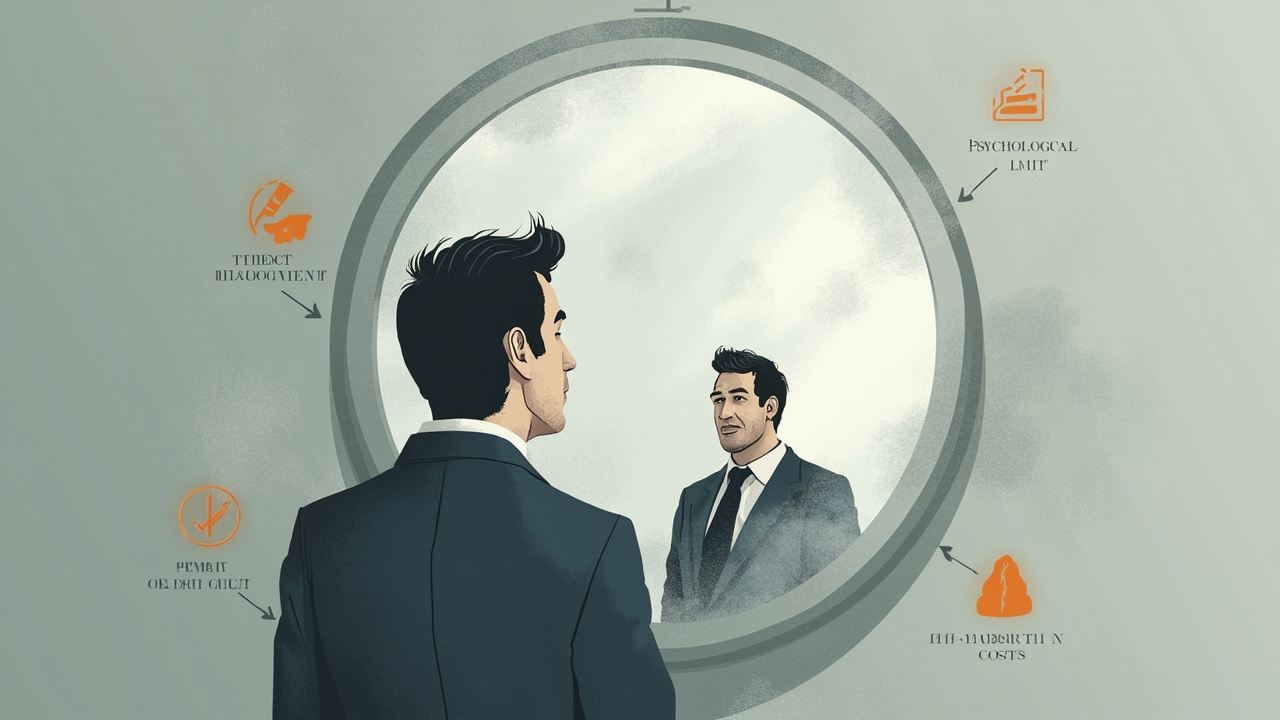
You open your account, sick green as far as the eye can see, stare at the number and your mind goes blank. Every crash feels like a judgment failure on your part; every missed rally feels like bad luck; every time you get trapped you tell yourself next time you'll strictly follow discipline—but next time is the same. You don't lose money because you're stupid, and it's not bad luck either: you've been scammed. Scammed by the rules, scammed by your own psychology, scammed by the fundamentally unpredictable nature of the world. This article unpacks five truths—transaction costs, order flow, loss aversion, decision fatigue, the sandpile effect—and gives you a simple method that doesn't rely on prediction or gut feel.
13 min
Wealth Awakening

81% of Retail Investors Lose Money on AI Stocks: Understand the TWSE Underlying Logic in 30 Minutes

You open your phone and see your AI stocks are down again, with paper losses exceeding NT$100,000. According to the latest data from the Taiwan Stock Exchange and SITCA, between 2025 and 2026 the loss rate for retail investors participating in AI concept stocks reached 81%. Eight out of ten ended up losing money. The problem is not that you aren't smart enough. It is that the rules of the game you joined were never designed for you. This article breaks down three underlying rules: why the core reason for losses is a systematic bias in participation timing rather than stock-picking ability, why Taiwan's century-old iron rule (the market is a voting machine short-term and a weighing scale long-term) gets ignored by retail investors whose average equity holding period is under six months, and how financial institutions' business model systematically forces you to pay more than necessary. It then runs a 20-year wealth comparison showing a gap of more than NT$2 million between ideal execution, normal execution, and the 2008 black swan scenario, and closes with three Taiwan-specific blind spots (0050's top-10 concentration above 70%, dividend-tax filing-method optimization, and high-dividend ETF turnover risk) plus a four-step decision framework.

13 min
Wealth Awakening

TWSE Breaks 40,000 in H2 2026: Four Principles to Protect Your Principal from Getting Wiped Out

The TWSE is at 40,000 but your account is still losing money. This is not a joke, it is happening right now. The index hitting a new high and your account making money are two completely different things, and that is the biggest cognitive blind spot for 90% of Taiwan retail investors. This article uses the real recovery cycles of the 2008 financial crisis (TWSE fell nearly 60%, recovery over five years), the 2020 COVID crash (nearly 30% in a single month), and the 2022 rate-hike cycle (close to 32% drawdown) to show how the wrong capital allocation can lock your losses in. It also breaks down the cost gap between active funds charging 1.5% to 2.5% in annual management fees versus index ETFs like 0050 under 0.4%, and the hidden transaction-cost bill that can exceed NT$10,000 a year for an active retail trader. It then walks through four principles to protect your principal in a TWSE-40,000 high market: building a capital firewall, replacing lump-sum entry with dollar-cost averaging, setting written stop-loss and take-profit rules before entry, and rebalancing annually. It closes with four veto iron rules to keep you from adding at the worst possible moment.

12 min
Wealth Awakening

Buying the Dip at TWSE 40,000? This Is the Real Reason Taiwanese Retail Investors Lose Money

Taiwan stocks have broken 40,000 points. You open your phone, look at your account, and wonder whether to add to the bottom—then a year later you are down NT$300,000. Taiwanese retail investors lose money not because they pick the wrong stocks or lack inside information, but because their understanding of bottom-fishing is fundamentally wrong from the start. This article breaks down 3 underlying rules (using the wrong timing cancels time compounding, Taiwan stock volatility exceeds psychological capacity, and the structural interest alignment of Taiwan's financial institutions), 3 sweat-inducing account scenarios (including a 20-year gap of NT$2.86M), a 4-question decision framework, 4 veto rules, 4 practical action steps, 2 overlooked Taiwan-specific traps (after-tax dividend income yield, and leveraged ETF daily reset decay), and an emergency plan for extreme markets. Core line: in Taiwan stocks, what makes you lose money is never the market, it is your misjudgment of yourself. Action hint: before your next impulse buy, run the 4 questions and check the veto rules.

18 min
Wealth Awakening

91% of Taiwan Retail Investors Lose Money! The 5 Deadly Sins—The 3rd Is the Most Fatal

According to TWSE statistics, the proportion of Taiwan retail investors with consistent long-term profits is below 10%; over 90% lose money in the market. You open your Taiwan stock app, see the numbers dropping again, and your finger hovers over the screen unsure whether to cut losses—is this a scene you live through every day? This article breaks down 5 deadly sins for Taiwan retail investors: chasing rallies and selling on dips, over-concentration, no stop-loss (disposition effect), ignoring trading costs and taxes, and no investment plan. The 3rd sin is the most fatal: the disposition effect causes you to sell winners too early and stop losses on losers too late. Using NT$1M as a sample: even at half-price commissions, monthly turnover can eat 7–8% of return per year in trading costs alone, plus a 0.5% difference in ETF management fee can mean a six-figure gap over 20 years of compounding. Includes 4 iron rules, 4 action steps, and differentiated strategies for different groups.

17 min
Wealth Awakening

60% of Taiwanese Have Stock Accounts, Only 10% Make Money: The Truth About Stocks in 36 Minutes

Taiwan has over 12 million brokerage accounts—roughly 60% of all adults have entered the market—yet fewer than 10% achieve stable long-term profits. The shared fate of the other 90% is not bad luck or wrong picks, but treating speculation as investing and using an investor's mindset to deceive themselves. This article breaks down the structural disadvantage of short-term trading, the overconfidence bias from behavioral finance amplified by Taiwan's 2016–2024 bull run, three underlying iron rules (compounding cost erosion, low-buy-high-sell losses, and the liquidity trap of strong capital), four questions to ask before every order, a complete four-step action plan, three real account scenarios (5-year and 20-year horizons), two Taiwan-specific high-level traps (dividend tax plus NHI supplemental premium, and ETF tracking error plus premium/discount), and an emergency plan for extreme market conditions. Pain point: even in Taiwan's strongest bull run, most retail investors left with less than they started. Promise: a tested framework that turns stock decisions into a discipline, not a feeling.

11 min
Wealth Awakening

From All-In on AI to Nothing Left: The 5 Endgame Blind Spots of Taiwan Stock Retail Investors

Three months after going all-in on concept stocks, your account is down to less than half—that is the real story of hundreds of thousands of Taiwanese retail investors last year. Long-term returns for Taiwan retail investors are systematically below the broader market, not because of stock-picking skill, but because of entry-timing bias compounded by hidden costs continuously eating away at returns. This article breaks down 3 underlying rules (behavioral cost as the real erosion, structural market asymmetry against retail investors, and the revenue logic of financial institutions that pushes you to trade more), 3 account-checking scenarios with hard numbers, 4 ironclad veto rules, 4 actionable steps, a four-question decision filter, and age-based application boundaries for fresh graduates, young families, middle-aged parents, and seniors. Pain point: you keep buying high and selling low and cannot explain why. Promise: a reusable framework that puts your trading decisions back in rational control, with concrete rules for each life stage.

15 min
Wealth Awakening

The More You Day-Trade, the More You Lose: The Real Cost the Rich Never Pay for Short-Term Trading

You stare at the screen all day, buying and selling, but the account keeps getting thinner. Using Taiwan Stock Exchange rules — brokerage cap of 1.425‰ and day-trade transaction tax of 1.5‰ — this article calculates the real cost of churning a NT$1 million position in and out daily as a NT$68,000 monthly loss before you even make a single profitable trade. It then uses the Taiwan 50's 7%–9% annualized return over the past 20 years to contrast the 20-year gap between 'day-trade every day' and 'just hold and forget.' Also included: four day-trading iron rules and a four-step action plan. TWSE data shows day-trade volumes exceeded 40% of total trading at the peak around 2021, but the share of consistently profitable day-traders is extremely low and still falling. Even with a 55% win rate, academic simulations show that after costs, the long-term net return converges to zero or negative.

11 min