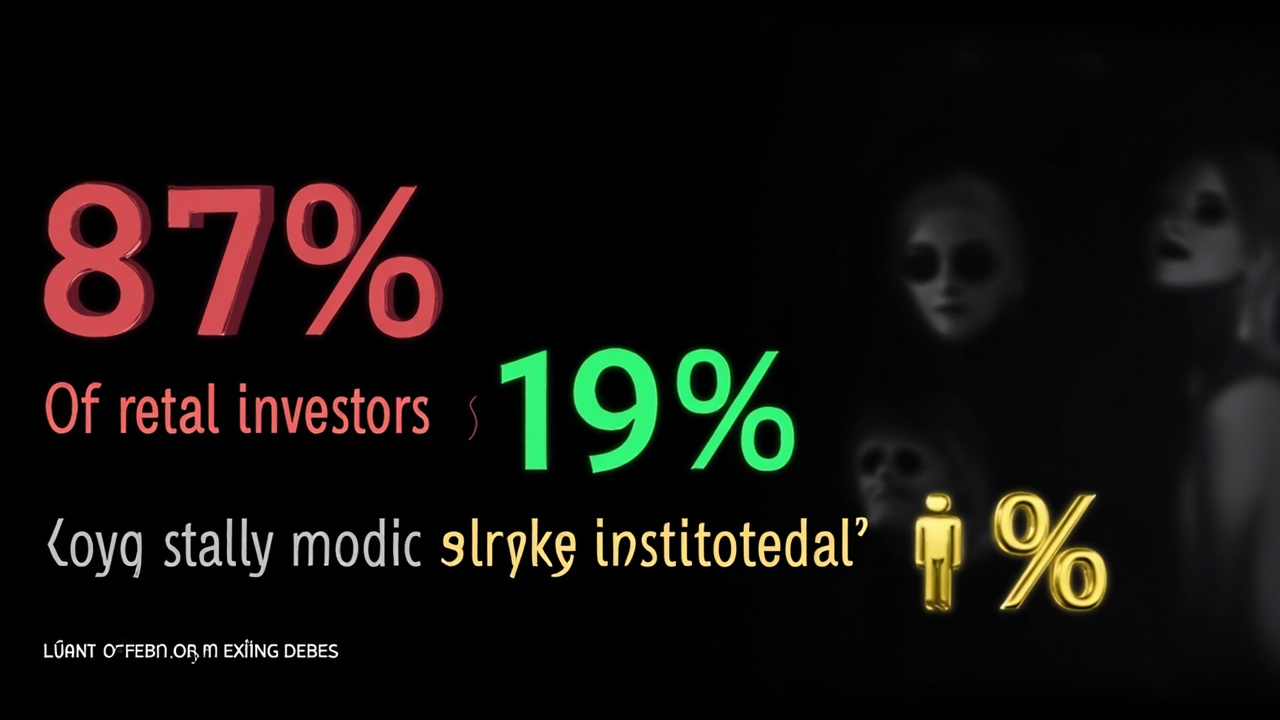
81% of Retail Investors Lose Money on AI Stocks: Understand the TWSE Underlying Logic in 30 Minutes
You open your phone and see your AI stocks are down again. Your paper losses exceed NT$100,000, and your hands are shaking. This is not a story about a few unlucky people. According to recent data from the Taiwan Stock Exchange and SITCA, between 2025 and 2026 the loss rate for retail investors participating in AI-related concept stocks reached 81% or higher. In other words, eight out of ten people ended up losing money. You thought you were participating in Taiwan’s biggest wealth opportunity. It turns out you were just providing liquidity to institutions and the big players—you aren’t an investor. You are the exit.
There’s something you have to get straight first. Many people say retail investors lose because they aren’t smart enough, aren’t working hard enough, and don’t have the information. That’s the biggest lie. The core reason retail investors lose money is not information asymmetry. It is that the rules of the game you joined were never designed for you. The underlying logic of the market has never been about making everyone money. It’s about the redistribution of wealth. The question is which side you are standing on.
In Taiwan, people who don’t understand the rules are always making money for those who do. The rules themselves are written in public data—nobody is translating them for you. Today I’ll translate them for you.
Why Do AI Stocks Make 80% of Retail Investors Lose Money? The Market Structure Behind It
From late 2024 to early 2025 the AI concept stocks exploded. TSMC, Quanta, Wistron, Hon Hai—one by one they hit new highs. Everything you saw on PTT, Dcard, and YouTube was money-making news. Your colleague said he made NT$300,000 on Quanta. Your neighbor said he doubled his money on Wistron. You couldn’t resist. You charged in at the high. Then it started to drop right after you bought. When it dropped you thought it was a pullback and added more. It kept dropping until your mindset collapsed, and finally you cut your losses at even lower prices. Does this process sound familiar?
According to TWSE trading statistics, retail investors’ buying volume during the last two layers of a market rally often accounts for the highest share of total turnover. Where are institutions and the big players? Before you charged in, they had long been positioning for the exit. This is not a conspiracy theory. It is public order-flow data. Anyone can open the TWSE three-major-institutional-investors buy-sell statistics and see it.
Have you ever thought about why your timing always lands near the high? It’s not bad luck. It’s because the information you receive is, by nature, second-hand. When the media starts running big coverage on a stock, when your colleagues start discussing a concept, that information has already been digested by the market. The热度 (heat) you see is someone else’s exit smoke screen.
First underlying rule: the core reason for Taiwan retail investor losses is not inadequate stock-picking ability. It is a systematic bias in the timing of participation. Taiwan’s financial research institutions and related academic studies both point out that retail investors’ buy timing statistically shows a clear chasing-high pattern. You are not an isolated case. You are part of a group behavior, and that group behavior itself is the source of market liquidity—and the prerequisite for institutions and big players to be able to ship out smoothly.
Let me run a number to show you how serious this problem is. Assume you put NT120. Three months later the price fell back to NT290,000, nearly 30%. If you panic-cut at that moment, that money is truly gone.
But if you had entered at the beginning of the AI concept rally (when the price was around NT500,000. Same stock. The difference is only the entry timing, and the wealth outcome can differ by more than NT$400,000. This isn’t a stock-picking problem. It’s a question of how well you understand the rhythm of the market.
Taiwan’s Century-Old Iron Rule: In the Short Term It’s a Voting Machine, In the Long Term It’s a Weighing Scale
Taiwan’s stock market has a century-old iron rule that almost every retail investor knows but has never truly internalized. The rule: in the short term the market is a voting machine, in the long term it’s a weighing scale. This isn’t anyone’s personal opinion. It is a basic consensus from market-behavior research, and it is the core concept repeatedly cited by SITCA in retail-investor education materials.
But the problem is: even though you know this sentence, your behavior is the complete opposite. You check your stocks every day on your phone. You ride the emotional rollercoaster of one-day moves. You start speculating on earnings before the report comes out. You start wondering if you should exit when the index drops 200 points. You say you’re a long-term investor, but you make short-term judgments every day. This contradiction is the second core reason 80% of Taiwan retail investors lose money.
According to SITCA’s 2024 statistics, the average holding period for Taiwan retail investors in the equity portion is less than six months. Six months. You think you’re doing long-term investing, but your average holding period tells you you are actually doing short-term trading—you just don’t have the technical skills or information advantages of short-term traders.
The power of long-term investing in Taiwan’s stock market is backed by historical data. The TAIEX rose from a 2003 low of around 4,000 points to over 23,000 points in 2024, a roughly 5x increase over 20 years, with annualized return of roughly 8% to 9%, not including the compounding effect of dividend reinvestment. If you factor in reinvested dividends, based on TWSE historical data, the dividend-inclusive total return index over 20 years performed far more impressively than looking at index price alone. But 90% of retail investors never captured that number, because they didn’t hold for 20 years. In every wave of volatility in between they either chased high or sold low, personally handing back the fruits of long-term compounding.
Three Execution Versions: The Real Wealth Gap
Assume you set aside NT120,000 per year—and consistently invest it in a TAIEX-related ETF (such as 0050). Based on TWSE’s roughly 7% to 8% historical annualized total-return estimate over the past 20 years.
Ideal execution version: you DCA every month, regardless of ups and downs. After 20 years your principal is NT5.2 million to NT$5.8 million. Your money more than doubles, and you barely need to make any active judgments along the way.
Normal execution version: you DCA every month, but you panic-pause for three to six months when the market drops more than 15%, then resume after the rebound. According to behavioral-finance research, this stop-and-go execution bias reduces your actual annualized return by 1 to 2 percentage points. After 20 years your account value is roughly NT4.6 million. About NT$1 million less than the ideal version.
Extreme black swan version: during the 2008 financial crisis, the TWSE fell from 9,000 points to 3,900 points, a drop of more than 56%. You panic-sold all your ETFs at the bottom. This is one of the most extreme black swan events in Taiwan in the past 20 years. If you liquidated everything at the bottom and never resumed, you didn’t just lose paper losses—you lost the entire rally from 3,900 back to 23,000. That is the truly devastating wealth loss.
The three outcomes can differ by more than NT$2 million, and what determines the gap is not which stocks you picked but whether you executed with discipline within the right framework. Taiwan stock market’s underlying iron rule isn’t stock picking. It’s holding behavior.
Third Underlying Rule: The Business Model of Financial Institutions Systematically Forces You to Pay More Than Necessary
The business model of Taiwan’s financial institutions (banks, brokerages, asset management firms) is built on one core logic: the more you trade, the more they earn. The more complex the products you hold, the more they earn. The more anxious you are, the easier it is for them to upsell you high-fee products. This isn’t saying all financial institutions are bad people. It’s saying that in many cases their interests and yours are not aligned.
For Taiwan stock trading, brokerage commissions on the round-trip generally run around 0.1425%, plus the 0.3% securities transaction tax on sells. A full buy-sell transaction costs you about 0.485%, meaning every NT5,000. If you trade four times a month, that’s 48 times a year, with an average trading principal of NT120,000 a year. That NT$120,000 comes out of your salary, earned from hard work. Just like that, it disappears.
But the more hidden cost is not this. The more hidden cost is the management fee on active funds. Many active equity funds recommended by Taiwan bank relationship managers charge 1.5% to 2% per year, sometimes even more. You might think 1.5% is nothing, but calculate the compounding effect over 20 years: same NT3.8 million**; if you invest in an active fund with 1.5% in fees, your account is roughly NT1 million gap, just because of that 1.35% annual management-fee difference, eaten away by 20 years of compounding.
This is a number your relationship manager won’t proactively tell you. Not because they are lying to you, but because their performance review is based on sales numbers, not on your investment return. This is a problem of system design, not personal morality. But the result is that your wealth is slowly eaten away by hidden costs without you knowing it.
Three Hidden Blind Spots Specific to the Taiwan Market
First blind spot (for fresh entrants and students): many beginning investors assume Taiwan stocks work the same way as US stocks, but Taiwan’s stock market has a uniquely structural feature—electronics and technology stocks make up more than 60% of total market cap in Taiwan’s listed companies, and TSMC alone accounts for roughly 30% of the TAIEX. This means the TAIEX is essentially an index heavily concentrated in semiconductors and the electronics supply chain. Its volatility has a very high correlation with global tech stocks.
You think buying 0050 is diversification, but you are actually making a heavy concentrated bet on Taiwan’s tech supply chain. This isn’t necessarily bad, but you have to know this fact to make a proper risk assessment. According to TWSE constituent data, the top 10 holdings concentration in 0050 exceeded 70% at the end of 2024. This is a Taiwan-specific market feature you must understand.
Second blind spot (for investors with 1 to 3 years of experience): holding-for-dividend concepts are common in Taiwan, but 90% of dividend holders overlook a detail. Taiwan dividend income is added to your consolidated income for tax purposes, and the actual after-tax return differences between stock dividends and cash dividends vary widely across income brackets. According to Ministry of Finance rules, dividend income can be filed on a combined basis or separately. The separate-withholding rate is 28%. If your consolidated income tax rate is above 30%, filing separately is actually more favorable. If your tax rate is below 28%, combined filing may be better.
This tax-optimization detail has never been carefully calculated by many pure dividend holders. They may overpay tens of thousands in tax every year. This is a Taiwan-specific tax structure that must be factored into dividend-holding planning. The optimal answer varies by person. It is recommended that you consult a qualified tax professional to confirm your strategy.
Third blind spot (for investors with 5+ years of experience): Taiwan’s ETF market has exploded in recent years, but there is a hidden risk that almost nobody discusses. Taiwan’s high-dividend ETFs (such as 0056, 00878, 00919) each have different stock-selection logic and tracking indices. The turnover rate, holdings concentration, and distribution method vary significantly across them. Some high-dividend ETFs have annual turnover rates exceeding 30%, meaning their actual transaction costs are much higher than the management fee suggests.
According to SITCA public data, the total expense ratio of an ETF should include management fees, custodian fees, and transaction costs—not just the management fee. Experienced investors configuring ETF allocations must check every ETF’s prospectus. Look at the tracking error, turnover rate, and distribution source. Only then can you achieve what you think is diversified low-cost investing.
A Long-Term Reusable Decision Framework
In the Taiwan stock market, those who don’t understand the rules are always making money for those who do. The rules themselves are written in public data. This sentence isn’t just a punchline. It’s a complete action instruction: it means you don’t need to be smarter than institutions. You just need to understand the rules better than yesterday’s retail investor.
Step 1: Use institutional buy-sell as a contrarian indicator. Don’t watch the news to pick stocks. Watch the three-major-institutional-investors buy-sell data. When institutions keep selling heavily while retail investors keep buying heavily, that is usually when you should step back and observe, and vice versa. The TWSE publishes three-major-institutional-investors buy-sell statistics every day after the close. This is free public information.
Step 2: Change your holding horizon from 6 months to 6 years. The TAIEX’s annualized return over the past 20 years is 8% to 9%, but that return is only available to long-term holders. Set your DCA plan for at least 5 years of automatic execution. Don’t stop contributing because of short-term volatility. If you can’t trust yourself not to pause on short-term moves, set up automatic deductions. Don’t check stock prices every day.
Step 3: Do an investment check-up every December. Open your account. Look at your holding period, average cost, expense ratio (total expense ratio, not just management fee), and whether your asset allocation matches your risk tolerance. If you find that your holding period is under 1 year, more than three of your holdings are in the same industry, or your total expense ratio exceeds 1%, those are red lights you must address.
Step 4: Write down “the cost you actually pay each year” and post it somewhere you can see. Include transaction costs, management fees, and the hidden cost of tracking error. This number is the minimum price you pay to invest. When you see this number, you will lean more toward long-term holding of low-cost index ETFs, rather than frequent trading of active funds.
Disclaimer: All historical returns, institutional buy-sell statistics, tax calculations, and scenario projections referenced in this article are drawn from TWSE, FSC, Ministry of Finance, and SITCA public data, and are for conceptual illustration only. Investing always carries risk. Past performance does not guarantee future results. Actual outcomes may differ due to market volatility, tax changes, exchange-rate moves, and personal actions. Tax calculations should follow the latest Ministry of Finance announcements. Where necessary, you should consult a properly licensed accountant, tax agent, or financial advisor.
Tags
AI Stocks Losses, Retail Losses, Chips, Three Major Institutions, 0050 Concentration, Hold Stocks Tax Savings, High Dividend ETF, Tracking Error, Investment Discipline, Holding Behavior, Behavioral Finance, Transaction Cost, Compounding Effect
Comments