Trump Pauses the Iran Strike: The Real Decoder Behind TSMC and Oil Prices
You stare at TSMC’s stock price on your phone, finger hovering over the order button, afraid to press it. Oil jumps, Trump posts, Taiwan stocks shake. You don’t know whether to enter or run, and can only stand there watching others make money, watching your fixed deposit interest fail to keep up with inflation, that frustration worse than the pork lunch box jumping to NT$120.
But let me tell you something: what is making you most anxious right now is not that you don’t understand investing, but that you have been hijacked by a logic that doesn’t even exist. You think geopolitical tension equals a Taiwan stock drop, you think Trump pausing the strike means the market is safe to enter. Both judgments are wrong, and this mistake costs Taiwanese retail investors money every few years—and they lose without knowing why.
Why did Trump pause the strike on Iran at that moment? What is the real interest calculation behind it? How does this connect to TSMC, to oil prices, to your portfolio? And most importantly—should you enter right now?
“Reading where the capital is beats reading the news by one step.”
Trump Is Not a Pacifist, He Is an Interest Calculator
You cannot use ordinary politicians’ logic to understand Trump. Every decision he makes has a clear interest chain behind it. In early 2025, US inflation had not yet been fully tamed, the Fed’s rate-cut timetable kept being pushed back, and Trump faced political pressure: oil prices could not rise any further. Because if oil rises, American consumers’ wallets shrink and the Republican base wobbles.
Iran is a key node in global crude oil supply. Once the US launches a military strike on Iran, or Iran blockades the Strait of Hormuz, international oil prices could spike past US$100 per barrel within 48 hours—political suicide for Trump. So he chose to hit the brakes at that moment, not because he suddenly became a pacifist, but because striking Iran at that point inflicted the most damage on his own political interests.
Retail Investors’ First Reaction: Treating Short-Term Emotion as Long-Term Positioning
When Taiwanese retail investors see the news of Trump pausing the strike, what is their first reaction? A sigh of relief, thinking that geopolitical risk has come down and Taiwan stocks should rise, so TSMC is a buy. The logic sounds fine, but it makes a fatal mistake: treating short-term emotion as long-term positioning.
Have you noticed that every time Taiwan stocks plunge on geopolitical news, they rebound within days? When Russia–Ukraine broke out in 2022, Taiwan stocks fell, but TSMC’s foreign holding ratio did not drop significantly that year. When Middle East tensions escalated in 2023 and oil prices spiked, Taiwan stocks oscillated, but foreign capital actually added to TSMC positions at the lows. This is not coincidence; this is positioning logic.
Foreign capital, institutions, and big players do not look at today’s news; they look at 3–5 years out on profit visibility. TSMC’s leading-edge process irreplaceability in the global semiconductor supply chain does not change because Trump posts today. That is what you should be watching, not the headline.
Three Account Scenarios: The Real Cost of Trading on the News
Scenario 1: Suppose you are a Taipei office worker saving NT10,000 in a savings account. Then the Taiwan market bottomed around 12,629 in October 2022, rebounded to over 17,000 by end-2023, and broke 23,000 in 2024. The months you paused DCA were the months you missed the cheapest shares. Using TSMC as an example, the 2022 October low was around NT$370; if you had continued DCA at that time, your average cost would have been at least 20% cheaper than those who paused on the news.
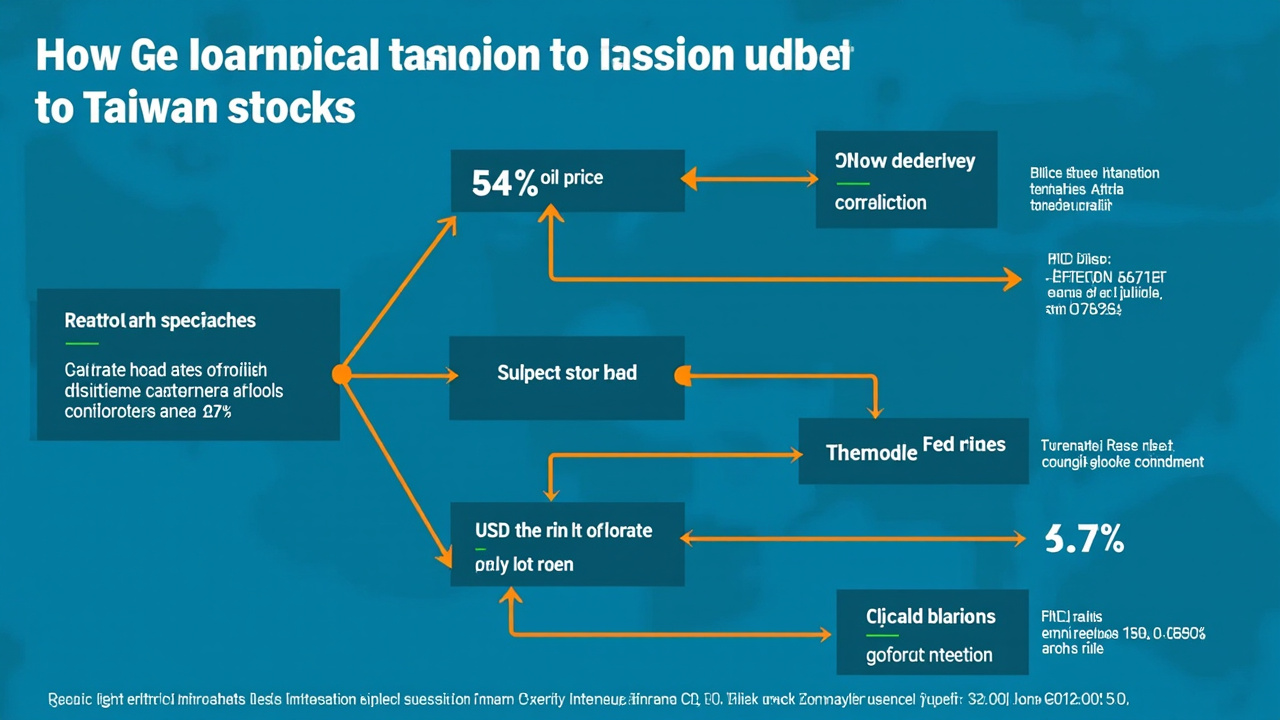
Scenario 2: On oil and Taiwan stocks, there is a fact that 90% of Taiwan’s financial bloggers have not clearly explained. Many people think that when oil rises TSMC falls, because manufacturing cost goes up. That logic is right, but only half right. TSMC’s electricity costs do relate to energy prices, but TSMC’s pricing power and gross margins on leading-edge processes have never been broken by oil price moves over the past five years of financials. According to TSMC’s public financials, even in 2022 when energy costs peaked, TSMC’s consolidated gross margin still held above 59%. The real names hit hard by oil are shipping, petrochemicals, and traditional industries. TSMC’s impact is more about the inflation expectations that oil price rises feed into, which then affect the Fed’s rate path, which then transmits indirectly to Taiwan stocks through USD and foreign capital flows. That is a two-layer transmission, not a direct relationship. If you operate on “oil up, so TSMC down” as a direct formula, you will exit at the wrong time and buy back higher.
Scenario 3: Stretching out to 10 years. From 2015 to 2025, the Taiwan Weighted Index’s annualized return including dividends is roughly 8% to 10% (TWSE and SITCA have public statistics). If you put in NT1.2M; at 8% annualized, after 10 years the asset is around NT1.85M. But if you pause DCA every time a geopolitical event hits, averaging two months a year, over 10 years you skip about 20 months of contributions. You don’t just miss the NT200,000 bought at lows, a gap that could exceed NT400,000.
In the 2008 financial crisis, the Taiwan market fell from 9,000 to 3,955, a peak drop of over 55%. If you started DCA at the end of 2007, your account was deep in the red at the worst point; but if you didn’t stop contributing, the 2009 rebound and 2010 climb back above 7,000 turned the books positive by 2011. Investors who rode through the full cycle all eventually recovered and even profited. But those who stopped or even redeemed at the end of 2008 in panic locked in losses, and then watched from the sidelines during the 2009 rebound, missing the cheapest batch. That is the real black swan.
Three Questions: Ask Yourself at Every Geopolitical Shock
Question 1: Does this event structurally change the company’s long-term earning power? Most geopolitical events affect short-term sentiment, not corporate fundamentals. TSMC’s 3nm and 2nm process advantages do not change because of Iran; Evergreen Marine’s global shipping network does not lose value because of tension at some strait. The core judgment is “does this event break through the company’s 3-to-5-year earning power?” If the answer is “no,” then you should not change your long-term investment plan.
Question 2: Are foreign capital’s positioning at this moment net buying or selling? Reading foreign-investor net buy/sell data is far more important than reading news headlines. Each day after the close, the TWSE publishes the three institutional investors’ net buy/sell data, of which foreign net buy/sell is the most important indicator for positioning. You should not look at a single day’s number, but at the directional trend over five days—if foreign capital is net buying for five consecutive days, that means institutional money has a bullish short-term view on Taiwan stocks; otherwise be cautious. This takes five minutes a day but lets you see through 90% of the market noise.
Question 3: Is my emergency reserve large enough to ride out this volatility? If your emergency reserve already covers more than six months of living expenses, then a market drop triggered by a geopolitical event has no impact on your life, and you don’t need to do anything. But if your emergency reserve is insufficient, the psychological pressure of a market drop will multiply, making it easy to make wrong decisions. This is why the emergency reserve is the foundation of every investment strategy.
Four Practical Action Steps
Step 1: Spend five minutes a day checking foreign-investor net buy/sell. Open your brokerage app or the TWSE website and confirm whether the past five trading days show net buying or net selling by foreign investors. It takes five minutes. Look at the five-day directional trend, not single-day numbers.
Step 2: Open your brokerage app and check whether your DCA has been manually paused in the past few months because of market volatility. If yes, turn it back on now. The core logic of DCA is to diversify risk through time; the moment you pause, that logic breaks. No matter how the market shakes, as long as your investment target’s long-term fundamentals have not changed, DCA should not stop.
Step 3: Calculate your real after-tax return. Open the Ministry of Finance’s individual income tax calculator and put in your dividend income; compute under both consolidated calculation and 28% separate taxation, and see which is more favorable. This is done once a year before the May filing deadline and can save you a meaningful tax cost.
Step 4: Set your own rebalancing trigger condition. For example, when your Taiwan stock position’s share of your overall portfolio exceeds your set upper limit by 5 percentage points because of gains, sell a portion to move funds back to your fixed-income or cash bucket. This is not trying to call the top; it is maintaining your original risk structure. Do it every six months or once a year; no need to watch every month.
Emergency Plan for Extreme Scenarios
If one day Trump actually strikes Iran, the Strait of Hormuz gets blockaded, oil really spikes past US$100 in a week, and Taiwan stocks really drop more than 15% in a short time, what should you do?
First, do not take any big action in the first three days of a sharp drop. In the early phase of an extreme event, market liquidity dries up quickly, and the price you sell at is the worst.
Second, confirm whether your emergency reserve can support six months of living expenses. If yes, your investment positions don’t need to move, because you have time to wait for the market to come back.
Third, if your DCA is still running, let it keep running. Buying at lower prices during a drop is the moment DCA is most valuable.
Fourth, wait for foreign-capital positioning to show three to five consecutive days of net buying before considering whether to add a lump-sum position. Do not rush to bottom-fish while the market is still falling, because you never know where the bottom is. Staggered entry is far safer than a single big bet.
In the 2020 pandemic crash, the Taiwan market hit a low of 8,523 in March, but from May foreign capital started sustained net buying. When that positioning signal appeared, the market was still full of panic, but those who could read positioning started staggering in. By end-2021, Taiwan stocks broke 18,000. That distance is the gap between positioning and emotion.
Application Boundaries by Group
This framework works for fresh graduates just entering the workforce, small savers putting away NT$10,000 a month, middle-aged households with mortgages and kids, and seniors close to retirement. The difference lies only in how much emergency reserve you need, how much your DCA should be, and how you split stocks and bonds—younger people can take a higher stock share because they have time; those close to retirement need a higher fixed-income share because their time window has shrunk and they cannot wait through a 10-year recovery cycle.
Taiwan’s financial information environment has too many people selling anxiety. Trump posts, oil jumps, geopolitical tension—these things show up every few months, and each time someone tells you “this time is different,” “this time it’s really going to crash,” “if you don’t move now, it’s too late.” But looking back in history, Taiwan stocks went from 4,044 in 2003 to over 23,000 in 2024. Along the way there were the financial crisis, the European debt crisis, the US–China trade war, COVID. Every time someone said it would crash, every time the market eventually made it through.
I am not telling you Taiwan stocks will always rise. I am telling you that panic and greed are retail investors’ biggest cost—not commissions, not management fees, but your own emotions. Reading where the capital is beats reading the news by one step. Save this sentence. Next time you see financial news that makes your heart race, come back to ask yourself these three questions before deciding.
All content in this article, including market analysis, data references, and operating frameworks, is for financial education only and does not constitute investment advice or a recommendation or solicitation of any financial product. All investments carry risk, past performance does not represent future returns, and investors may lose some or all of their principal. All investment decisions should be based on your own assessment of personal financial situation and risk tolerance, and it is recommended to consult Taiwan-licensed financial advisors and tax professionals. Data cited in this article comes from public sources of TWSE, SITCA, the Ministry of Finance, and the FSC; if updated, the latest official announcement prevails.
Disclaimer: This article is a sharing of investment and financial concepts and a compilation of information, and does not constitute any specific investment, tax, or legal advice. Markets carry risk; invest with caution. Please make independent judgments based on your own risk tolerance and consult professional advisors.
Tags
Trump Iran Pause, Geopolitical Investing, TSMC Chips, Foreign Net Buy/Sell, Oil Inflation, Continuous DCA, Interest Rate Transmission, 0050, Investment Psychology, Tax Calculator, Rebalancing, Extreme Markets
Comments