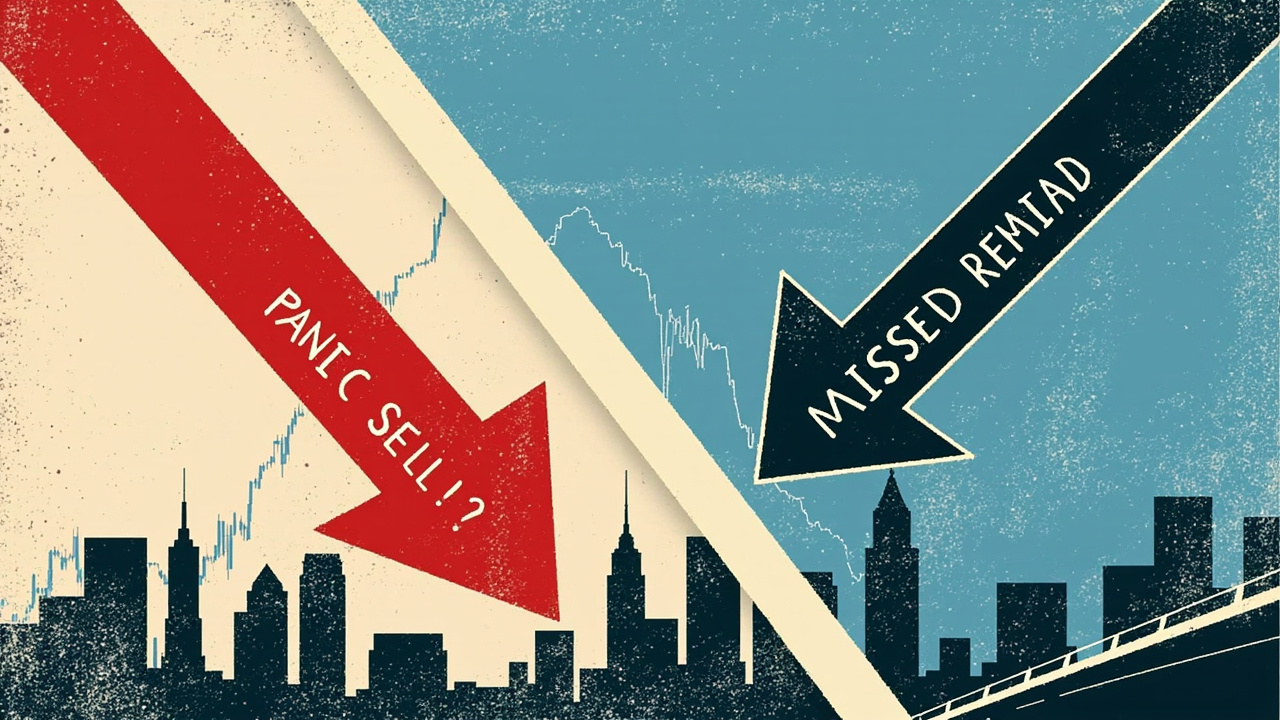
On the day of the crash, you press sell, and the account shrinks by NT$300,000 in an instant. You think you are protecting yourself, but you have just completed a wealth transfer — and the person who took your shares is smiling at the screen. This is the real script playing out in every market crash in Taiwan.
In March 2020, the Taiwan stock market collapsed from 12,197 to 8,523, retail investors net-sold more than NT200 billion go? Who took it? Deep down, you already know the answer. The problem is not that you are stupid — it is that you are using a decision-making framework that is guaranteed to fail in a crash, and that framework was built for you by strong money over decades.
A market crash does not destroy your wealth — it redistributes it, and the direction of distribution depends on the quality of your decision in that moment.
Why You Lose Money in Every Crash
Behavioral finance has a concept called ‘loss aversion.’ This was proven experimentally by Nobel laureate Daniel Kahneman and Amos Tversky: the psychological pain of a loss is twice the pleasure of an equal-sized gain. In plain language, the pain of losing NT20,000. This isn’t weakness — it is written into your DNA.
The problem is that strong money in the market knows this completely, and uses it against you.
One morning the board is full of limit-down stocks, your phone notifications won’t stop, someone in the group chat says it’s going to bottom out, someone says ‘this time it’s different,’ someone posts an analysis saying there’s more downside. You stare at the floating loss in your account, hands shaking, heart racing, and the only thought in your head is — sell first, wait for the bottom, then buy back. So you sell. Then the market rebounds. Then you wait and wait, can’t bring yourself to chase higher, and in the end you just sit and watch it rally back. How many times have you been through this script? Once? Three times? Or is every crash like this?
First Underlying Rule: Your Real Loss = Paper Loss + Missed Rally
In a crash, retail investors’ real loss is not the floating number you see — it is what happens after you turn that paper loss into a realized loss, plus the opportunity cost of the rally you miss. The two together are the full extent of your real loss. TWSE statistics show that from 2001 to 2023, for holding periods of more than one year on the Taiwan stock market, the probability of a positive return exceeds 70%, but the same data also shows that the actual returns of individual retail investors have long been far below the broad index — the core reason is wrong buy/sell timing decisions — sell on the way down, chase on the way up.
Let me show you with numbers: suppose in March 2020 near the TAIEX bottom you had NT1 million, had you not sold, would have grown to nearly NT$2 million by that point. What you saved by panic-selling was just the last few percentage points of the down move, but what you paid was the entire rebound.
Second Underlying Rule: The Rebound Is Always Faster Than You Expect
Long-term data from SITCA shows that since the 1990s, every time the Taiwan Weighted Index has dropped more than 20%, a significant rebound has followed within the next 12 months — without exception. But the problem is that during every crash, the market is flooded with voices saying ‘this time it’s different’ and ‘there’s more downside,’ and those voices are almost always wrong in hindsight.
Why do retail investors fall for it every time? Because during the down move, the bearish analysis sounds the most convincing, the most logically complete, and has the most terrifying data. This is no accident — in moments of panic, pessimistic voices have a natural distribution advantage, because they match your current emotional state. In fear, you actively seek out information that supports selling (this is called ‘confirmation bias’), and strong money knows this, so they take your order while you panic-sell.
In the 2008 global financial crisis, the Taiwan Weighted Index fell from a high of 9,859 to a low of 3,955, a drop of nearly 60%. If you sold out of fear near 4,500, thinking you had successfully avoided the risk — by the end of 2009 the Taiwan market had recovered to around 8,000, and in 2010 it kept climbing. You sold at 4,500 and only dared to buy back at 7,000 — your loss is not that you avoided risk, it is that you sold at the low and bought at the high, losing on both ends.
Third Underlying Rule: The People Telling You to Stop-Loss May Not Have Your Interests in Mind
During a market crash, some of the advice telling you to cut losses, hold cash, and wait for an opportunity does not fully align with your interests. A portion of Taiwan’s financial institutions’ revenue is tied to your trading frequency — brokerage, trading commissions, fund subscription fees are all generated when you buy and sell.
Every time you buy back, you pay nearly 5% in costs. A round-trip on a NT50,000. You sell in a crash waiting to buy back on the rebound, and you end up paying an extra NT$50,000 in trading costs to your broker, and most likely sell at a relative low and buy at a relative high. That is a double loss.
Four Investment Iron Rules
Rule 1: Volatility you cannot stomach is your real risk. Not the number on the screen — it is whether you can continue to live normally under that drawdown, without it affecting your sleep. If the losses keep you up at night, your equity allocation must be reduced.
Rule 2: The money you invest must be one you are certain you will not need within five years. If you plan to buy a house in three years, that down payment cannot be in the market, because the market may be at a low exactly when you need the money, and you will be forced to sell at a loss — that is the worst outcome.

Rule 3: The target you invest in must be something you truly understand. If you bought a stock whose financials you can’t read, whose industry you don’t understand, and which someone just told you would go up, when a crash hits you have no way to judge whether to add or exit, because you have no basis for the decision. For most retail investors, index funds are a more suitable choice, because you are buying the whole market and don’t need to judge individual companies.
Rule 4: You must have an investment plan set before you buy. Including how long you intend to hold, under what conditions you will sell, and what you will do with the money afterward. If you don’t have a plan, every decision in a crash will be an emotional reaction, not strategy execution.
Four Action Steps
Step 1: Open your bank or brokerage account and split your current assets into three buckets. The first bucket is 3–6 months of living expenses as an emergency reserve, kept in a savings account or money market fund. Online savings rates in Taiwan are around 1.5% to 2%, or you can use money market funds offered by investment trust companies — high liquidity, low risk. The second bucket is money you are certain you will use within three years (down payment, children’s education), which should be in low-volatility instruments, not all in the stock market. The third bucket is your long-term investment position, and this is the money you should consider holding — or even adding to — during a crash.
Step 2: Open your brokerage account, look at your current holdings or funds, and ask yourself one question: ‘Was this position bought with money from the third bucket?’ If not, you need to rebalance your allocation so that your long-term investment position uses only third-bucket money. This step is important because it determines whether you will have the mental space to avoid bad decisions during a crash.
Step 3: If you haven’t started a DCA plan yet, go to an investment trust company or a bank fund platform right now and set up a DCA into a TAIEX index fund or a total market ETF. Set the amount to 10%–20% of your monthly income, and pick a level that you won’t be tempted to stop contributing because of market volatility. The core logic of DCA is to use time to diversify your entry points, automatically buying more during crashes, without you having to guess where the bottom is.
Step 4: Write down your investment plan. One sheet of paper is enough. Write down three things — how long you plan to hold this money; under what conditions you will sell (need the money or a fundamental change in the target’s underlying business); if the market falls 30%, what is the dollar loss, and can you continue to live normally? Put this paper somewhere you can see at any time. Next time the market crashes, read this paper before making any decision.
Two Taiwan-Specific Advanced Traps
The first: The hidden trap of ‘pausing’ your DCA. Many people choose to pause their DCA during a crash with the reasoning ‘wait for it to finish falling, then resume,’ but according to SITCA data, people who pause their DCA during drawdowns of more than 20% and only resume after a 15%+ rally end up with a higher average cost over the long term than those who never stopped. The reason is simple: the time you stop contributing is exactly when you would have bought the cheapest units. The most panicked moment in the market is exactly when DCA is most effective.

The second: Taiwan’s voluntary labor pension mechanism. According to the Ministry of Labor, on top of the mandatory contribution workers can voluntarily contribute up to an additional 6% of salary into their personal labor pension account, and this voluntary amount is tax-deductible. More importantly, the Labor Pension Fund is managed by professional institutions commissioned by the Ministry of Labor, with an annual guaranteed minimum return (two-year time deposit rate), and the fund’s actual long-term returns are typically above the guaranteed rate. The core advantage of this tool is that it forces you to save, diversifies your entry timing, and has tax benefits. During a crash, you don’t need to look at it at all, because you can’t even see the daily NAV moves — which actually protects you from emotional decision-making. If you haven’t activated your voluntary labor pension contribution, go to your HR department and ask right now. It is one of Taiwan’s office workers’ most underutilized long-term wealth tools.
Extreme-Scenario Contingency Plan
If the market experiences an extreme situation like the 2008 global financial crisis with a drawdown exceeding 50%: first, confirm that bucket 1 and bucket 2 are safe — the emergency reserve and near-term money are not exposed to high-risk assets. If the paper loss in bucket 3 doesn’t affect your daily life, you have the ability to hold and wait for recovery. Second, during the extreme decline do not make any large-scale allocation adjustments — don’t sell everything, don’t borrow to add. The most rational thing is to keep executing your original DCA plan. Third, if your financial situation is under real cash flow pressure (job loss, major medical expenses), prioritize protecting cash flow; asset allocation optimization is secondary.
Taiwan stock historical data shows that since 1990, every drawdown exceeding 40% has eventually recovered and exceeded its prior high within a few years, but the recovery period has ranged from one to seven years. After 2008, the recovery period was about three to four years. This tells you: if your holding period is long enough, extreme drawdowns can be healed by time, but only if your capital allocation allows you to endure the wait.
This article is for financial education only and does not constitute any investment advice. Data cited is from public sources including the Taiwan Stock Exchange, SITCA, the Ministry of Labor, and the FSC, for reference only. Investors should evaluate based on their personal financial situation and risk tolerance, and are advised to consult a Taiwan-licensed financial advisor and tax professional. All investments carry risk, past performance is no guarantee of future returns, and investors may lose part or all of their principal.
Disclaimer: This article shares investment and financial concepts and compiled data only. It does not constitute any specific investment, tax, or legal advice. Markets carry risk, invest with caution, and please use your own judgment based on your personal risk tolerance and consult a professional advisor.
Tags
Retail Psychology, Loss Aversion, Crash Discipline, Continuous DCA, Voluntary Pension Contribution, Emergency Reserve, Three-Bucket Allocation, Behavioral Finance, Rebalancing, Kahneman, TAIEX Drawdowns, Investing Rules
Comments