
90% of Retail Investors Lose Because They Cannot Let Go: The Wealthy “Lock-In and Double” Batch Profit-Taking Method
You made NT$300,000 on paper and ended up with nothing—has this ever happened to you?
You stare at the uptrend candlesticks, heart racing, finger hovering over the mouse, an inner voice saying “just a bit more, just a bit more”—then the price reverses, your NT100,000 and then into loss. You tell yourself “wait for it to come back,” and then it never does.
This is not an isolated case. This is the standard script of 90% of Taiwanese retail investors.
TWSE data shows that Taiwan retail investors’ annual turnover ratio is far higher than institutional investors, but retail investors’ overall returns lag the broader index over the long term. The problem is not that you pick stocks poorly; the problem is that you don’t know how to sell. Buying stocks, many people manage. But selling stocks is the core that decides whether you ultimately put the money in your pocket.
Paper profit is not your money; locking it in is what counts. Locking it in takes discipline, not luck.
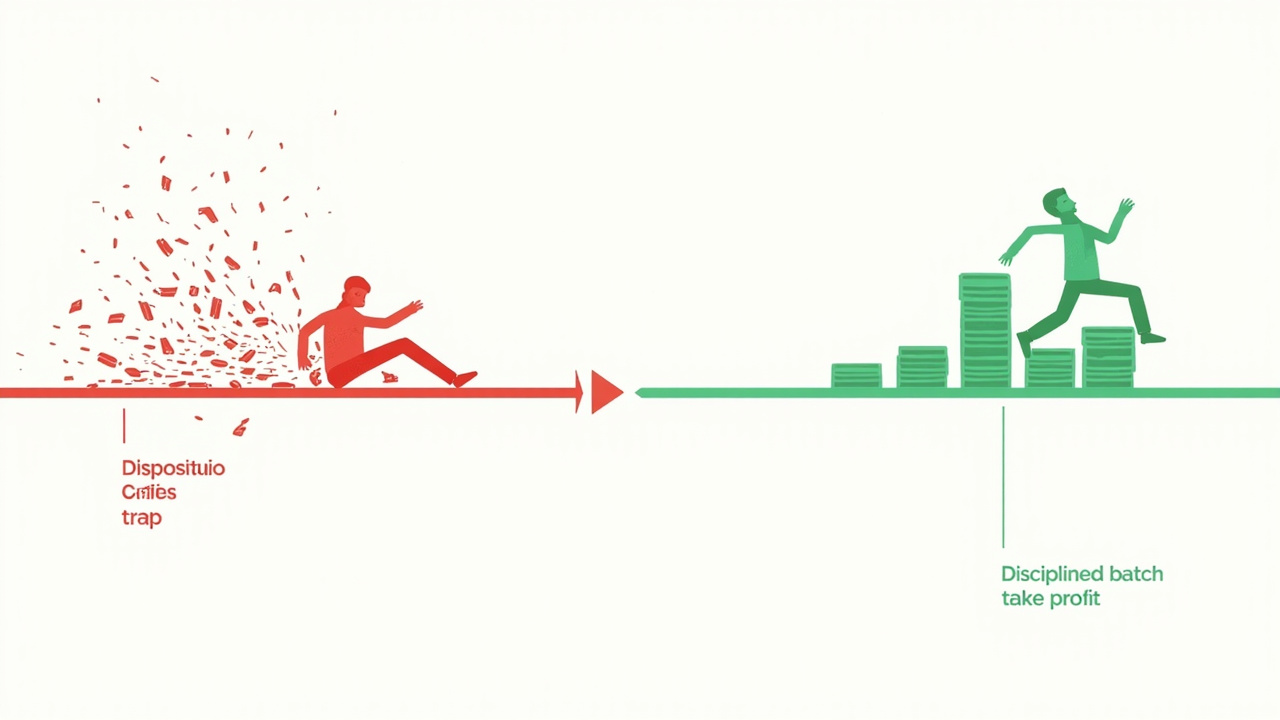
First Underlying Rule: The Disposition Effect Makes You Sell Winners Too Early and Hold Losers Forever
You think you don’t want to sell because you have confidence in the stock, but the truth is—you don’t want to sell because you are running from the fear of being wrong by selling.
This is a phenomenon with extensive empirical research support in behavioral finance, called the disposition effect. In short: people tend to sell winners too early and cling to losers too long. Academic research in Taiwan has reached the same conclusion—Taiwanese retail investors sell at higher rates than institutions when sitting on paper gains, but cut their selling rate sharply when in paper losses.
Sounds counter-intuitive, right? You think you hold winners too long because you are greedy, but research says—most retail investors actually sell winners too early and cling to losers too long. And those people who do hold winners until a NT$300,000 gain shrinks to zero, the problem is they had no pre-set profit-taking mechanism and were making decisions on emotion alone.
Without a take-profit plan, gains are just numbers temporarily stored in your account.
Let me show the math: suppose you bought one lot of TSMC at NT550, giving you a paper gain of NT450, leaving NT550. Then it kept falling to NT$390—your gain was almost wiped out.
But if you had a batch profit-taking plan and sold half at NT60,000 of profit, with the rest still held—even if it later fell to NT$390, your overall result would still be positive.
Second Underlying Rule: Taiwan’s Information Environment Naturally Encourages You to Hold
Some of Taiwan retail investors’ profit-taking困境 has been bred by the market information environment. Every day you open the financial news and see headlines about which stock hit the daily limit, which guru’s position doubled, which foreign investor is buying heavily—you almost never see anyone discussing “I sold today, I executed my take-profit plan, I locked in my gain”.
Why? Because selling is not news; holding is the story. Taiwan’s financial media ecosystem naturally encourages you to hold, wait, and expect higher target prices—analyst reports’ target prices are always higher than current prices. This is not a conspiracy; it is the inevitable result of a business model: an analyst’s job is to keep you watching the stock, not to help you calculate when to lock in.
According to SITCA data, the long-term performance of self-directed Taiwanese retail investors as a whole lags behind DCA index funds, partly because retail investors have no systematic take-profit mechanism at the high, and panic-sell at the low, resulting in a buy-high-sell-low pattern that returns all the gain they could have made back to the market.
Taking profit is not a personal willpower issue. The entire market environment simply does not give you the right tools and concepts—this is the collective predicament of Taiwan’s retail investors, not just your individual failure.
Third Underlying Rule: The Wealthy Are Better at Letting Go of the Uncertain Upside
The wealthy are not wealthy because they are more ruthless; on the contrary, the wealthy grow their wealth because they are better at letting go of the uncertain upside and locking in the certain gain first.
The math behind this is simple: suppose you have NT300,000 gain, for NT1.3M stays exposed to market risk, and you need the market to keep rising to preserve the gain**. But if you lock in the NT300,000 is no longer subject to market swings**, and you can redeploy it—into the next investment decision, or keep it as ammunition for the next correction.
The real logic of the wealthy “lock-in and double” is not about one big bet paying off; it is about locking in certain gains each time and letting that locked-in capital continue compounding.
Three Scenarios: Without, With, and 20-Year Gap
Scenario 1 (Retail investor without a take-profit plan): Around the 2021 Taiwan market peak of 18,000 points, you put NT150,000–200,000 of paper gain (asset NT500,000 was fully exposed to that drawdown, your paper assets shrank to about NT$350,000**—you didn’t just lose the gain, your principal also lost 30%. From the 2022 low, the longest recovery cycle meant you had to wait until the index returned to your entry cost; for some individual stocks, that took over two years.
Scenario 2 (Executing a batch profit-taking plan): Same NT33,000; at 30% paper gain you sold another 1/3 to lock in about NT100,000 locked in, with principal fully preserved**.
But the precondition is: you need enough discipline at 20% paper gain to actually hit the sell button; you need to accept that you may miss the rest of the upside; you need to bear the psychological pressure of selling and watching the stock keep rising—these are real execution difficulties.
Scenario 3 (20-year compounding gap): Each year operating with NT$500,000 of Taiwan stock principal—those with a take-profit plan lock in an average 8–10% of real annual take-profit returns; retail investors without a plan, based on Taiwan academic estimates, after deducting trading costs and behavioral drag, often achieve only about 60–70% of the broader index’s return over the long term. After 20 years, this gap gets compounded to a heartbreaking number.
The worst-case in extreme scenarios must also be stated: in a 2008-style systemic crash (over 50% peak drop in a single year), even with a batch take-profit plan, if your stop-loss is not strict enough, or if you start batch buying halfway down the mountain, you may still face a 30–40% paper loss. A take-profit plan is not all-powerful—it can systematically lock in gains in normal markets, but it cannot fully protect your principal in extreme crashes.
The One-Third Take-Profit Method: A Universal Decision Framework
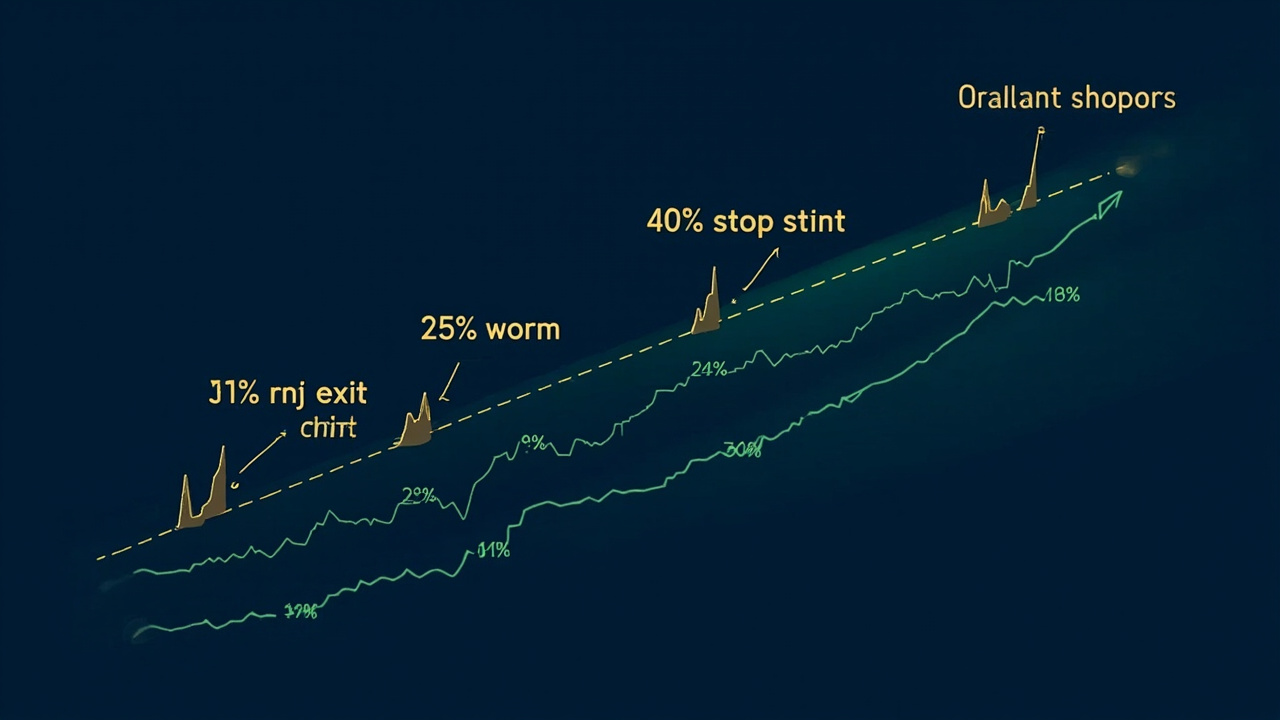
The standard definition used by Taiwan’s financial regulators and academia is: the investor pre-sets multiple profit-taking target prices, and sells shares in batches as the price reaches each target, to reduce the timing-selection risk of a single sale and to lock in paper gains in stages.
In plain language: don’t bet on a single peak. Spread your profit-taking actions across several steps, sell a portion each time it rises—then even if you don’t sell at the high, you lock in some real profit.
Specific operation (three tranches):
- First tranche—sell when the paper gain reaches your preset first target (e.g. 20%). The function is to confirm the investment is working and lock in the first bucket of profit.
- Second tranche—sell when the paper gain reaches the second target (e.g. 40%). The function is to let you participate in the middle leg of the rally.
- Third tranche—set a trailing stop that follows the price up, but exits once the price falls more than the set amount from the high (e.g. a 15% drop from the high). The function is to let you participate in the later leg while not returning all the earlier gains.
The applicable precondition is that you already have paper gains, you are uncertain about the outlook, and you want to participate in further upside while protecting existing gains. The failure scenario is a long sustained bull market—batch profit-taking will pull you out early and you miss the later upside. That is the cost; you have to accept it.
Application Boundaries by Group
Fresh graduates just entering the workforce: Limited capital, the focus is not take-profit but first building the DCA habit, treating Taiwan broad-market ETFs as the core position. Start executing the take-profit framework only when your paper gain exceeds one month’s salary; before that, focus on building positions.
Office workers with families: Mortgage, children’s education expenses, the discipline on take-profit needs to be stricter. Set your first take-profit target not too high; trigger the first sale at 15–20% gain—you cannot afford the double hit of paper wealth evaporating and the financial fallout.
Middle-aged investors with assets: The priority is protecting existing wealth, not chasing maximum return. The third tranche’s trailing stop should be set tighter; consider exiting on a 10% pullback from the high—do not let a large paper gain shrink by more than half before reacting.
Seniors close to retirement: Capital no longer has enough time to wait for recovery. Any paper loss exceeding 20% of principal is hard to repair before retirement; consider a more conservative Taiwan equity allocation, and allocate the proceeds from take-profit to lower-volatility products, not continued all-in on individual stocks.
4 Veto Rules
- Before buying any stock or ETF, you must first set your take-profit target and stop-loss line—not think about it after buying, write it down before buying. Deciding your take-profit target after buying is called hindsight, not a plan.
- Take-profit selling must execute when the price actually hits the target—you cannot change the plan temporarily because the news says more upside is coming. If the plan itself is flawed, fix the plan, do not override the plan with gut feel at the moment of execution.
- The stop-loss line must be a number you will actually execute—not a psychological comfort written on paper. Anyone holding a Taiwan stock for over 3 years with a paper loss exceeding 30% still waiting to break even—your stop-loss should have triggered long ago—you must clearly explain why you keep holding.
- Locked-in profits must have a pre-planned destination—you cannot lock in profits and immediately jump into another hot stock. The point of taking profit is to give your capital a chance to redeploy, not to use the gain as ammo for the next speculation. If you know you will not be able to resist buying again immediately after taking profit, transfer the locked-in capital to a separate account for physical separation.
4 Practical Action Steps
Step 1: Audit your current positions. Open your brokerage app and list every position you currently hold, recording your entry cost—you need to know the paper P&L for each position; this is the starting point for all subsequent actions. This can be done in under 5 minutes.
Step 2: Write down three numbers for each position. On a piece of paper or in your phone’s notes—first take-profit target price, second take-profit target price, stop-loss line. Target prices can reference entry cost × 1.2 and × 1.4 (20% and 40% gains); the stop-loss can be set at 85% of entry cost (exit on a 15% loss). These numbers are not absolute standards; you can adjust them to your risk tolerance, but you must have a specific number, not a vague feeling.
Step 3: Set up price alerts. Major Taiwan brokers’ apps (Yuanta, Fubon, Cathay, etc.) all have price-triggered alerts. Set all the target prices and stop-loss lines from Step 2 as app alerts—then you don’t need to watch the market daily; the system will notify you when the price hits. Once you receive an alert, your task is to execute the plan, not to think about whether to sell.
Step 4: Quarterly health check. Open your trading records and see how many times in the past 3 months you executed take-profit as planned, and how many times emotion overrode the plan. Write down the reasons for not following the plan—was the plan itself unreasonable, or were you swayed by the news? The purpose of this check is not to punish yourself, but to make your plan increasingly aligned with your own mindset and style.

2 High-Level Details 90% of Taiwan’s Bloggers Don’t Cover
Detail 1: Tax timing of profit-taking on individual stocks. Many people know Taiwan currently levies a securities transaction tax (1.5‰ on each side for buy and sell), but regarding dividend income and the reinvestment of locked-in capital, many people have not fully calculated the tax cost. Especially if you hold both high-dividend ETFs and individual stocks, the timing of your take-profit relative to the ex-dividend date affects how your dividend income is taxed. According to the Ministry of Finance, dividend income can be combined with consolidated income or taxed separately (28% separate tax); the tax calculation result varies by person—after a large profit-taking event, it is recommended to run the numbers with a Taiwan-licensed tax advisor. Do not let tax issues eat into your profit-taking gains.
Detail 2: Taiwan ETF profit-taking logic is fundamentally different from individual stocks. Many people apply individual stock take-profit frameworks directly to Taiwan ETFs, which is a common mistake. Individual stocks carry fundamental change risk, so you need take-profit and stop-loss mechanisms to protect yourself. But Taiwan broad-market ETFs (such as 0050, tracking Taiwan’s top 50) are backed by Taiwan’s 50 largest companies; they will not go to zero, and the long-term trend follows Taiwan’s overall economy. For these, overly aggressive take-profit can actually leave you without a position when the market rebounds after a correction.
The correct operating logic for Taiwan ETFs is closer to high-low rebalancing—when your position’s share of your portfolio exceeds your target allocation because of gains, sell the excess to bring the share back. Not setting a hard “sell at 20% gain” target. The difference between these two logics is one of the most common confusions for retail investors with 1–3 years of experience.
Emergency Plan for Extreme Market Conditions
If you face a sharp drop with Taiwan stocks down more than 5% in a day or falling for two consecutive weeks—the first action is not to immediately cut losses, but to confirm whether this is a systemic risk or a single-stock risk.
If the entire Taiwan market is falling, your broad-market ETF position can stay put, because historically every systemic correction in Taiwan has recovered, as long as you hold a broad-market ETF. But if a specific stock you hold has a fundamental problem (earnings far below expectations, major customer loss, structural industry change), your stop-loss must execute, do not continue holding with a “wait for it to come back” mindset.
If you face a year-long bear market—once paper gains are gone, switch the batch profit-taking plan into stop-loss mode. At that point you need to ask yourself one question: “If I were seeing this stock for the first time today, would I buy it at this price?” If the answer is no, the only reason you keep holding is unwillingness to let go—and unwillingness is the most expensive investing emotion.
If you are currently sitting on a paper loss from buying halfway up the mountain, the best thing you can do is re-evaluate the position’s fundamentals, set a stop-loss line you will actually execute, then accept the lesson. Use this tuition to gain the ability to operate with a plan in the future. Sunk cost is not a reason to keep holding.
Universal Decision Tips
When you are unsure whether to sell, first ask yourself: “If this money were cash, would I buy in at today’s price?” If the answer is no, you should seriously consider selling.
This is not a framework that lets you sell at the top every time; it is a framework that ensures you never return all your gains to the market—that gap is the difference between retail investors and the wealthy.
Buying stocks tests your eye; selling stocks tests your discipline. Discipline can be trained, as long as you have a framework and actually execute it.
All content in this article, including concept analysis, operating frameworks, and account comparisons, is for financial education only and does not constitute investment advice or recommendation for any stock, fund, or financial product, nor any form of buy-sell recommendation. All investments carry risk; past market performance is no guarantee of future results, and investors may lose some or all of their principal. All numbers and cases in the video are illustrative for educational purposes, not precise predictions. Before making any investment decision, please fully assess your personal financial situation and risk tolerance, and consult a Taiwan-licensed financial advisor and tax professional. All financial products mentioned in the video are FSC-approved compliant products; no unapproved product is recommended.
Disclaimer: This article is a sharing of investment and financial concepts and a compilation of information, and does not constitute any specific investment, tax, or legal advice. Markets carry risk; invest with caution. Please make independent judgments based on your own risk tolerance and consult professional advisors.
Tags
Disposition Effect, Pocket the Gains, Staged Profit-Taking, One-Third Profit-Taking, Trailing Stop, Behavioral Finance, TWSE Data, 0050 Rebalancing, Disposition Effect Taiwan, Securities Transaction Tax, Tax After Profit-Taking, Sunk Cost, Investment Discipline, Paper Gains
Comments