
You collect a distribution every month, your account balance grows, you think you’re making money — but your retirement is quietly being stolen.
This isn’t scaremongering. You watch the distribution land each month, feeling secure, telling yourself this beats a time deposit, that you’ve finally found a steady way to make money. But have you actually counted: how much of what you receive is genuine portfolio profit? How much is your own principal being paid back to you under a different name? How much is propped up by a mechanism called the “stabilization fund” that uses other people’s money to keep that distribution number pretty?
The three words “stabilization fund” won’t show up in fund-company ads. Salespeople will never bring it up voluntarily. But it sits quietly in the prospectus of the high-dividend ETF you bought, operating perfectly legally, eroding what you think is steadily growing retirement savings.
Core one-liner: a stable distribution rate doesn’t mean you’re making money — it only means the fund company has a way to keep you on board.
A Scene You Definitely Recognize
Your coworkers, your neighbors, your parents, maybe even you — in 2022–2023 you saw ads for high-dividend ETFs like 0056, 00878, 00919 blanketing everything. Salespeople said the annual distribution rate was 6%–7%, far better than time deposits, and you’re investing in big Taiwan companies — very stable. So you bought.
Every month or quarter you saw the distribution land, it felt tangible, it felt like passive income, it felt like retirement planning was done.
But have you thought about this? When the market crashed in 2022, when the Taiwan index dropped from 18,000 to 12,000 points, how did those high-dividend ETFs keep their distribution rate so high? The constituent stocks’ dividend income clearly shrank — so why didn’t the ETF’s distribution fall proportionally?
The answer behind this is the stabilization fund.
The Underlying Logic of the Stabilization Fund
Per FSC regulations, an ETF may set aside part of its earnings or assets as a “distribution equalization reserve,” intended to top up distributions when distribution sources fall short, keeping each period’s distribution amount relatively stable and avoiding large distribution volatility.
In plain language: when the fund doesn’t earn enough to distribute, it pulls from previously saved reserves to top it up, so the distribution number you see stays pretty. Sounds fine, right? What’s wrong with stable distributions?
The problem is this. The source of the stabilization reserve includes the fund’s own assets — meaning in some cases, part of what you receive as “distribution” is really your own principal being carved out and returned to you under a different name. Legally, this is called “return of principal.”
SITCA’s rules clearly state: distribution sources may include principal, and fund companies must disclose this in the prospectus. But the last time you bought an ETF, did you flip through the prospectus? Did you read the distribution-source disclosure?
First underlying rule: a high distribution rate doesn’t equal a high return rate. From the distribution you receive, you must subtract the principal portion — that’s the money you actually made. If your principal drops from NT900,000, but you received NT60,000 — you lost NT$40,000. This isn’t to scare you — it’s basic math.
The day a distribution lands isn’t the day you made money — it’s the day you confirm whether you made money.
Treating High-Dividend ETFs Like a Time Deposit Is the Biggest Cognitive Error
A time deposit’s principal doesn’t shrink, but an ETF’s principal can. That is the biggest cognitive error of treating a high-dividend ETF like a time deposit.
Park NT1 million back plus interest — your total assets have zero shrinkage risk. Put NT850,000, and during the period you’ve collected NT$180,000 in distributions.
How do you view this investment? You might think “NT850,000 = total NT30,000” — but that’s a dangerous calculation. If you’d parked NT1,045,000 (at 1.5% annualized). In other words, your high-dividend ETF result is NT$20,000 worse than the time deposit.
This is the hidden loss of seeing distributions without seeing principal erosion.
3 Calculation Sets: Wrong vs Right
Set 1: The Real Loss of the Wrong Approach
Suppose you put all NT1 million, and you’ve collected about NT1,120,000–1,140,000, looks like profit.**
But if during the down-leg you panic-sold, or sold after ex-dividend when rights didn’t fully fill, your actual loss could be 10%–20%. This is the biggest risk of treating a high-dividend ETF like a time deposit — you think you’re steadily collecting distributions, but when the market crashes and you panic-sell, that trade gives back all the distributions you collected.
Set 2: The Return of the Right Approach
The right approach isn’t to not buy high-dividend ETFs — it’s to use the right mindset and the right method. If you split NT700,000 in a broad-market ETF (such as 0050) and NT$300,000 in a high-dividend ETF — then set annual rebalancing, looking at total return rather than distribution rate, then from 2022 to 2024 as the Taiwan index recovered from 12,000 to over 22,000 points, your total return will materially beat the pure high-dividend-ETF allocation.
This result requires you to ride out the 2022 drop without panic-selling, hold through 2023, and have the discipline to rebalance. How many of those three conditions can ordinary people meet? This is why the right strategy plus wrong execution still loses money.
Set 3: The Worst-Case Extreme Black-Swan Scenario
In 2008 the financial crisis saw the Taiwan index drop over 50% from its peak. If you had put NT900,000 — even at 6% annual distributions, you’d need about 7 to 10 years to return to your starting principal, and only if the market kept recovering and you kept holding without selling.
The 2020 pandemic shock saw the Taiwan index drop more than 30% in a single month. Those who bought in January 2020 saw paper losses over 30% — distributions couldn’t make up for it. High-dividend ETFs are not principal-protected — that is a fact you must engrave into your brain.
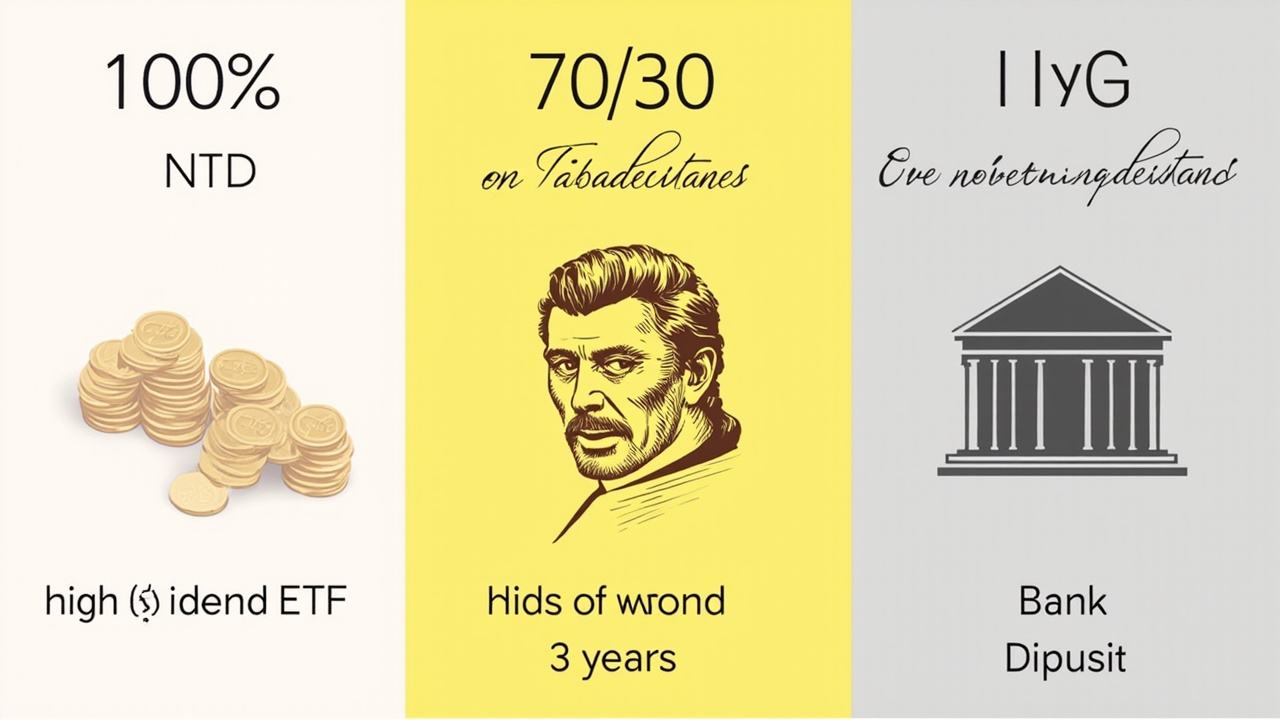
2 Taiwan-Local Advanced Traps to Avoid
Trap 1: Disclosure of the Ratio Between Earnings Equalization Reserve and Return of Principal
Per FSC rules, ETF companies must disclose the composition of distribution sources at each distribution. You can find this data on the fund company’s website or SITCA’s Fund Information Observation Station. But many investors don’t know how to look, or don’t know to look.
You can open SITCA’s fund-rating site right now, find your ETF, click into the distribution-source disclosure. If it shows a certain percentage from earnings equalization reserve or return of principal, you need to seriously consider how much of what you received is real investment profit and how much is just left-hand-to-right-hand shuffling.
Most people don’t know this lookup, but the information is fully public — you can check it right now.
Trap 2: The Second-Generation NHI Supplementary Premium on High-Dividend ETFs
Per Ministry of Health and Welfare rules, **financial income from a single distribution exceeding NT20,000, paying thousands to tens of thousands in supplementary premium per year. This hidden cost has never been counted into the distribution-rate calculation.
For example, holding NT180,000 a year, and the second-generation NHI supplementary premium is roughly NT$3,800. Doesn’t sound like much, but it’s an extra layer of cost on top of management fees.
4 Veto Iron Rules
- If your emergency reserve is less than 6 months of expenses, you cannot treat a high-dividend ETF as a time deposit. ETF NAV fluctuates, and when you need money you may be at a low point and forced to sell at a loss. That’s not a time deposit — that’s gambling.
- If your investment horizon is less than 5 years, you shouldn’t use a high-dividend ETF as a time-deposit substitute. Short-term capital needs within 5 years should prioritize principal safety and go into time deposits or short-term bond funds.
- If you can’t stomach 30%+ principal shrinkage without selling, you shouldn’t use a large position in a high-dividend ETF as your retirement core. In 2022 many cut at -20% and missed the 2023 rebound. If your psychological tolerance is limited, your position must be within a range that lets you sleep.
- If you haven’t read the prospectus of the ETF you hold, don’t add to your position before you do. The prospectus contains distribution-source disclosure, stabilization-fund mechanism, and fee structure — these are the basic information for making decisions. Adding without reading is blind.
4 Action Steps
- Open the SITCA fund-rating website, search for the high-dividend ETF you currently hold, find the distribution-source disclosure for the most recent three distributions, confirm what percentage comes from return of principal or earnings equalization reserve. If that percentage exceeds 30%, you need to seriously reassess what this product means to you.
- Open your brokerage account, total all distributions received since you bought this ETF, then compare your current NAV with your original purchase NAV — calculate your real total return rate. That’s the number that tells you whether you really made or lost money, not the distribution-rate number.
- Reset your reference allocation by life stage: young people just starting out, with investment horizons over 20 years, can tolerate volatility — high-dividend ETFs can make up 20%–30% of the portfolio, but the core should be broad-market ETFs; 40–50 year-olds can use high-dividend ETFs at 30%–40% as cash-flow supplement; 55+ near-retirees face the most impact from high-dividend ETF principal volatility, so cap the position under 20%.
- Set an annual rebalancing checkpoint, ideally January or July each year. Open your account and check whether your overall portfolio’s asset-class proportions have drifted from target.
Extreme-Market Contingency Plan
If the Taiwan index drops over 20% in a short period and your high-dividend ETF paper loss expands, the first thing to do is check whether your emergency reserve is enough. If it is, don’t touch your ETF position — selling turns paper loss into actual loss.
Second, stop looking at the numbers in your account — frequent checking only leads to emotional bad decisions. Third, go back to your original purpose in buying this ETF — if the purpose was long-term retirement planning, a short-term drop doesn’t change the purpose, and your actions shouldn’t either.
If your living funds come under pressure before the market drops over 30%, what you should do is use your emergency reserve — not sell the ETF. That’s why emergency reserve is the prerequisite of every investment strategy.
Final Words
Before buying any financial product, ask yourself three questions: how does it make money? How does it lose money? Under what circumstances will it make me lose the most? If you can answer all three, buy; if you can’t, hold off.
High-dividend ETFs aren’t bad — they’re a legal and compliant financial tool. In the right usage scenario they can help you build retirement cash flow and maintain confidence in holding through market volatility. But they’re not time deposits, they’re not principal-protected, their distribution sources need to be checked by you, their real return needs to be calculated by you, and their stabilization-fund mechanism needs to be understood by you.
No one will tell you these things proactively, because telling you doesn’t benefit them — salespeople are evaluated on sales volume, fund companies’ revenue is management-fee scale. This interest structure means they won’t actively put the information most adverse to sales in the most visible place.
This isn’t saying they’re bad people — it just means you must take responsibility for your own money.
All content in this article is for financial education only and does not constitute investment advice or recommendation. All numbers and cases are for illustration only and do not represent any specific financial product’s future performance guarantee. Investing carries risk; ETF NAV and distributions fluctuate with market conditions; past performance does not guarantee future results. Please evaluate based on your personal financial situation, risk tolerance, and investment goals before making any investment decision, and consult a Taiwan-licensed financial advisor and tax professional. This channel does not engage in discretionary trading or investment-advisory services.
Disclaimer: This article is for the purpose of sharing investment and financial-planning concepts and compiled data, and does not constitute any specific investment, tax, or legal advice. Markets carry risk; invest prudently. Make your own judgment based on your personal risk tolerance and consult a professional advisor.
Tags
High Dividend ETF, Stabilization Reserve, Distribution Trap, 0056, 00878, 00919, Principal Return, Total Return, NHI Supplementary Premium, Retirement Money, Distribution Source, Investment-Linked Policy
Comments