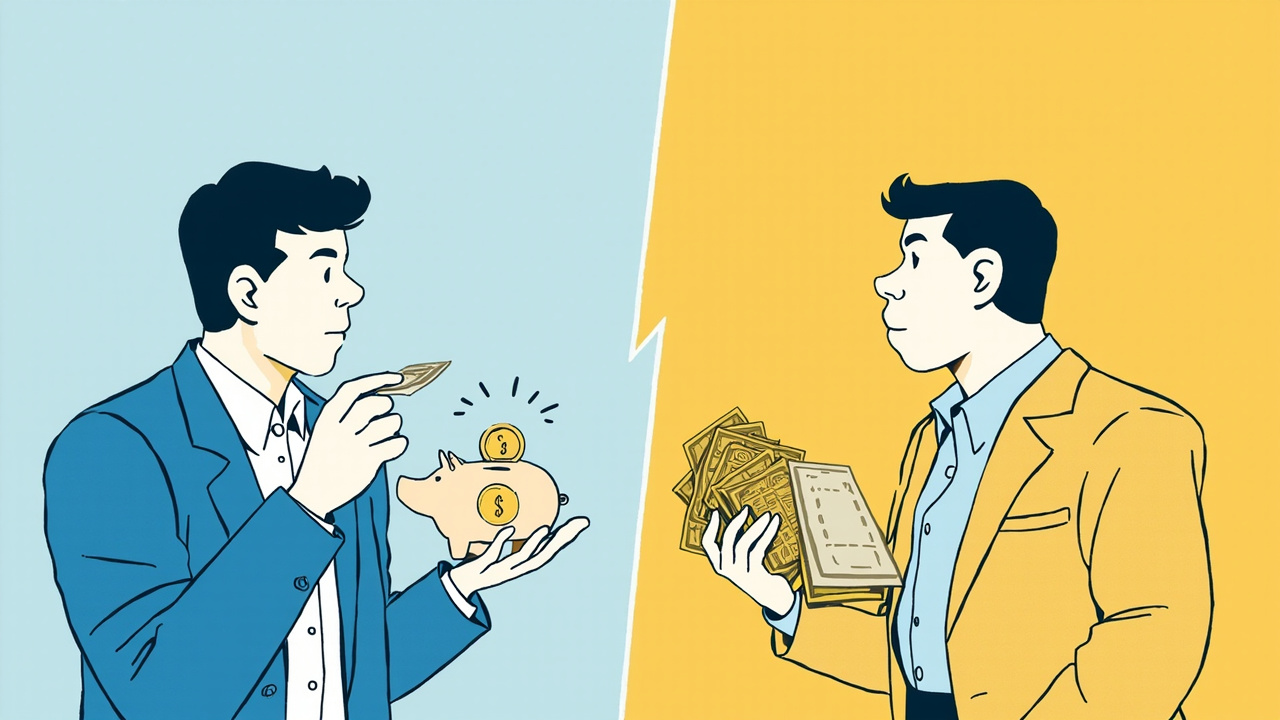
You have NT6,000 a year — it feels safe and steady. But did you know **on the very same day you parked that money in the bank, that neighbor driving the imported car was busy borrowing NT6,000; he earned NT$300,000.
You find it unbelievable — how could he dare owe the bank that much? But the truly unbelievable thing is you clearly have capital in hand, yet you live poorer than the person in debt. This picture plays out every day in Taiwan. You frantically save for a sense of security, but the people who are actually wealthy frantically borrow. You see debt as risk; they use debt as a tool. You see saving as a virtue; they know saving is letting money die slowly.
This article shares information for financial-education purposes only and does not constitute any investment advice or loan recommendation. Each person’s financial situation, risk tolerance, and income stability are different; what works for someone else may not work for you. Please evaluate all asset allocation and borrowing decisions on your own and consult a Taiwan-licensed financial advisor, loan officer, or tax professional.
Rule 1: The Poor Save Money, the Rich Accumulate Assets
What were you taught growing up? Saving is good, borrowing is bad, right? Your parents told you not to owe anyone, that owing is shameful, to live within your means, to keep both feet on the ground. So you obediently listened — every month when your salary came in you saved, never splurged, never invested, never borrowed.
But do you know what that logic looks like in the eyes of the wealthy? Self-castration — actively giving up the chance to multiply wealth.
You think you are managing money, but you are just hoarding a stack of depreciating numbers. Inflation eats 2% to 3% of your purchasing power every year, while your bank interest is barely above 1%. You are not saving money; you are legally letting money shrink.
Money itself is not wealth; money is only a tool for exchanging wealth. What is true wealth? It is assets that can continuously generate cash flow — property, stocks, a business, royalties, anything that makes money for you.
The rich do not borrow to consume; they borrow to buy assets. They use the bank’s money to buy a rental property; monthly rental income exceeds the mortgage payment, that is positive cash flow. They use borrowed money to buy equity in a company; the annual dividend is larger than the interest paid.
But you? You put your money in the bank, the bank lends it to the wealthy, the wealthy use your money to earn more, then toss you a bit of interest as a payoff. You are not managing money; you are funding someone else’s wealth management. You think you are a saver, but you are actually an ATM between the bank and the rich.
Speed Difference Is the Core of the Class Gap
You might say: I can also take my savings and buy assets — why borrow? Because of speed.
Assume you save NT1 million. Four years later you finally have NT60,000 in a year. But if you dared to borrow NT20,000 in annual interest — and invested the NT60,000 in a year, pay NT40,000**.
In year one of borrowing you earn NT60,000. That four-year time gap is the key that widens the class gap. More brutally, during those four years inflation is eating your purchasing power, property prices keep rising, stocks keep rising, and by the time you save up NT1 million could once buy may now cost NT$1.2 million.
You are always chasing, but you can never catch up — because you are in low gear while they are in high gear.

Rule 2: The Poor Fear Debt, the Rich Use Debt
The moment you hear the word debt you feel terrified, feeling it is dangerous. But have you ever thought about why the wealthiest entrepreneurs, real-estate investors, and tycoons all carry astronomical amounts of debt? Terry Gou, Morris Chang, and other public-company bosses have corporate debt in the hundreds of billions or trillions — are they poor? No, they are the wealthiest people in Taiwan.
Because they understand a concept you do not: leverage. What is leverage? Using a small force to pry open a large result. With NT1 million of business. But if you borrow NT10 million of business. If that business returns 10%, NT100,000, NT1 million — after paying the bank interest, you still earn several times what your own money would have made.
That is why the rich borrow aggressively, because they know money is a tool with time value. The more you borrow, the more you pry open, the faster you earn.
But here is the key: the rich borrow to buy assets that appreciate or generate cash flow; the poor borrow to buy consumer goods that depreciate.
You swipe your credit card in installments for the latest iPhone, borrow money to buy a car, borrow money to go to Japan — those things will not help you earn money, they only make you poorer. When you use debt for consumption, of course you get poorer. But the rich use debt for investment; every dollar they borrow generates more money for them. Both are debt, but one is a downward spiral and the other is upward leverage.
A house you live in yourself is called a liability on the accounting books, because it eats your cash flow every month. A rental property is an asset, because it generates cash flow for you every month. Buy assets first, then use the income from those assets to buy liabilities; the poor buy liabilities first, then get trapped by them for life, never having spare money to buy assets.
Rule 3: The Poor’s Money Sleeps, the Rich’s Money Works
You put money in the bank, and it lies there sleeping, paying you a bit of pocket-money interest each year. But what about the rich’s money? It works for them 24 hours a day. They buy stocks, stocks pay dividends every year; they buy rental property, property collects rent every month; they invest in businesses, businesses generate revenue every day. Their money never rests; it keeps rolling.
What is harsher is that the money they use is not even their own — it is borrowed. They let other people’s money work for them while their own money goes to do bigger things. That is the power of compounding combined with leverage.
NT1.43 million. Sounds like a profit, but the purchasing power of NT800,000 today — you are actually losing money.
But if you took that NT10.6 million. Same principal, same time horizon, different choice, ten times the difference.
Two Outcome Comparisons: The Gap Between Saving and Borrowing
Calculation 1: Saving NT$10,000 a Month from Age 25 for 40 Years
Assume you start working at 25, save NT10,000 × 12 × 40 = a total of NT6.5 million.** Sounds good, right?
But if you take that NT34.9 million.** You did not misread that — NT10,000 saved per month, same 40 years — one choice gives you NT34.9 million, a difference of more than five times.
Calculation 2: Buying Property at 30 vs Renting and Investing
Assume at 30 you want to buy a NT2 million as a down payment, take an NT28,000 a month in mortgage; over 30 years the total interest is about NT28,000 of your cash flow every month.**
But if today you do not buy this house and live in it, instead you rent a place for NT2 million down payment and invest it in an 8%-return target, and also invest the NT26 million.**
And you still have the same quality of life in your rented place. But if you chose to buy and live in the home, 30 years later you have a house, but your savings may be nearly gone — because every month’s cash flow has been eaten by the mortgage.

The 4 Prerequisites of a Leverage Mindset
This mindset is not for everyone, because it has prerequisites:
- You must be able to judge what a good asset is
- You must have stable cash flow to handle surprises
- You must have risk tolerance
- You must have financial knowledge
If you have none of these and you go borrow money to invest, that is not a rich-person mindset; that is gambling.
Scenarios Where Leverage Mindset Fits
- You borrow to buy a property with stable rental income; rental income exceeds the mortgage payment (positive cash flow), and the location has future appreciation potential.
- You borrow to invest in equity of a company you have researched deeply; the company pays stable dividends every year, and the dividend yield exceeds your borrowing rate.
Scenarios Where You Must Absolutely Avoid Leverage
- You have no stable income and your cash flow could break.
- You are borrowing to buy depreciating consumer goods.
- You cannot evaluate the target you are investing in.
- Your emergency reserve is below 6 months of living expenses.
4 Steps to Build Your Leverage Decision Framework
Step 1: First Clarify Whose Money This Is
It is not a question of borrow or not borrow; it is first clarifying whose money this is, when you will need it, and what it will be used for.
Step 2: Calculate Your Real Cost of Borrowing
Lay out every possible interest rate (mortgage, personal loan, credit-card revolving) and add it up. Credit-card revolving rates can go as high as 15% — a cost no investment can beat.
Step 3: Calculate Your Cash-Flow Safety Margin
Before borrowing, confirm that your cash flow can withstand 6 consecutive months with zero income, otherwise borrowing shifts from being a “tool” to becoming a “trap.”
Step 4: Build Your Assets-vs-Liabilities List
Sort every financial item into two categories:
- Assets: things that generate cash flow (rental property, dividend stocks, a business)
- Liabilities: things that only cost money (your own home, a car, credit-card consumption)
The goal is to make the cash flow generated by your assets exceed the cash flow eaten by your liabilities; that crossover point is called the starting line of financial freedom.
Conclusion: Buy Assets First, Then Use Asset Income to Buy Liabilities
You do not need to borrow a lot, but you do need to understand the logic. You think saving is a virtue, but in the face of inflation saving is slow suicide. You think borrowing is sin, but borrowing used correctly is financial leverage.
The real flip is not “don’t borrow” and not “borrow wildly” — it is build your asset base first, then use the cash flow from those assets to support your liabilities. The poor use labor income to repay loans; the rich use asset income to repay loans. That is the gap.
Next time someone tells you “don’t owe the bank,” you can nod politely and keep walking your own plan. Because what they know are manners; what you know is the rules. Manners keep you safe; rules set you free.
Disclaimer: All content in this article is for financial-education purposes only and does not constitute any investment advice or loan recommendation. Each person’s financial situation, risk tolerance, and income stability are different; what works for someone else may not work for you. Please evaluate all asset allocation and borrowing decisions on your own and consult a Taiwan-licensed financial advisor, loan officer, or tax professional. All numbers and calculations mentioned in this article are estimates based on specific assumptions and do not guarantee actual investment outcomes. Borrowing to invest involves risk; past performance does not guarantee future results.
Tags
Borrowing Mindset, Leveraged Investing, Rich Mindset, Poor Money Traps, Asset Allocation, Mortgage Concepts, Rental Income, Passive Income, Emergency Reserve, Compounding Effect, Financial Leverage, Investment Risk, Investing on Margin, Taiwan Mortgage
Comments