
You think the reason you cannot save NT45,000**, and the Directorate-General of Budget, Accounting and Statistics (DGBAS) household savings rate is still above 20% — but that average is pulled up by a small group of high earners, and in reality most office workers earning NT5,000 a month.
Why? Not because you earn too little, but because three actions you do every day are quietly evaporating your money without you realizing it.
Today I’m going to tell you three things: exactly where your money is leaking from, why the savings logic that Taiwan’s financial institutions have drilled into you is fundamentally wrong from the start, and a complete method you can start executing the moment you get home from work today.
Income decides your ceiling, but your savings structure decides whether you can break through the floor.
The First Invisible Leak: Spending Is Designed So You Don’t Feel It
The financial situation of most Taiwanese office workers follows the same script: in the morning you buy a NT120 takeout, after work you grab a late-night snack, on the weekend you meet friends and swipe a credit card, and the moment an e-commerce notification pings you click in and buy something you’ll ‘eventually need anyway.’ Each individual purchase is small, each feels reasonable, but together NT$15,000–20,000 vanishes every single month.
The scariest part is the subscriptions you keep paying for — Netflix, Disney+, Spotify, the gym, an app you haven’t opened in three months — at least NT$1,000–2,000 a month, all on auto-debit, so you never feel a thing.
TFTI’s research shows that the average Taiwanese consumer holds 3–5 subscriptions, of which at least 2 are used so rarely they are essentially paying for nothing. This is the invisible spending black hole — it isn’t that you overspend, it’s that your consumption behavior has been designed to take the feeling out of spending. E-commerce platforms and subscription services know one thing very well: when you can’t feel the money leaving, you won’t stop paying.

The Second Leak: The Nominal vs Real Wage Trap
Taiwan’s wage structure has something called the gap between nominal wages and real wages. Nominal wages are the number printed on your pay slip; real wages are how much your money can actually buy after stripping out inflation.
DGBAS data shows that from 2000 to 2023, Taiwan’s cumulative CPI rose by roughly 30+ percentage points, but over the same period the real wage growth of Taiwanese employees has been very limited over the long term, and in many years it has actually been negative.
What does this mean? Even if the number in your account doesn’t change, your purchasing power is shrinking every year. The money sitting in your savings account earns about 0.0-something % in annual interest, while inflation eats 1-something to 2+% a year — you do nothing and your money shrinks. This is the hidden tax you pay every day: the inflation tax.
Did your bank tell you? Yes. But the way they put it is: ‘You should take your money and buy our investment-linked insurance policies or funds, that’s how you beat inflation.’ Sounds reasonable, but the problem is that investment-linked insurance policies in Taiwan can have add-on fees as high as 150% in the first few years — and that is not anyone’s opinion, it is information that the FSC’s Insurance Bureau publicly requires insurers to disclose. A large share of the premium you pay in year one never actually enters the investment account; it is deducted as fees.
The marketing logic of Taiwan’s financial institutions: they aren’t helping you fight inflation, they are using your anxiety about inflation to sell you a product that is better for their profits. Beating inflation is a real need, but the solution they hand you is not necessarily the one that’s best for you.
The Third Leak: The Fatal Logic of Spend First, Save Later
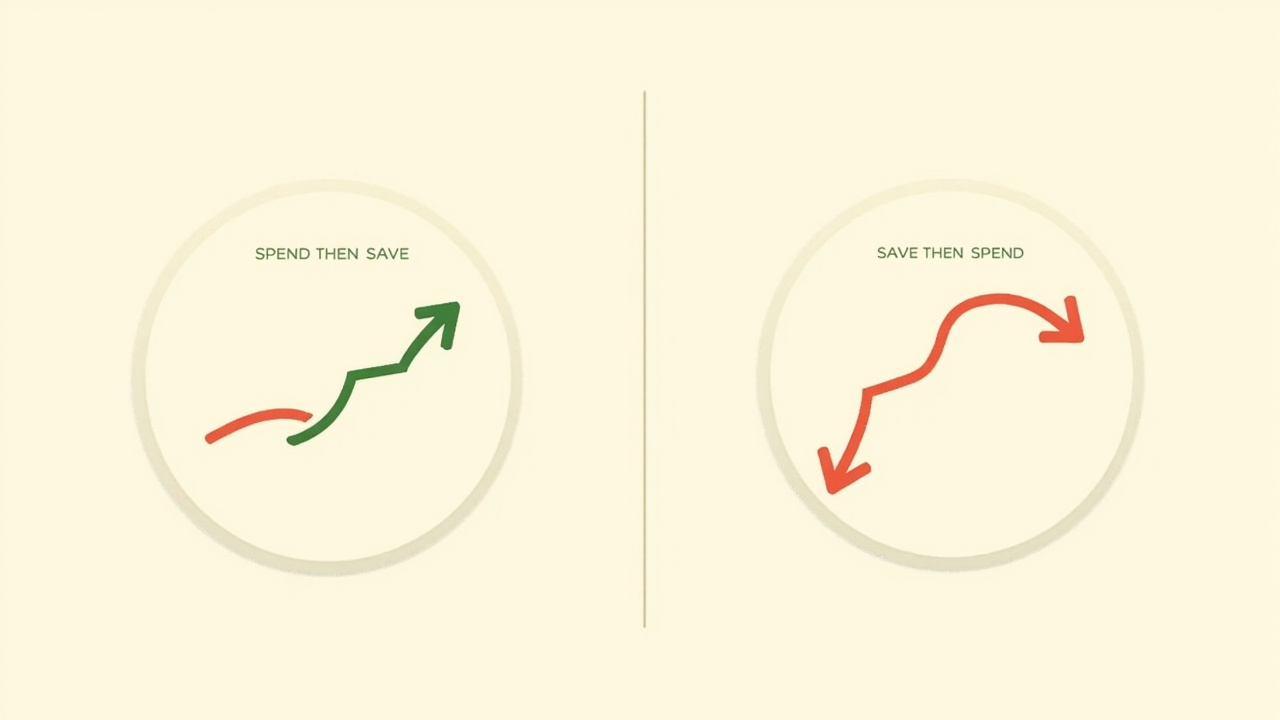
Taiwan’s banks and financial institutions have long drilled one idea into people: spend first, then save whatever is left — they call it ‘living within your means.’ It sounds reasonable, but this logic has a fatal flaw: human consumption desire has no bottom, and you can always find a reason to spend what’s left. It’s not that you lack willpower — this is how the human brain actually works, and behavioral economics has extensive research to back it up.
The correct logic is reversed: the moment your salary lands, move out the portion you want to save first; only what remains is what you can spend — this is forced savings, or more precisely ‘pay yourself first.’
The FSC’s 2022 financial literacy survey found that over 60% of Taiwanese respondents said they do not have a fixed savings plan, and only save what is left at the end of the month — and out of those 60%, how many complain that they cannot save? Almost all of them. This isn’t coincidence, it’s cause and effect.
Two Scenarios: The 20-Year Gap Between Savings and DCA Investing
Suppose you save NT1.21 million.** But if you take the same NT2.7–3.0 million**.
But there is an important caveat that must be made clear: the figure above is an ideal scenario, meaning you invest on time every month, never stop, and never panic-sell during market drawdowns. In the real world, ordinary people cannot do that. According to the Securities Investment Trust & Consulting Association of the Republic of China (SITCA), the average holding period for Taiwanese fund investors is less than 2 years, and many cut their losses during market corrections. If you paused your contributions twice during the holding period, stopping for 3–6 months each time, your actual return might drop to just 4–5%, leaving you with around NT$1.8–2.2 million after 20 years — still much better than the savings account, but the gap has narrowed.
The worst case: during the 2008 global financial crisis, the Taiwan Weighted Index fell more than 50% from peak to trough. If you had started investing at the end of 2007, your account would have been deep in the red by the end of 2008, but if you had kept DCA-ing through it, you would have roughly broken even by 2010, with positive returns from then on. The worst case is panic-selling at the bottom, that is when you actually lock in a loss. The tool itself isn’t the problem; your behavior is the variable that decides the outcome.
The Three-Layer Financial Structure: A Framework You Can Use Long Term
Layer 1: Emergency Fund. This is the floor of your financial safety net. It cannot be invested — keep it in a savings or high-yield savings account. The goal is capital preservation and liquidity. The amount should equal 3–6 months of basic living expenses — students or fresh grads can start with 3 months, mid-career people with mortgages or kids should aim for 6 months, and those close to retirement should target 12 months.
Layer 2: Forced Savings Account. The moment your salary lands, auto-transfer to this account. The amount is 10–20% of your monthly pay (no lower than 10%). The purpose of this money is to accumulate investing principal — it is not for spending.
Layer 3: Investment Account. This is where your money actually starts to work. But there is a prerequisite to enter this layer: Layer 1 and Layer 2 must already be in place. Starting to invest without an emergency fund means that when an emergency hits, you are forced to sell at the worst possible time — this is the real reason many small-capital investors in Taiwan end up losing money.
The core logic of the framework: protect yourself from being knocked down by life first, then let your money start growing — the exact opposite of what most people do.

4 Non-Negotiable Iron Rules
- Until your emergency fund is in place, you cannot put more than one month’s salary into investing. This applies to everyone — no matter your age or income, investing without a floor is just gambling.
- Reject outright any financial product whose fee structure you cannot understand. Investment-linked insurance, structured notes, structured products — if your salesperson cannot clearly explain every fee on a single sheet in five minutes, don’t buy. This rule applies especially to fresh graduates and pre-retirees, because these two groups are the main marketing targets of Taiwan’s financial institutions.
- You cannot invest money you may need within the next 3 years. Down payments, kids’ tuition, major expenses coming up in the next 3 years — that money cannot go into stocks or funds.
- Do a full financial check-up at least once a year — review your income/expense structure, investment allocation, and coverage gaps. This is not optional, this is mandatory. Many Taiwanese have kept paying on insurance policies and funds they bought 10 years ago whose fee structures no longer match current market standards, but they have never re-examined them.
4 Actions You Can Complete Today
Step 1: Open a separate emergency fund account. Open your online banking app (Bank of Taiwan, Cathay United Bank, E.Sun, CTBC — all work), open a separate sub-account or digital account, name it ‘Emergency Fund,’ set up an auto-transfer within 3 days of your salary hitting the account, with the amount starting at 10% of your monthly pay, then adjust upward once you’re used to it. This takes about 10 minutes.
Step 2: Audit every subscription. Open your credit card statement or mobile payment history, find every auto-debited subscription service, list them, and ask yourself: how many times did I use this last month? Cancel any service you used fewer than twice. This takes about 15 minutes, and the monthly savings may be bigger than you think.
Step 3: Start a DCA plan (only after Step 1 and 2 are done). Set up a DCA plan for an ETF through your brokerage account. Taiwan has multiple ETFs tracking the Taiwan Weighted Index or global markets, and you can start with as little as NT$1,000. If a 20% market drop would keep you up at night, your investment amount is probably set too high — dial it down to a level you can live with.
Step 4: Set an annual financial check-up date. Just like an annual health check, put it on your calendar. Once a year, open every account, review your income/expense structure, investment P&L, and coverage gaps, and adjust based on your current life situation. This is a habit that most Taiwanese never build in their entire lives, but its long-term value far exceeds what you can imagine.

A Taiwan-Specific Advanced Tip: Voluntary Contributions to the Labor Pension
Taiwan’s voluntary labor pension contribution mechanism is a severely underused tool. Under the Labor Pension Act, you can voluntarily contribute up to an additional 6% of your salary into your personal labor pension account on top of the statutory 6% employer contribution, and this amount is deductible from your taxable salary income, directly lowering your taxable income — in effect, the government subsidizes part of your investment cost. The Labor Pension Fund is managed by professional institutions commissioned by the government and has a guaranteed minimum return mechanism, making it a hidden gem for small-capital savers seeking forced savings and stable allocation — but Ministry of Labor statistics show the voluntary contribution rate in Taiwan is very low, and most people never use it.
This article is for financial education purposes only and does not constitute any investment or financial planning advice. All investments carry risk; past performance is no guarantee of future results. The financial products mentioned in the video are all approved by Taiwan’s FSC, with data sourced from official Taiwanese public records. Before making any investment decision, please assess your own financial situation and risk tolerance, and consult a Taiwan-licensed financial advisor or tax professional.
Disclaimer: This article shares investment and financial concepts and compiled data only. It does not constitute any specific investment, tax, or legal advice. Markets carry risk, invest with caution, and please use your own judgment based on your personal risk tolerance and consult a professional advisor.
Tags
Savings Structure, Hidden Spending Black Hole, Subscription Economy, Forced Savings, Wage Stagnation, Real Wages, Investment-Linked Trap, Emergency Reserve, Auto Transfer, Cancel Subscriptions, Three-Layer Financial Structure, Voluntary Pension Contribution, Inflation Tax, Financial Checkup
Comments