You think parking your money in a bank fixed deposit is the safest, most sensible way to manage your finances?
In reality, it is the most terrifying and most idiotic act of financial suicide you will ever commit. As you watch that measly 1.5% annual interest trickle into your passbook, you have no idea that the bank is already using your hard-earned cash to run a frenzied, zero-capital arbitrage scheme behind your back.
Today we are going to tear this fixed-deposit lie wide open — a lie our elders have worshipped as gospel truth — and show you exactly why anyone chasing absolute safety is destined to stay poor for life.
30 Years of Saving NT$5 Million, and He Still Can’t Afford a Home
From childhood, the one piece of advice our elders never tired of repeating was: always have the virtue of thrift. Earn money, save money, and rush it straight into the bank as a fixed deposit.
That mindset actually worked in the old agricultural society, or during Taiwan’s early economic take-off, when fixed-deposit rates routinely hit 8% or higher. Back then, just working hard meant your interest alone could outrun inflation.
But in today’s era of global money-printing and rapidly depreciating fiat currencies, clinging to that old fixed-deposit mentality is like charging a modern tank with a spear and a machete.
Consider a real case from Tainan. Uncle Wang worked his whole life, pinched every penny, and refused to even treat himself to a slightly pricier bubble tea. The moment his salary hit his account, he immediately locked away almost all of it in fixed deposits. For 30 years he never gambled, never splurged, never got scammed. He just obediently parked his money in the bank.
Today, Uncle Wang’s passbook shows NT5 million probably cannot even buy a decent two-bedroom elevator apartment in the city. Uncle Wang’s real wealth has been eaten alive by the invisible monster called inflation.

Banks Don’t Produce Anything — They Just Move Money Around
Walk into any bank and the marble floors, the crisp uniforms, the imposing counters — your gut instinct tells you that handing your money over to such a giant financial institution must be rock-solid safe. But have you ever stopped to ask where the profits that keep this entire empire running actually come from?
The answer is brutal: every cent of those profits is sucked straight out of fixed-deposit savers like you.
When you deposit NT1 million, the bank immediately turns around and lends it out to whoever needs funding.
They might lend to a young couple buying a home at a 2.5% mortgage rate, to a small business owner at a 5%+ business-loan rate, or even to someone drowning in credit-card debt at a staggering 10%+ revolving interest. In this relay of money, the bank never spends a single cent of its own. They simply act as a toll booth — buying money cheap and reselling it at a high markup.
You shoulder the massive risk of currency depreciation. You put up NT$1 million in real cash. And in return, all you get is a pathetic 1.5%, while the bank effortlessly pockets the fat spread in the middle.
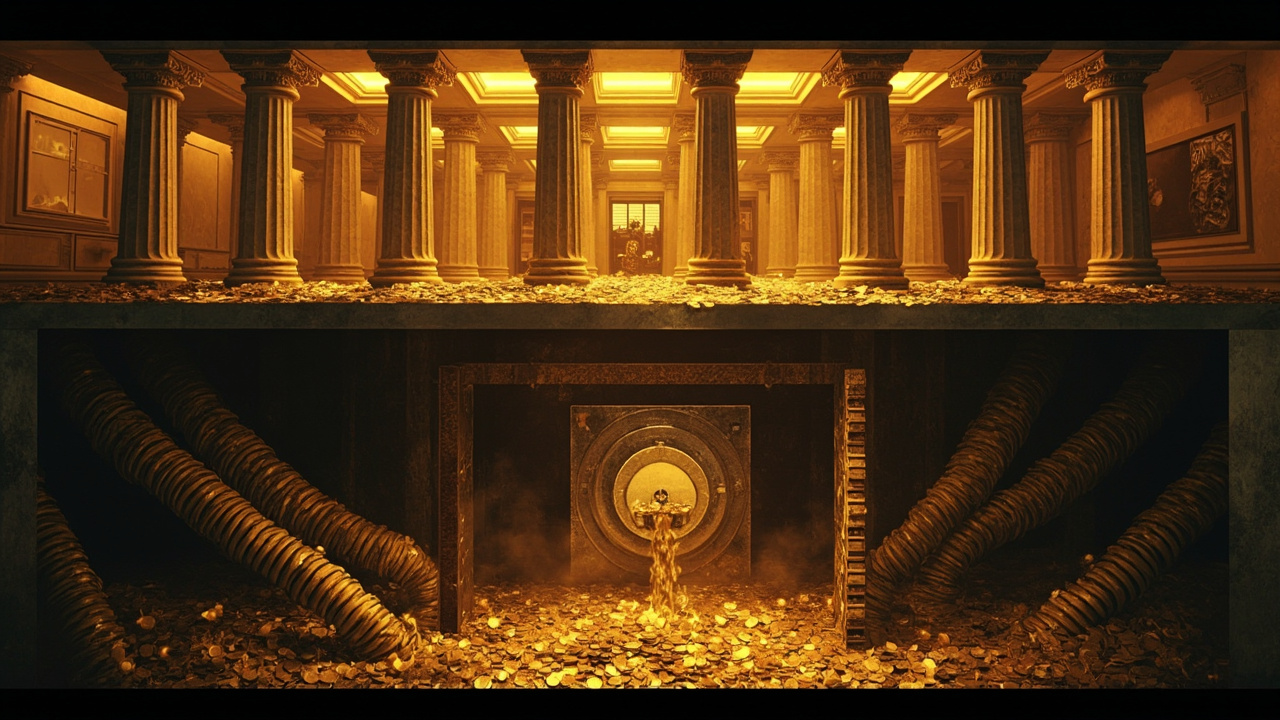
Fractional Reserve Banking: Your NT$1 Million Gets Multiplied Into Millions
Even more chilling is a rule baked into the modern financial system called fractional reserve banking. When the bank receives your NT100,000 in the vault for daily withdrawals. The remaining NT$900,000 can be loaned out in full.
That NT810,000 of it to someone else. This endless loop of borrowing and re-depositing is what economists call the money multiplier effect.
Under this wild multiplier effect, the original NT$1 million you deposited can balloon into several million in credit-money sloshing around inside the financial system. That is why the markets are flooded with cheap money. That is why real estate and stocks keep marching higher. Every single day, the banking system uses your fixed deposits as ammunition, firing credit-money into the market at full blast.
While you are still smugly patting yourself on the back for your 1.5% fixed-deposit interest, the bank has already used your money to inflate giant asset bubbles — and the inflation bill for those bubbles ends up being footed by you, the lowly fixed-deposit saver. Anyone who parks money in the bank is effectively subsidizing those bold enough to borrow. It is a brutal mechanism that robs the poor to enrich the rich.

Official Inflation Is a Carefully Wrapped Financial Lie
Many elders hear the government announce that this year’s consumer price index only rose 2%, and they quietly calculate: “My fixed-deposit rate is 1.5%, so I’m losing a little, but at least my principal is safe.” That is a fatal illusion, and it is dead wrong, because official CPI calculations deliberately exclude the very asset prices that hurt you most.
Take the biggest single expense in most ordinary people’s lives — buying a home. In many inflation datasets, the weight assigned to housing prices is drastically understated, or even stripped out entirely.
To see real inflation, you have to walk into a traditional wet market in Taiwan and feel it in your bones. Think back ten years: a hearty chicken-leg bento in Taipei set you back about NT130. Over those ten years, the real price of that lunch has surged over 60% — far beyond anything official data admits.
Look at the bubble tea that younger generations love. A classic pearl milk tea used to be NT100. Run the numbers against these real prices, and Taiwan’s actual inflation rate is easily above 4%.
When your money sits in a fixed deposit earning 1.5% while real inflation runs at 4%, you are reliably losing 2.5% of your actual purchasing power every single year. Leave NT1 million will probably buy less than half of what it does today.**

Loss Aversion: The Fatal Cognitive Flaw of Fixed-Deposit Savers
Why do so many smart middle-class people, who clearly understand that inflation exists, still cling to fixed deposits? To answer that, we have to dig into a fatal psychological flaw baked into the human brain over millions of years of evolution.
Back in our tribal days, the brain was hardwired to be hyper-alert to risk, just to keep our genes alive. That is why the pain of losing something hits the brain far harder than the joy of gaining the same amount. This biological mechanism, known as loss aversion, becomes a death sentence in modern financial markets.
When ordinary people face investing, their primal brain fires off screaming danger warnings. They watch stock indices swing up and down, and their nervous system goes into full panic. To escape that psychological uncertainty and pain, they retreat into the comfort zone of a bank fixed deposit. Because the number on the passbook never shrinks, that nominal guarantee of safety soothes the deep fear buried in their brains.
But we need to completely break this wrong definition of risk and rebuild the financial lens of the wealthy. In the rich’s dictionary, real risk is absolutely not the normal short-term ups and downs of an asset’s price. Real risk is the absolute certainty that the asset you hold will lose its purchasing power over the long haul.
Fixed deposits are the perfect cover for purchasing-power decay. They use the illusion of an unchanged number to hide the destruction of real value. The moment you choose a fixed deposit, you have already given up your ticket to participate in society’s wealth redistribution game.

Wake Up From Fixed Deposits: Turn Cash Into Assets That Make Money
The first step to escape this slow-motion financial bankruptcy is to彻底戒除 your sick dependency on the bank’s promise of “principal protection.” Treat the bank as a tool for payment convenience or for borrowing cheap money — never as a safe harbor that can shield you from inflation.
Set aside enough emergency reserves to cover six months to a year of living expenses; that part can sit in your regular savings account. But every remaining dollar that was destined for a fixed deposit must be ruthlessly redeployed into a real pool of productive assets.
If you are an ordinary office worker who can’t read a corporate financial statement and doesn’t have time to stare at charts all day, the simplest and most brutal counter-attack is to drip your money into a broad-market index ETF in batches. Don’t obsess over whether the index is high or low right now, and don’t try to predict tomorrow’s crash. You only need to trust one bedrock logic of capital — human economic progress always trends upward over the long run.
As long as humans still have desires, as long as technology keeps advancing, the broad market index will keep printing new all-time highs through all the volatility. Every monthly contribution you make is like dispatching another tireless army to conquer territory on the market for you. Powered by compounding — the eighth wonder of the world — the you of ten years from now will be deeply grateful to the you who took that brave step today.
The rich have seen through the game of relentless currency devaluation, so they would never in a million years sit on piles of cash. They treat cash as a block of ice melting fast, and they swap it for solid bricks of assets before it disappears. Fixed-deposit savers, on the other hand, clutch that melting ice like a treasure and watch helplessly as it dissolves into nothing.

Closing: Stop Being the Fool Who Sacrifices a Lifetime of Financial Freedom
Quitting fixed deposits does not mean chasing reckless, high-risk, high-return speculative products. It means becoming a wise capitalist who ties your fate tightly to high-quality assets. We must transform from being a cheap-fund provider ruthlessly exploited by the banking system into a sharp investor who knows how to harvest the market’s dividends with the power of capital.
Shatter the obedient-child filter your elders put on you from childhood, and walk straight into this brutal but opportunity-packed financial world. In an era where governments can print money without limit, the biggest danger is refusing to take any risk at all.
Stop being the fool who clings to surface-level numbers while sacrificing an entire lifetime of financial freedom. Only by bravely embracing volatility and buying core assets can you survive in a world ravaged by the inflation monster.
If a fixed-deposit trap has held you hostage for 30 years, now is the perfect moment to wake up. Drop a comment and tell me: what percentage of your fixed deposits are you ready to rotate into real assets? Let’s smash that obedient-child filter together and march toward a life of financial freedom.
This article touches on financial and investment topics. Please evaluate based on your personal situation and consult a qualified financial advisor.
Comments