
Have you ever thought that the thing that crushes an ordinary person’s entire financial life is rarely a single accident, or a sudden job loss—but a moment at 25, on a salary of just over NT$30,000 a month, when they didn’t even realize they were making a choice?
Today let’s talk about an ordinary guy named Xiao-Chen. His story is probably the real mirror image of you, me, or someone we know. Like most of us, he grew up in Taiwan, finished college, and found a reasonably stable job. His life plan was simple: work hard, get gradual raises, save money, buy a home, get married, have kids. He figured that as long as he followed this path most people walked, step by step, he would eventually get the life he wanted.
But 15 years later, that same Xiao-Chen, on a rainy late night, stood in front of the convenience store ATM staring at the balance on the screen—a number with fewer than five digits—and couldn’t come back to himself for a long time.
He couldn’t figure it out. He’d clearly worked so hard, was more diligent than anyone, never late, never left early—why had life brought him to this point? The answer to this question is brutally cold.
1. The Mortgage Trap Beneath Collective Anxiety
The story begins with the first decision he made 15 years ago, the one with the deepest consequences. That year Xiao-Chen was 25, working in marketing at a small-to-medium business, earning NT$35,000 a month. Back then, Taiwanese society was saturated with a collective anxiety, and at the center of that anxiety were just two words: buy a home.
Turn on the TV, financial experts were talking about housing. Scroll through your phone, online news headlines all read “if you don’t buy now, you’ll miss out” and “home prices hit yet another new high.” Coworkers, friends, lunch breaks, after-work gatherings—the conversation always revolved around “which development are you looking at?”, “how much have you saved for the down payment?”, “my so-and-so bought such-and-such three years ago and made over NT$3 million.”
These messages were heating up Xiao-Chen’s anxiety like boiling a frog in warm water. Looking at his small rented apartment in New Taipei, NT$10,000 a month in rent felt like throwing away every paycheck, one by one, into the water without even a splash. The landlord’s politely brushed-off glance when collecting rent each month kept reminding him: “You’re just a passer-by. This isn’t your home.”
Just then, a first-home mortgage promotion—a lifeline—appeared before his eyes. The bank’s mortgage officer told him with great assurance that his profile was excellent, and although he was a little short on the down payment, no problem—he could top it up with a personal loan.

2. The Real Cost of “If You Don’t Buy Now, You’ll Never Be Able To”
The officer helped him crunch the numbers: a NT25,000, his salary was NT10,000 after the loan payment.
At the time, his reasoning went like this: “Rent is also NT15,000 more, I go from being a tenant to being a homeowner. How is this not a great deal? A little hard now is fine, my salary will go up eventually, and then it gets easier. And this isn’t just buying a house—this is fighting inflation, investing in my future.”
His parents were also very supportive. Their generation’s even firmer belief was “land equals wealth,” and having a roof of your own is what it really means to have a footing in society. He told himself, and everyone who cared about him: “If I don’t buy now, I’ll never be able to in the future.” In the atmosphere of the time, that sentence sounded like gospel, indisputable.
So on a sunny afternoon, he signed his name on that thick contract—in that moment he felt he had finally stepped onto the right track, not knowing he was chaining himself into a 30-year financial cage.
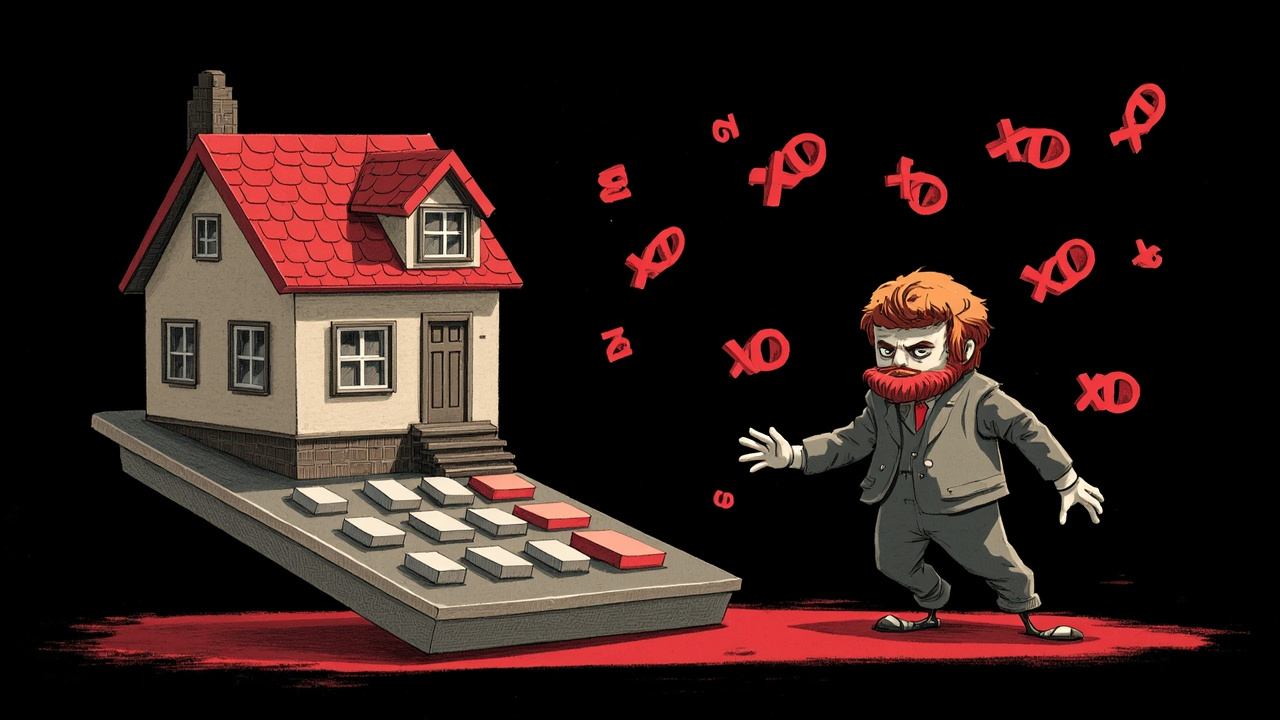
3. Why Does That Step at 25 Decide an Entire Life?
Breaking down this tragedy, you find it has three cruel structural layers:
The first is the death spiral of over-leverage. When you top up the down payment with a personal loan, when you lock in the future with a 30-year mortgage, your monthly income is immediately stripped of 70% or more. Any accident—illness, layoff, failed business, a family member hospitalized—will instantly collapse your entire financial structure, because you have no buffer at all.
The second is the loss of career optionality. When you’re crushed by NT$25,000 in loan payments every month, you don’t dare switch jobs, start a business, study abroad, or give yourself a year-long gap year to find the path that really suits you. You’re pinned to that “reasonably stable” job, even as it slowly kills your passion and possibilities.
The third is the invisible loss of opportunity cost. The ten years from 25 to 35 are the golden decade of life, when learning capacity is strongest, physical energy is best, and opportunity cost is lowest. When you devote that entire decade to a 30-year mortgage, what you lose is: the time to learn new skills, the chance to meet new people, the possibility of trying a new industry, and the space to make mistakes and get back up.
In that moment 15 years later, standing in front of the ATM, what Xiao-Chen lost wasn’t money—it was every possible fork in the road his life could have taken.

4. The Other Path You Could Take: Invest in Yourself vs. Invest in a House
What you should really be choosing at 25 isn’t “buy now or buy later,” but “should this money go into a house, or into yourself?”
Let’s run the numbers: with the same NT35,000 to NT80,000, or even NT$100,000.** That growth rate is something no real estate return can match.
More importantly: the return on investing in yourself follows you for life, while a house depreciates, gets buffeted by policy, gets hijacked by interest rates, and can become a heavy burden at the wrong moment.
Of course, this isn’t saying never buy a home—it’s saying buying a home should be a “choice” you make when your financial strength is already strong enough, not a “have-to” you make when your financial strength is still weak. Get the order wrong, and no amount of effort will help.

Conclusion: What You Choose at 25 Is the Next 30 Years of You
The financial tragedy of ordinary people has never come from not trying hard enough—it’s from making a decision that looked reasonable but was actually devastating at 25 under collective anxiety. When the whole society is shouting “if you don’t buy now, you’ll miss out,” what you need isn’t to shout along—you need to stop and ask yourself: “Is this really the life I want, or the one others have told me I should want?”
From today, re-examine every major financial decision you make and ask yourself three questions: Is this decision based on my real needs, or on the collective anxiety of society? Will the me of five years from now thank present-day me for this decision, or resent me? If something unexpected happens, how much buffer do I still have to get back up?
What you choose at 25 is never a house—it’s the next 30 years of you. Choose right, and even slow progress will take you far; choose wrong, and the faster you run the more you stay in place.
This article shares general financial and career concepts and does not constitute any investment, real estate, or legal advice. Major financial decisions should be based on your own income, risk tolerance, and family situation, with independent judgment and, when necessary, consultation with a qualified professional financial advisor or real estate professional.
Disclaimer: This article shares investment concepts and compiled reference material. It does not constitute any specific investment, tax, or legal advice. Markets carry risk and investing requires caution; please make independent judgments based on your own risk tolerance and consult a professional advisor.
Tags
25歲財務決策, Mortgage Traps, 薪資成長錯位, 信貸綁架, 財務悲劇, 青年買房, 投資自己, Emergency Reserve, 多元收入, 職涯選擇, Inflation, 人生選擇權
Comments