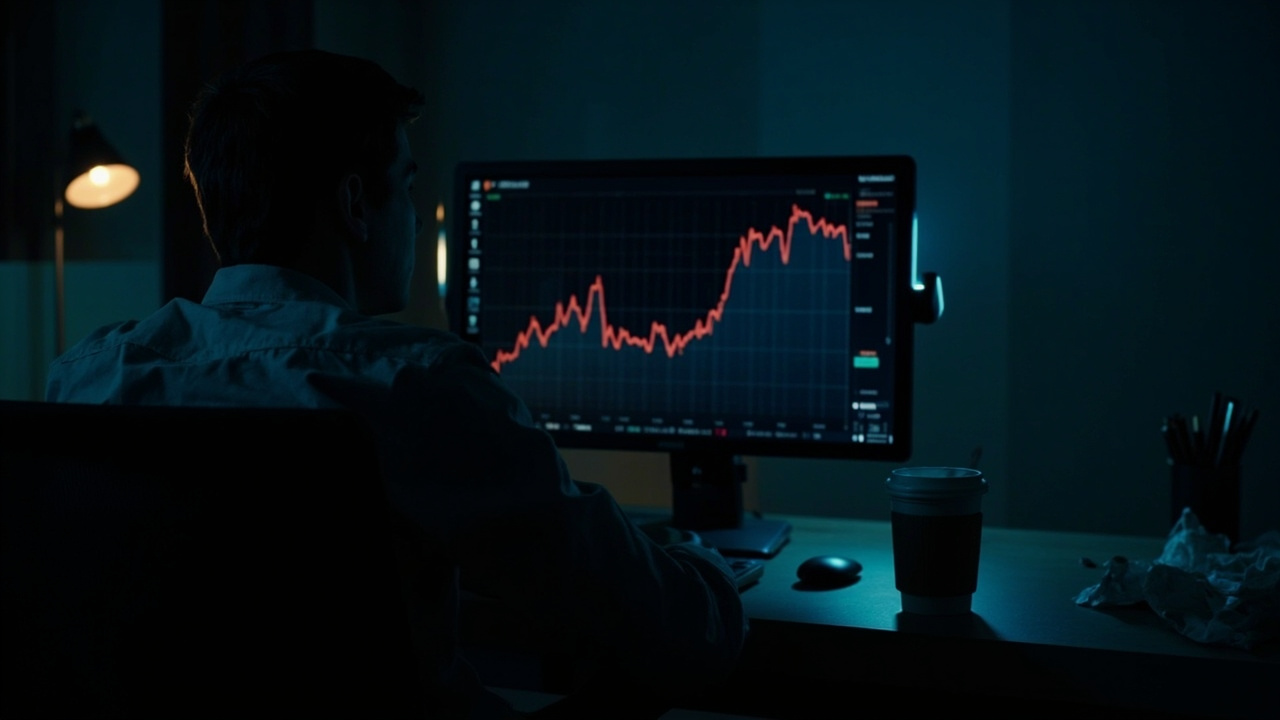
Day Trading on a NT$40K Salary: A Behavioral Finance Case Study
Have you ever scrolled through social media and seen those polished “wonder-kid traders”? They carefully screenshot their red profit-and-loss statements and claim they can withdraw cash every day. Watching them buy luxury cars, designer watches, and frequent high-end venues at a young age can stir up a sense of deprivation and make you question the value of your own daily grind.
You might think that learning this magical trading technique could finally free you from your modest salary. Today, I’ll calmly walk through the mechanics of why this approach almost always ends in financial damage for ordinary people.
The myth of “no-capital trading” is a system designed to extract fees and losses from people who want to climb the wealth ladder but have no starting capital. You may feel like a brilliant market operator, but in the eyes of the brokerages, you are simply a high-volume fee generator.
Why Smart Young Professionals Fall Into Day-Trading Traps
In Taiwan today, young workers face a persistent wage squeeze. Even with a degree from a top university, monthly pay often fails to keep up with rising prices. Long hours at the office, combined with the sight of housing prices climbing out of reach, can erode rational judgment over time.

When someone tells you there is a high-profit game that requires no starting capital, it feels like offering a glass of cool water to a person dying of thirst in the desert. Online influencers have learned to package high-risk speculation as modern financial literacy, suggesting that a smartphone and an internet connection are enough to beat seasoned professionals. In practice, this is a systematic transfer of wealth from salaried workers to the brokerage industry.
How the T+2 Settlement Window Creates Risk
To understand the trap, we need to look at Taiwan’s unique settlement system. Under current rules, buying a stock today does not require immediate payment from your account. The brokerage gives you two business days before the funds are actually debited.

This system was originally designed to give large institutions flexibility in cash management. For retail speculators, however, it looks like a blank check to trade far beyond their actual means. This is the basis of the so-called “zero-capital day-trade” approach.
The logic is simple: buy at the open, sell at the close, complete the round trip within hours, and never need to put up the full purchase price. For young people whose bank balances cannot cover a NT$10,000 emergency, this appears to be the perfect arbitrage.
The Gamification of Trading Apps
The moment you tap the buy button, dopamine floods your brain and you feel as though you control enormous market power. In reality, you have no financial cushion to absorb even a small adverse move.

Brokerage apps are designed using the same psychological principles as mobile games and casinos. The constantly flashing red and green numbers, the celebratory animations on profitable trades, and the immediate feedback loop all encourage frequent trading — and frequent trading means frequent commissions paid to the brokerage.
From Overconfidence to the Trap
Beyond the direct commissions, day trading distorts behavior in ways that are hard to recognize until it is too late. The first time you make a few thousand NT$ by pure luck on a morning trade, you attribute the result to skill rather than randomness. This kind of unearned confidence is the most reliable predictor of future losses.

When the stock you loaded up on suddenly drops, the natural human reaction is not to cut losses calmly — it is to freeze, then to bargain with yourself that “as long as I don’t sell, it isn’t a real loss.” This is the well-documented loss-aversion bias. Most retail traders respond by adding to the position, hoping to bring the average cost down, but they are really just digging the hole deeper.
Limit-Down Lock: When Exit Disappears
Taiwan’s stock market includes a daily price-limit mechanism. In normal conditions, a stock can only fall by a fixed percentage per day, which sounds protective. In a panic, however, it becomes a one-way trap.

When a popular stock suddenly reveals bad news, every institutional seller rushes to exit at once. The order book fills with millions of sell orders at the limit-down price, and no buyer is willing to step in. Your sell orders sit in the queue, never executed. You cannot exit, and two days later the settlement amount becomes due in full.
This is the moment of reckoning: a retail trader whose checking account cannot cover a small emergency suddenly owes hundreds of thousands — or millions — of NT$ for shares that are still falling.
Case Study: How a NT2M Hole
To make this concrete, consider a recent case. Xiao Chen is a young office worker in his second year on the job, earning around NT$40,000 per month. After hearing about no-capital trading at a friend’s birthday dinner, he tried it with very small size and was rewarded with a few small wins.

Encouraged by early success, he requested repeated increases in his daily trading limit. One day he spotted a thematic stock being discussed heavily on online forums. At the morning open he used his full limit to buy as many shares as the system allowed.
By noon the story changed. Unknown institutional sellers hit the stock with heavy volume, and the price collapsed in a straight line until it hit the daily limit-down. It stayed locked there until the close.
Xiao Chen could not sell. He was now on the hook for more than NT20,000.
The Long Shadow of Settlement Default
Many people assume that settlement default simply means you can no longer trade stocks. The actual consequences are far more severe.

When you fail to settle, your brokerage reports the incident to Taiwan’s Joint Credit Information Center. The record stays on your file for several years. From that point on, every bank in the country sees you as a high-risk borrower. Credit cards are cancelled. New credit card applications are declined. Even small installment plans for phones or appliances get rejected.
When you later want to settle down, get married, and apply for a mortgage, the bank officer types your ID number into the system and your application goes straight into the recycle bin. The brokerage can also petition the court to freeze your bank accounts and garnish up to one-third of your future salary to repay the debt. In effect, you have pre-spent decades of your future labor income to cover one impulsive trade.
What Disciplined Investors Actually Do
Once you see the structural mechanics clearly, the difference between retail speculators and long-term investors becomes obvious. Wealthy investors almost never spend their time on short-term noise trading, because the expected return after costs is negative for the average participant.

Their approach rests on a simple, time-tested principle: any money made purely by luck will eventually be returned by skill. They look for asymmetric setups where the downside is bounded and the upside is meaningful. They allocate capital patiently into high-quality businesses with strong competitive advantages, and they wait for compounding to do the heavy lifting.
While a day trader stares at flashing numbers all night, losing sleep over a few hundred NT$ of fluctuation, a long-term investor is reviewing the annual report of a business she plans to own for the next decade.
Breaking the Speculation Mindset
If you want to escape this cycle, the first step is to recognize the psychological pattern for what it is: a gambling habit dressed up as a financial strategy. Delete the trading apps that are designed to keep you hooked. Stop following the so-called wonder-kid influencers whose profit screenshots are usually fabricated.
Redirect your energy toward building skills that produce real income. Once you have built a genuine financial cushion, allocate it according to a diversified, low-cost, long-term plan that you can stick with through market cycles. A robust financial firewall, not a hot stock tip, is what separates long-term investors from the next settlement-default headline.
If this article shifted your view of short-term trading, please share it with someone you know who is still staring at the trading screen. Subscribe for more behavioral-finance insights from the Aciemind Lab.
This article discusses investment risks and personal finance planning. Please assess your own situation and consult a qualified financial advisor before making investment decisions.
Comments