
You clock in on time, work overtime diligently, and earn a top annual review — and at the end of the year your salary rises by only 1.5%.
But the colleague in the next department who can actually use AI tools just got a raise this year, plus a project bonus.
The tightness in your chest is not jealousy; you genuinely cannot figure out what happened to this world.
This is not an isolated case. According to surveys recently published by 104 HR Bank and 1111 Job Bank, more than 75% of Taiwanese companies explicitly state they are willing to pay above-market salaries for talent with AI-related skills, with the average raise running around 9.5%, and in some tech sectors exceeding 15%.
At the same time, DGBAS Taiwan’s 2023 employee compensation statistics show that the average real-wage growth for all employees was only about 1.5% to 2% — after inflation, it is essentially standing still.
Because the discovery is: even though everyone clocks in the same way, the salary curve of one group is bending upward while the salary curve of another group has already started being pressed downward.
This is not a matter of luck; it is an elimination race you did not realize you were already in.
The core sentence of this article — please remember it for the rest of your life after reading today:
In an era of skill inflation, your salary ceiling is set by when you most recently updated your skills, not by your years of service.
1. Why the Path of Earning Raises Through Seniority Is Already Dead
Many Taiwanese white-collar workers hold a deeply rooted belief: “Do it long enough and you will get a raise.”
That belief was correct 20 years ago, because the industrial structure back then was relatively stable and technology iterated slowly. Doing a job for three years really did make you more valuable than a newcomer.
But that logic is now completely broken.
Why? Because cost pressure on Taiwanese companies keeps growing. When an AI tool can replace 60% of a mid-level admin’s repetitive work, the company’s calculation changes — it is not that they want to fire you; they want fewer people doing more.
That means they are willing to pay top dollar to the person who can command AI tools and amplify output for them; but for the person who has simply been doing the same thing for 10 years, the budget only gets tighter.
According to the Ministry of Labor’s 2023 manpower demand survey, demand for digital-skilled talent in Taiwan’s manufacturing and service industries is growing at more than 18% annually, yet the supply gap of qualified candidates in the market is over 35%.
This is not theory; this is exactly why salaries for AI-related roles can pull apart so much in such a short time.
You might say, “I am not an engineer; what does AI have to do with me?”
This is the first cognitive blind spot for 90% of Taiwanese white-collar workers, and the most expensive misconception. The AI-skill premium is not limited to engineers — it is seeping into every role in every industry:
- A marketing planner who uses AI for content generation and data analysis delivers three times the output of one who does not.
- A finance professional who automates reporting with AI can do the work of three people on his own.
- Even in HR, those using AI tools for candidate screening have already started taking budget share from traditional HR.
This is the cross-industry skill repricing driven by the AI salary premium.
2. The AI Skills Market: Real Gold, and Plenty of Gilding
The Taiwanese market is now flooded with AI courses — from a few thousand NT$ online classes to tens of thousands for in-person bootcamps. Everyone tells you that learning them will lead to a raise or a career switch.
But when a company is willing to pay 9.5% more, what exactly are they buying?
According to 104 HR Bank interviews with HR professionals in Taiwanese companies, when hiring AI-related talent, what they value most is not how many courses you took or how many certificates you earned, but whether you can embed AI tools directly into business workflows and solve real commercial problems.
That is a critical distinction. Many people spend a lot of time learning how to operate the interfaces of various AI tools, but back at work they still cannot figure out how to use them to save or make money for the company.
Companies want results, not your learning résumé.
The Three High-Pay AI Application Scenarios
The AI application scenarios currently commanding the strongest salary premium in Taiwan, according to the Industrial Economics and Knowledge Center (IEK) of the Industrial Technology Research Institute (ITRI), concentrate in three directions:
- Process automation: using AI tools to automate workflows that originally required repetitive manual operations, directly reducing the company’s labor cost.
- Data analysis and decision support: using AI tools to quickly process large volumes of data and produce actionable insight reports.
- AI-assisted content production: bulk production and optimization of marketing copy, customer-service replies, and product descriptions.
These three directions share a common trait — they are all cross-functional. No matter which department you are in, the moment you can layer these capabilities onto your core job, you become the scarce composite talent the market is looking for.
Your core domain knowledge is king; AI is the amplifier. A finance professional with 10 years of experience who embeds AI into the financial-analysis workflow is far more valuable than a newcomer who only knows how to operate AI tools but has no business background. Many people get this logic backwards.

3. Three Sets of Calculations: The 20-Year Salary Gap Is NT6 Million
Calculation 1: The Real Cost of the Seniority Path
Assume you are 35 this year, working as a marketing planner at a mid-sized Taiwanese company, earning NT$45,000/month.
You figure AI has nothing to do with you, and you keep working the old way. According to DGBAS wage statistics, average annual salary growth for non-technical roles in Taiwan is around 1.5% to 2%; at 1.8%, your monthly salary 10 years from now is roughly NT$53,000.
It sounds like a raise, but Taiwan’s average inflation over the past 10 years has been about 1.5% to 2% — your real purchasing power has barely improved.
Even harsher: if 30% of your role is replaced by AI tools over that decade, what you face is not salary stagnation but forced demotion or early exit.
This is not the worst case; this is the most common case.
Calculation 2: The Result of the Skill-Upgrade Path
Same starting point: 35 years old, NT$45,000/month marketing planner. You spend three months systematically embedding AI content-generation and data-analysis tools into your daily workflow, lifting your personal output by 40%.
According to 104 survey data, this kind of skill combination commands a market salary premium of around 8% to 12% in Taiwan’s marketing roles; conservatively at 9% — your monthly salary can adjust to about NT$49,000 within one to two years.
The number does not look big, but the key is not year one — it is the compounding effect of year five and year ten. A higher salary base means every raise translates to a larger absolute amount, and your career ceiling is also completely different.
Calculation 3: The Long-Term 20-Year Wealth Gap
People on the skill-upgrade path can expect a monthly salary of NT85,000 in 20 years; people on the seniority path sit around NT$60,000.
The gap is roughly NT25,000 per month, accumulating over 20 years to over NT6 million in pure salary difference.
That does not yet count the difference in career-promotion opportunities.
What about the extreme case? In Taiwan’s three major economic shocks — the 2001 dot-com bust, the 2008 financial crisis, and the 2020 pandemic — unemployment clearly spiked, and the layoff ratio for repetitive-work roles was far higher than for technical roles.
According to historical Ministry of Labor data, in Taiwan’s 2009 manufacturing and service-industry layoff wave, employees with digital skills were laid off at a rate below the average.
Skill upgrade is not just about getting a raise; it is about whether you can keep your job when the next economic shock hits.
4. The Hidden Elimination Trap for Senior White-Collar Workers
Many mid-career professionals with 10+ years of experience have a particular resistance to AI, feeling it is something for the young, that they cannot learn it, or that their company does not need it.
This mindset is extremely common in Taiwanese workplaces, but behind it lies a more dangerous logic error:
You think your resistance is because the learning cost is too high, but the real issue is that you underestimate the opportunity cost of not learning.
Taiwan’s workplace has a very local characteristic called “hidden elimination” — the company does not directly tell you “you have been replaced by AI”; they just:
- Gradually narrow your scope of work.
- Compress your budget.
- Hand promotion opportunities to the young employee who can use AI tools.
- Then wait for you to choose to leave on your own.
This process can last three to five years, and while you are inside it you may not even feel it. But by the time you realize it, it is already very hard to turn things around.
This is the cognitive blind spot unique to the senior cohort. You think your moat is experience, but when AI can generate in three seconds an analysis report that would take you three hours, your moat narrows to judgment, relationships, and business logic.
And those are exactly the parts AI finds hardest to replace — and the parts you should reinforce the most.
5. Four Iron Rules
If any one of these four is missing, your skill-upgrade plan will be a waste of effort.
Rule 1: You must first clarify where the core value of your main job lies, before you know which环节 to embed AI in. This applies to everyone, but is especially important for white-collar workers with more than three years of experience. The right approach is to first list the three most time-consuming, most repetitive, lowest-value-add tasks in your daily work, and then look for AI tools that can solve those three.
Rule 2: Your skill upgrade must produce quantifiable output results before it can be persuasive in salary negotiations. You cannot just tell your boss “I learned AI” — you need to be able to say “I used AI to cut a process from three days to half a day, saving the company how much in labor cost.” Without quantified results, the skill is just decoration on your résumé.
Rule 3: When investing in skills, prioritize tools with high portability rather than tools that only work on a single platform. AI tools iterate extremely fast; today’s most popular tool may be replaced by something better within two years. You should invest your time in capabilities whose underlying logic can transfer across tools — for example, the logic of prompt design, the mindset of data cleaning, and the architecture of process automation.
Rule 4: Do not use AI tools on workflows involving confidential data before you have clarified your company’s internal policies. In Taiwan’s workplace environment, some companies have clear information-security rules for employees using external AI tools on company data, and violations can lead to legal liability.
6. Four Steps to Take Action
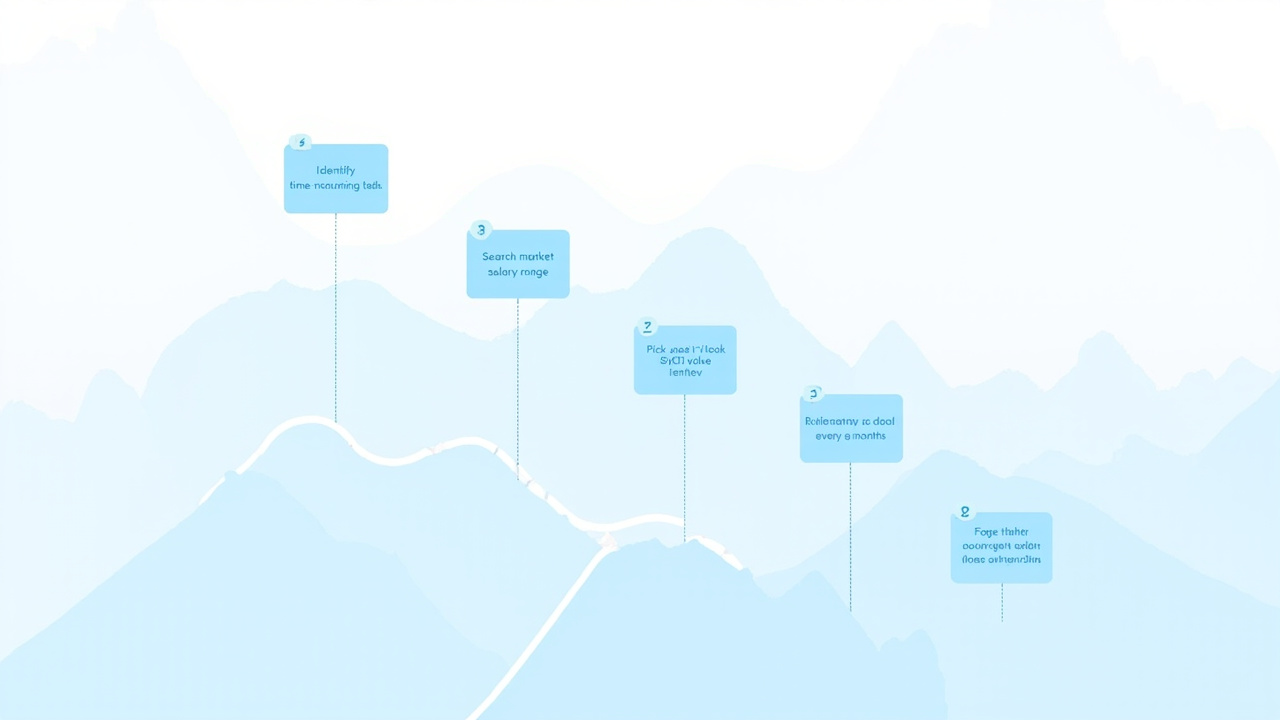
Step 1: Tonight, open your phone’s notes app and write down the three most time-consuming repetitive tasks in your job, and for each one estimate how many hours of your week it consumes. This takes less than five minutes, but it is the starting point of your entire skill-upgrade plan.
Step 2: This weekend, spend two hours on 104 HR Bank searching for openings that combine your current role with AI keywords, and see what AI-skill requirements the market is asking for and what salary range is on offer. This action will give you a very real market price for yourself.
Step 3: Based on your industry and role, pick the AI tool that most directly lifts your work output, and spend two weeks using it in a real work scenario, recording the before-and-after difference in time and output quality. Do not try to learn five tools at once; master one, produce a quantifiable result, then move to the next.
Step 4: Reassess your skill market every six months. Open 104 or 1111 and re-search the market for your role. Compare it to the skills you have updated over the past six months. Has your market value risen? If so, bring quantified data to your manager and negotiate a salary adjustment; if not, recalibrate your skill-investment direction.
7. Two Overlooked Taiwan-Specific Resources
Resource 1: Free Subsidized Courses from the Workforce Development Agency, Ministry of Labor
Taiwan’s vocational training authorities provide subsidized courses covering digital skills and AI-related training, with some courses fully subsidized or subsidized at over 80%.
Many Taiwanese white-collar workers do not know this, and they spend tens of thousands on private courses, when in fact through the Workforce Development Agency’s In-Service Digital Skills Training Program you can complete equivalent or even more rigorous training at a very low out-of-pocket cost.
You can go directly to the Workforce Development Agency’s official website and search for “in-service worker digital skills training” to check your eligibility and the courses you can apply for. This information is public, but very few people know about it.
Resource 2: Taiwan’s Workplace Culture of Active Salary Negotiation
Taiwan’s salary-negotiation culture has a very local characteristic: “only those who speak up get a chance.”
According to 104 HR Bank’s survey, more than 60% of Taiwanese white-collar workers never proactively request a salary adjustment — they wait for the company to offer one.
But the reality is that in a market with skill premia, company salary-adjustment mechanisms are usually slow to react; they respond to the market average, not your individual market value. If you do not proactively come to the table with quantified data, the company will not proactively give you a raise above the average.
Learning to speak up is the most undervalued financial skill for Taiwanese white-collar workers.
8. Contingency Plan: What If Your Industry Faces a Massive AI Replacement Wave?
If your industry faces a large-scale AI replacement shock over the next three to five years — for example, traditional manufacturing quality-control roles, general administrative assistants, or basic data-processing positions — your skill-upgrade strategy cannot just be layering AI tools onto your existing role.
You need to think about cross-functional skill migration.
The most effective strategy is to find your transferable core competencies — capabilities that do not depend on any specific industry knowledge but are needed across multiple industries, such as data analysis, process design, or client communication — and then layer AI skills on top of those transferable competencies, so that you have cross-industry employability.
This process can take one to two years of preparation, so the earlier you start the better. Do not wait until the industry shock has already happened to begin.
9. Execution Strategies for Different Groups
- Students or fresh graduates: Now is your best timing. You do not carry the baggage of old work habits, and your learning cost is the lowest. Before you look for your first job, spend three months systematically building an AI-assisted portfolio so the employer sees your real production ability in the first minute of the interview.
- Young working families with mortgages and kids: Monthly salary NT50,000, learning time very limited. Your strategy should be sharp focus — invest only 5 to 10 hours per week, concentrated on the one skill point that most directly affects your salary. Do not be greedy. Use the minimum viable execution and allow yourself to go slow, but do not stop.
- Mid-career professionals: The key is to amplify your business experience and judgment into quantifiable output using AI tools, so the company sees your irreplaceability. This positioning is your most competitive strategy at this age.
- Pre-retirees with 5 to 10 years to go: The goal is not to catch up to young people’s technical level, but to amplify your business experience and judgment into quantifiable output with AI tools.
10. The Final Core Decision Framework
The biggest risk of skill investment is not learning the wrong tool — it is never starting at all.
The era of earning only from a job has not ended, but the era of earning raises only through seniority really is over. Every choice you make right now is determining whether you will be standing on the side of the salary premium or the side of passive waiting five years from now.
In the era of skill inflation, your salary ceiling is set by when you most recently updated your skills, not by your years of service.
This article is for financial and career-education purposes only and does not constitute any investment advice or career-planning advice. All salary data is sourced from public materials published by Taiwan’s DGBAS, the Ministry of Labor, 104 HR Bank, 1111 Job Bank, and the IEK of ITRI, for reference only. Individual career outcomes vary and are influenced by personal capability, industry environment, and the broader economy. For personal career or financial planning advice, please consult a Taiwan-licensed career counselor or financial advisor. For all skill-investment and career decisions, please evaluate the risks and benefits based on your own situation.
Disclaimer: This article shares investing concepts and compiled reference material. It does not constitute any specific investment, tax, or legal advice. Markets carry risk and investing requires caution; please make independent judgments based on your own risk tolerance and consult a professional advisor.
Tags
AI Skill Premium, Salary Growth, Skill Inflation, Seniority to Salary, 104 Job Bank, Digital Skills, Workflow Automation, Data Analysis, AI Content Generation, Cross-Functional Skills, On-Job Training Subsidy, Salary Negotiation, Mid-Career Workplace
Comments