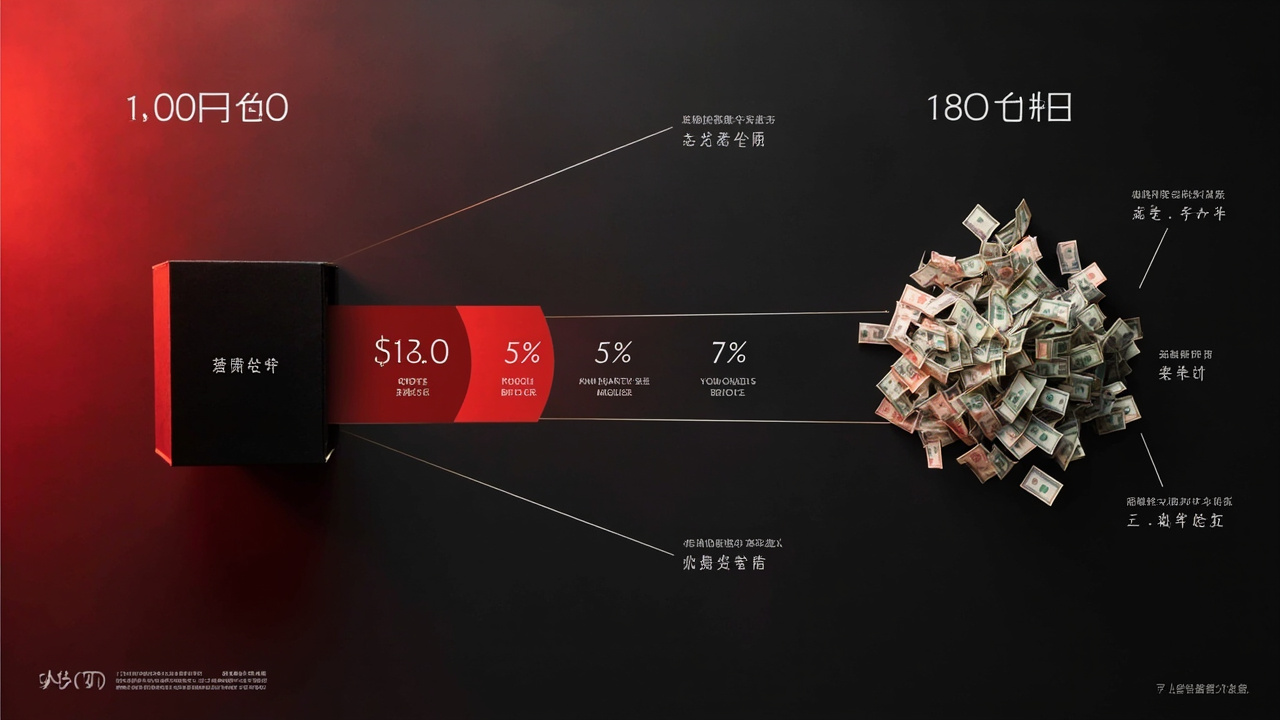
Hey, let’s call one fan Xiao Zhang. A few days ago he sent me a long private message. He said he’d given his all as a salesperson, talked his lips raw, smiled until his face hurt, and finally closed an order worth NT$10,000. The client was very happy and paid on the spot. It was the most glorious moment of his month — he was already daydreaming about what that commission could add to his family.
Then payday came. He opened his pay stub and checked it over and over, and finally in an inconspicuous corner, found the commission tied to that order. Guess how much? NT$250.
At that moment, Xiao Zhang said, he felt like he wasn’t inside a modern company but inside a giant, precision-tuned casino. He had bet his time and his dignity and walked away with the client’s NT10,000 in chips could only be exchanged for NT$250 in cash.
The remaining NT$9,750 vanished as if into thin air, and had nothing more to do with him.
You might think — is this company just unusually evil? But today I want to tell you that this isn’t an isolated case; it’s actually the underlying operating code of our commercial society. Xiao Zhang’s story is like a calm prism, refracting a reality that all of us live every day, a reality carefully wrapped in words like “stable benefits” and “career development.”
1. Tracking the Missing NT$9,750
Let’s play detective for a moment and trace where the missing NT$9,750 went. Of course this money didn’t simply evaporate — it flowed into a system, one we call “the company.”
Xiao Zhang told me that his company’s salary system is like a tightly woven net, full of terms ordinary employees can’t decode. First, his NT$10,000 in sales gets cut in half by something called a “conversion factor.” The company’s justification: your sales depend on the company’s brand, visuals, marketing, and technical support, so your personal contribution only counts for 50%.
You see, the very first slash already used a rule to wipe out half his credit. The remaining NT5,000 — the rationale being that the company still has to pay office rent, utilities and internet, admin staff salaries, finance and legal costs, and — most importantly — set aside reserves for future risk and generate profit for shareholders.
NT250. Every figure, every percentage, is written clearly into the employment contract. The moment you signed it, you tacitly accepted this set of value-distribution rules.
2. Work and Earning Are Two Different Things
You may feel indignant, but from a legal and business-logic standpoint it’s bulletproof. This is the cruelest thing about work: between the value you create and the pay you ultimately receive, there is always a vast, opaque black box.
The NT10,000 enters the company’s black box, it gets broken down and reassembled under countless line items called costs, fees, factors, and profit — and what finally lands in your hand is just the small slice that this complex system “allows” you to have.
This brings us to the core of today’s discussion: work and earning are fundamentally two different things. They are, in fact, deeply at odds with each other.
3. What Is the Real Nature of Work?
The core of work is: doing things for someone else. It’s essentially a transaction — the company buys your time and skills, stuffs the value you create into a black box, then returns a small slice to you according to the rules it has written.
You think you’re “earning money,” but you’re actually “exchanging money.” You trade 8 hours of time, wear and tear on your health, and emotional drain for a number on a slip that reads NT$250. This is not earning; this is transacting.
Real “earning” means converting value directly into cash, without passing through anyone’s black box.

4. Four Signals Telling You It’s Time to Leave Work Behind
That doesn’t mean all jobs are worthless — you just need to read these four signals:
- Your salary grows far more slowly than the value you create. When you go from NT50,000, ten times the effort only buys you a 1.67x salary — that’s a sign the black box is getting thicker.
- Your core skills have zero market value outside the company. When leaving the company means you can’t find an equally paid job, you’re not working — you’re being held hostage.
- You can’t see the full picture of how your value is monetized. You only know your monthly salary; you don’t know how much value you created or where it went.
- By the time you clock out each day you have no energy left to learn anything new. This is the black box striking back — all your energy is being squeezed dry by the company, with nothing left for yourself to accumulate.
Conclusion: See the Black Box and You Have a Choice
Xiao Zhang’s story is not an isolated case; it’s a structure. The name of this structure is “asymmetric value distribution” — you create NT9,750, and tells you it’s “reasonable.”
Want to break through? Only two paths:
- Inside the company, climb into the position that “designs the black box.” That means becoming the rule-maker rather than the rule-taker.
- Leave the company and design your own value-monetization path. Convert the NT9,750 off the top.
Work is a means, not an end. Once you can see every layer of deduction, every coefficient, and every rule inside that black box, you finally get to decide: stay inside the system, or step out and design a way of monetizing value that doesn’t need a black box at all.
This article is a sharing of workplace and financial-literacy concepts and does not constitute investment advice. Salary systems vary by company; please make actual decisions based on your personal situation and consult a properly licensed labor or financial advisor.
Disclaimer: This article shares investment and financial concepts and summarizes data; it does not constitute any specific investment, tax, or legal advice. Markets carry risk; invest with caution. Please make independent judgments based on your own risk tolerance and consult a professional advisor.
Tags
上班不賺錢, 折算係數, 提成制度, 價值分配, 黑箱, 黑心公司, 銷售員, 勞動契約, 商業模式, 財商覺醒
Comments