
Have you ever had this moment: 1 a.m., your phone screen glowing, your account in the red—not a little red, but a red that gets deeper the longer you wait.
You’ve already doubled down, told yourself to wait a little longer, and yet it just keeps getting deeper. You start replaying everything: did I buy too early? Did I lose my nerve? Not enough information? Not smart enough? Then you glance at your balance, then at your age—30, 32, 35—and an unspeakable fear hits you: if I can’t get a handle on money now, what about later?
What’s even more painful is that you’ve clearly been trying hard: watching candles, studying financial statements, scrolling news, listening to big names. When you win it feels like picking up money from the ground; when you lose it feels like leaking water—after a year your account quietly shrinks by 30%, 50%, or more.
You think the problem is investing, but you’ve likely been kept in the dark the whole time. What’s truly eating your future isn’t just the losses—it’s something more hidden. In the 2026 workplace shake-up, you’re trading your most valuable assets for something worth the least, and you haven’t even realized it yet.
Here’s the conclusion upfront: it’s not that you don’t try hard, and it’s not that you aren’t smart—it’s that you’re playing a game whose rules are extremely unfavorable to you, and you’ve been using the wrong chips.
Layer One — The Rules: You’re Wagering Against a Time Monster
You think investing is about who’s better at picking stocks, but in the real world it’s about who can last longer and burn more steadily.
Let me give you a number: if your account loses 50% in a year, you need to make 100% the next year just to break even; if you lose 70%, you need to make 233%. Sounds outrageous, but that’s math, not emotion. The cruelest thing about the market is that it lets you lose money fast, but makes recovery extremely hard.
Now another fact: an ordinary person only has about 3 to 4 hours of effective decision-making time per day; past that, the brain tires and judgment drops. But the market? It runs 24/7, with an information blitz and emotional swings. And who are you up against? Algorithmic-trading institutions, teams working around the clock in shifts, systems that can place an order 0.001 seconds faster than you.
It’s like what? You’re bringing a kitchen knife to a mining-excavator contest—you’re not losing because you didn’t try, you’re losing because the rules are stacked.

Layer Two — The Psychology: You’re Not Investing, You’re Being Designed
Have you noticed something? You’re always afraid to buy when it’s going up, and reluctant to sell when it’s going down. This isn’t your problem—it’s the default setting of the human brain.
In psychology there’s a term called loss aversion—simply put, the pain of losing NT100. So you hold on stubbornly when you lose, and you run away quickly when you make a little.
And the market’s specialty is exploiting this weakness. Take the 2008 financial crisis: many stocks first staged a fake rebound before falling. Why? Not because the market was kind—it was to give you the illusion: “Has it stopped falling? Should I bottom-fish?” The moment you step in, it keeps falling. What’s that called? A shakeout.
Now an even crueler statistic: studies show that more than 80% of retail investors underperform the index over the long term. Not by a little—by a lot. Why? Because they make decisions at the moments of strongest emotion: cutting losses in fear, chasing highs in greed. And what are institutions doing? Exactly the opposite.
So you think you’re trading, but actually you’re being traded by your emotions.
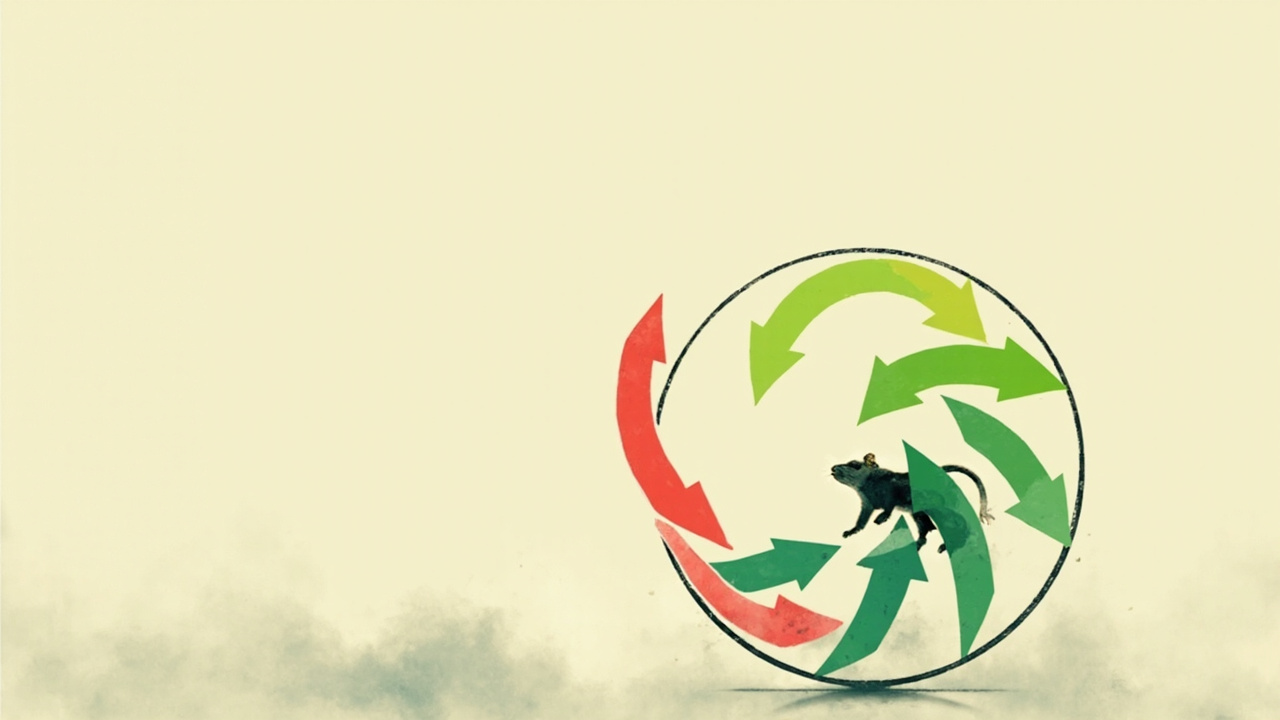
Layer Three — The Deeper Logic: The Real Asset Isn’t Money, It’s You
Let’s go one layer deeper. Why is it that when two people both lose money, one can bounce back while the other sinks further? The answer is something many overlook: human capital. In plain words, “your ability to earn in the future.”
Picture this: your account is down NT300,000 a year, that NT200,000 becomes a heavy blow.
It’s like a sandpile experiment: drop sand grain by grain, it looks stable, but at some point one tiny grain triggers an overall collapse. The workplace is the same: after 35, your ability to absorb risk isn’t measured by how much savings you have, but by whether you can keep creating value.
The 2026 trend is crystal clear: AI is replacing repetitive labor, companies are cutting replaceable people. Who survives? Not the hardest workers, not the most拼—those who are hardest to replace.
This is why I say you’ve been trading your most valuable things for the cheapest: you spend your time, experience, and focus on high-frequency trading and short-term speculation—what’s the result? You don’t make money, and you don’t build any ability either. That’s the most expensive price.

The Only Solution: Demote Investing from a Main Job to a Tool
So what do you do? Is there a path ordinary people can really walk? Yes. And it’s boring—in fact, it’s anti-human nature.
The only solution: stop trying to make money with money, start making money with yourself. The core idea is just one sentence: demote investing from your main job to a tool. You’re not going to翻身 through investing; you’re going to翻身 through your ability—investing is only there to keep you from being淘汰 by the times.
Method 1: Build a core-satellite portfolio. Simple: put 80% of your core assets in long-term index funds—for example, broad-market ETFs—don’t fuss, don’t trade frequently; let 20% to 30% of satellite assets be where you experiment, learn, and even take small bets. That way you can still participate in the market without being destroyed by it.
Method 2: Let your age decide your risk. A simple formula: 100 minus your age equals the percentage of risk you can bear. For example, if you’re 35, no more than 65% in volatile assets; the rest in something steadier. This isn’t absolutely correct, but it’s 100 times better than going all-in.
Method 3: Do a human-capital checkup once a year. Ask yourself three questions:
- Will the skills I have now still be worth money in three years?
- Am I continuously learning new capabilities?
- If the company lays me off tomorrow, do I have a second path?
If the answers make you uncomfortable, that’s right—it means you see the problem.
Conclusion: You Think You’re Gaming the Market, But You’re Wagering Against Time
You think what you’re missing is one turnaround, but what you’re actually missing is a system that lets you survive. Money can be lost and earned back, but if you lose your ability to earn—that’s the real zero.
Open your brokerage account now, ignore the returns, and ask yourself three questions:
- If trading were shut off tomorrow, would I still hold these assets?
- If they drop another 30%, can I bear it?
- If I cleared my position today, would my life get better or just more anxious?
If you don’t dare answer, that’s not the market’s problem—it’s time to redesign your life’s asset allocation.
Disclaimer: This article shares opinions and financial education only, and does not constitute any investment advice. Investing involves risk; past performance does not guarantee future returns. Please carefully assess your own risk tolerance before making decisions.
Disclaimer: This article shares investment concepts and compiled reference material. It does not constitute any specific investment, tax, or legal advice. Markets carry risk and investing requires caution; please make independent judgments based on your own risk tolerance and consult a professional advisor.
Tags
Investment Psychology, 時間陷阱, 損失厭惡, 人力資本, 核心衛星策略, 100 減年齡法則, Short-Term Trading, Retail Losses, AI 替代, 35 歲危機, Risk Management, Career Competitiveness
Comments