Why Are You the Only One Losing Money in a Booming Taiwan Stock Market? 6 Fatal Retail Investor Mistakes
The Taiwan Weighted Index has broken 20,000 points, and your account is still all red.
This is not a luck problem. This is the mistake you keep making.
A coworker says he made 30% on TSMC, and someone in the group chat says MediaTek doubled. You open your statement, and the loss number sits there quietly, like a silent slap.
The Taiwan stock market is clearly surging, so why are you the only one losing money? You start wondering whether you are simply not cut out for investing.
But let me tell you—it is not bad luck. You have stepped into the most common fatal mistakes that retail investors make, and you may not even realize you are making them.
This article breaks down 6 mistakes for you. Each one is a real wealth black hole. Count how many apply to you.
The index rises, but you lose to your own humanity. Once you understand this sentence, you will know why the Taiwan market keeps climbing while your account keeps sliding.
1. The Real Rally in Taiwan Stocks vs the Brutal Reality for Retail Investors
The Taiwan Weighted Index rose from a 2020 COVID low of roughly 8,000 points to over 20,000 points in 2024, a four-year gain of more than 150%. This is public data from the Taiwan Stock Exchange (TWSE).
However, according to statistics from the Securities Investment Trust and Consulting Association (SITCA), among retail investors who hold stock accounts in Taiwan, the proportion who achieve stable long-term profits is far lower than you imagine.
Many people enter the market full of confidence and exit with shrunken accounts, only to declare “the stock market is a scam.”
The stock market did not scam you. The way you operate is what is hurting you.
2. Six Fatal Mistakes
Mistake 1: Chasing Rallies and Selling on Dips—Letting Emotions Replace Judgment
Have you ever experienced this? TSMC climbs from NT800, and you keep waiting for a pullback that never comes. It climbs to NT900 and you say wait, NT700 and you say enough is enough, you cut your losses. Then it climbs back to NT$1,000.
This is not TSMC’s problem. This is your problem.
What is the essence of chasing rallies and selling on dips? It is using yesterday’s move to decide today’s trade—when something has gone up a lot, you think it will keep going up, so you chase in; when it has fallen a lot, you think it will keep falling, so you bail out. This is the exact opposite of sound investment logic.
Research from the Taiwan Academy of Banking and Finance shows that the result of frequent retail trading is usually that fees and transaction costs eat up most of the pre-cost return. Buying and selling Taiwan stocks both carry a brokerage fee, and on the sell side there is also a 3‰ (0.3%) securities transaction tax.
You think you are catching swings, but in reality you are paying the broker and the government.
Mistake 2: Only Buying Stocks You Have Heard Of—Mistaking Familiarity for Safety
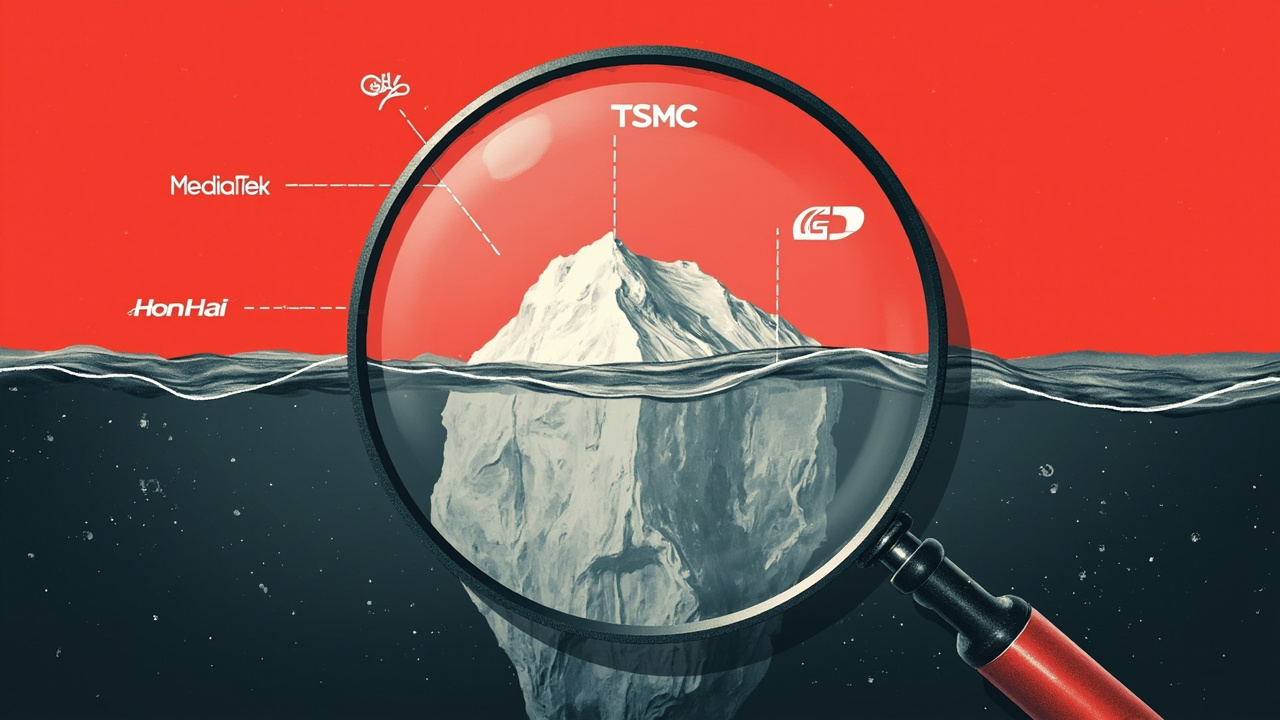
Have you bought TSMC? MediaTek? Hon Hai? You have heard of these stocks, they feel familiar, they feel safe.
But have you considered—is your understanding of these companies genuine fundamental analysis, or just “I heard they are strong”?
One of the biggest cognitive blind spots for retail investors is equating brand recognition with an investment margin of safety. These two things are completely different. A company whose phone you use every day does not mean its stock is reasonably priced right now. A company you have never heard of does not mean its stock has no investment value.
Stock prices reflect the market’s expectations of future earnings, not how famous the company is today.
Even more dangerous, because you are familiar with a few stocks, you concentrate most of your capital on them, with no diversification at all. In 2022, the Taiwan market pulled back more than 30% from its high, and many retail investors heavily concentrated in semiconductors saw their accounts shrink far more than the broader index.
Concentrated positions look impressive in a bull market and turn into a disaster in a bear market.
Mistake 3: No Asset Allocation—Putting All Your Eggs in One Basket
Many people have heard the term asset allocation, but few actually practice it. The FSC’s investor education materials make clear that diversification is one of the core principles of managing investment risk—this is not theory, it is an iron rule of how markets work.
Real Account Check on 3 Approaches
Suppose you have NT$1M of investable assets:
Approach A: All-in on a single stock (say a single electronics name you are bullish on)
- In 2022, the Taiwan market’s maximum drawdown exceeded 30%. If your pick fell even harder, your NT600,000, or less
- This is not a hypothetical; it was the real experience of many retail investors in 2022
Approach B: Splitting the NT$1M into parts
- NT$600,000 in a Taiwan broad-market ETF (such as 0050 or 006208, tracking Taiwan’s top 50 companies)
- NT$200,000 in a savings account or short-term fixed deposit as a liquidity buffer
- NT$200,000 allocated to other asset classes depending on personal circumstances
- In 2022, 0050’s maximum drawdown was roughly 30%, but it holds Taiwan’s 50 most core companies, and historically every major drawdown has been followed by a full recovery
Approach C: Not investing at all, putting NT$1M in a bank fixed deposit
- In 2023, Taiwan’s inflation was about 2.5%, and fixed deposit rates were roughly 1.5% to 2%—real purchasing power was shrinking
- This is also a choice, but you must be aware that your money is quietly thinning out
Historical Extreme Scenarios
- 2000 Tech Bubble: Taiwan stocks fell from 10,000 points to 3,900, a drop of more than 60%
- 2008 Global Financial Crisis: Taiwan stocks fell from 9,800 to 3,900, a maximum drawdown of more than 58%
- 2020 COVID Pandemic: Taiwan stocks fell from 11,000 to 8,500 in just one month
If you had gone all-in on a single stock at these moments, many people never saw a recovery to breakeven. But if you held a diversified Taiwan stock ETF, every one of these events recovered to a new high within a few years.
Diversification is not about maximizing your returns; it is about keeping you alive long enough to wait for the market to reward you.
Mistake 4: No Stop-Loss—Holding Onto Losers Forever
This mistake stings especially because it sounds so reasonable.
You buy a stock that drops 20%, and you say no problem, I am a long-term investor. It drops 30%, and you say I still believe it will come back. It drops 50%, and you say it has already fallen so much, I cannot sell. And so you stay stuck, sometimes for years.
Let me clarify a very important concept for you: long-term investing and holding onto a losing position are two completely different things.
- Long-term investing only makes sense when: the fundamentals of the company you bought have not changed, or you are buying a broad-market index fund that tracks the overall market. The Taiwan Weighted Index’s long-term upward trend is supported by the fundamental earnings growth of Taiwan-listed companies as a whole—in this case, holding long-term is logical
- But if you bought a stock whose fundamentals have deteriorated (revenue is declining, profits are falling, the industry’s outlook is worsening), continuing to hold is not called long-term investing. It is called refusing to admit you were wrong
The core difference between these two is—did you set your investment thesis before buying, and do you have the courage to exit when that thesis is invalidated?
Investing without a stop-loss plan is not investing. It is a combination of gambling and an ostrich mentality.
Mistake 5: Being Led Around by News and Group Chat Messages
Do you have a few stock groups on your phone? Every day someone posts “this one is about to pop,” “insider pick,” “whales are loading up”?
Let me tell you directly what these messages really are—by the time a message is circulating in a group chat, it is no longer news.
Truly useful information has already been digested by institutions, professionals, big players, and information-advantaged players before it ever reaches your group. The group chat messages you see are, more often than not, someone else’s exit liquidity.
The TWSE and the FSC have long promoted the message that retail investors should base their decisions on public information, financial reports, and legitimate research, not on messages of unclear origin.
Taiwan’s Securities and Exchange Act clearly defines the legal liability for insider trading. If you trade based on undisclosed inside information, you may be breaking the law. A more practical concern is—even if the information is real, you do not know how many hands down the chain you are from the source, nor how many people are still waiting to sell after you buy in.
Retail investors who follow group chat messages are, most of the time, the last ones to hold the bag.
Mistake 6: Not Understanding What You Bought—Treating Investing Like a Lottery
For the stocks in your account right now, can you tell me the EPS from the most recent quarter? Is the P/E ratio historically high or low? Who are the main competitors? What are the main risks?
If you cannot answer any of these, then what you bought is not an investment. It is a gamble.
I am not saying you have to become a financial analyst. I am saying you at least need to know where your money went and under what circumstances you will exit.
This problem is especially common in Taiwan because opening a brokerage account here is so easy—download the app, fill in your details, and you can start trading in a few days. Low barriers to entry are good, but they also push many people to throw money in without any understanding of how the market works.
According to SITCA, the asset size of Taiwan’s ETF market has grown rapidly in recent years, with a significant share coming from retail investors. For ordinary investors who lack the time and ability to do deep single-stock research, participating through ETFs is actually a relatively reasonable choice—because you are buying the growth of the entire market, not betting on the fate of a single company.

3. Four Veto Rules
Rule 1: Your investment capital must be money you can spare beyond 3 to 6 months of living expenses. This is the most basic precondition. If you have poured in your living expenses and emergency reserve, the moment the market drops you will be forced to exit at the worst possible moment.
- Students and fresh graduates: the emergency reserve standard is 3 months of living expenses
- Middle-aged families with dependents: the standard should be raised to 6 months
Rule 2: No single stock position may exceed 20% of your investable assets. If you cannot meet this diversification standard, honestly just buy a broad-market ETF; do not try to pick stocks.
Rule 3: Before buying anything, you must answer two questions—first, why are you buying it? second, under what circumstances will you exit? If you cannot answer these two, do not buy.
Rule 4: Do not touch any financial product you do not understand. Whether it is a complex structured product, a leveraged ETF, or any new gimmick you saw in a group chat, if you cannot explain how it works and what the risks are in one sentence, do not touch it.
4. Four Steps to Take Action
Step 1: Open your brokerage app and list every stock you currently hold. For each one, ask yourself those two questions: “Why did I buy this?” “Under what circumstances will I exit?” If you cannot answer for a stock, you need to reassess. Major Taiwanese brokers such as Yuanta, Fubon, Cathay, and KGI all have full position-detail functions in their apps.
Step 2: Calculate whether your emergency reserve is sufficient. Open your banking app and confirm that your savings or short-term fixed deposits hold at least 3 to 6 months of living expenses. This money is not for investing. Its function is to keep you from being forced to sell stocks at the worst possible moment.
Step 3: If you have not yet started dollar-cost averaging into a Taiwan broad-market ETF, set it up today—0050 tracks Taiwan’s top 50 companies; 006208 tracks the FTSE Taiwan Quality Index. Both are FSC-approved compliant ETFs, with full public disclosure available. The logic of dollar-cost averaging is to lower your average cost through staggered buying, reducing the risk of going all-in at a single high. Once set up, do not check it daily. Let time do the work.
Step 4: Set your annual review time. Every January, spend one hour revisiting your portfolio and ask yourself three questions:
- Is the reason I bought each holding still valid?
- Has my asset allocation drifted from my original target because of market moves?
- Have my financial goals changed?
Rebalance based on the review results, not on daily market news.
5. Two Overlooked Taiwan-Specific Traps
Trap 1: Tax Mechanics of ETF Distributions
ETF dividend income in Taiwan must be reported as part of consolidated personal income tax. According to Ministry of Finance rules, dividend income can be combined with other income or computed separately:
- Separate calculation at a flat 28% rate
- Combined into your consolidated income tax calculation
For investors with higher incomes and higher marginal tax rates, choosing the right calculation method is legal tax optimization. This is not about teaching you to evade taxes. This is telling you the legal options Taiwan’s tax code gives you.
If your annual income is above a certain level, this detail can save you a meaningful amount each year. For the calculation that fits your own situation, consult a licensed tax professional.
Trap 2: The Quota Logic Behind Relationship-Manager Recommendations
When selling financial products, bank relationship managers (RMs) in Taiwan have part of their performance evaluation tied to product sales volume. This is not to say every RM is out to get you, but the existence of this incentive structure means the product an RM recommends may not be the one that best fits your financial goals—it could be the current month’s bank flagship product with higher fees.
The FSC has regulations on this, requiring financial institutions to implement suitability assessments. Before accepting an RM’s recommendation, you can directly ask them:
- What is the product’s sales fee?
- What is the management fee?
- What is your flagship product this month?
You have the right to ask these questions, and the RM is obligated to answer.
6. Emergency Plan for Extreme Market Conditions
If the market suddenly drops more than 20%, what should you do?
- Do not panic-sell. Historical data tells you that Taiwan stocks have fully recovered after every major decline, but the moment you sell, your paper loss becomes a realized loss
- Check whether your emergency reserve is sufficient. If you have enough reserve, you have the ability to leave your investment positions untouched and wait for the market to recover
- If you are dollar-cost averaging, keep going. Do not stop. When the market falls, every DCA contribution buys you more units—this is the core advantage of dollar-cost averaging in a falling market
- Do not try to bottom-fish a single stock. You do not know where the bottom is—the history of 2000 and 2008 shows that many bottoms people thought were the real bottom turned out to be halfway down the mountain
7. Decision Aphorisms You Can Reuse Long-Term
Before you decide to buy, first clarify under what circumstances you will sell. This one sentence can help you avoid the biggest emotional trap in any market environment.
The index rises, but you lose to your own humanity. You committed 6 mistakes—chasing rallies, only buying familiar stocks, no asset allocation, holding onto losers, following group messages, buying things you don’t understand—each one has human nature at its root: your fear of missing out, your fear of admitting you were wrong, your fear of trouble, your fear of being alone.
These human weaknesses are the real reason you are still losing money in a Taiwan bull market.
Once you know where the problem is, you can solve it. Hold the four iron rules, take the four action steps today, and you have already beaten the majority of retail investors in the market.
All content in this article, including data analysis, strategy explanations, and operational advice, is for financial education only and does not constitute any investment recommendation or solicitation for any financial product. All investments carry risk, and past market performance does not guarantee future results. Each investor’s financial situation, risk tolerance, and investment goals differ. Before making any investment decision, please carefully assess the risks on your own and consult a Taiwan-licensed financial advisor or tax professional. This channel does not provide individual stock recommendations, does not promise any investment return, and does not engage in any account management or investment advisory services.
Disclaimer: This article is a sharing of investment and financial concepts and a compilation of information, and does not constitute any specific investment, tax, or legal advice. Markets carry risk; invest with caution. Please make independent judgments based on your own risk tolerance and consult professional advisors.
Tags
Retail’s 6 Mistakes, Chasing Rips Dumping Dips, Asset Allocation, Stop-Loss Discipline, Group Chat Trap, Diversification, Single-Stock Concentration Risk, Broad Market ETF, 0050 DCA, Suitability Assessment, Tax Planning, Emergency Reserve
Comments