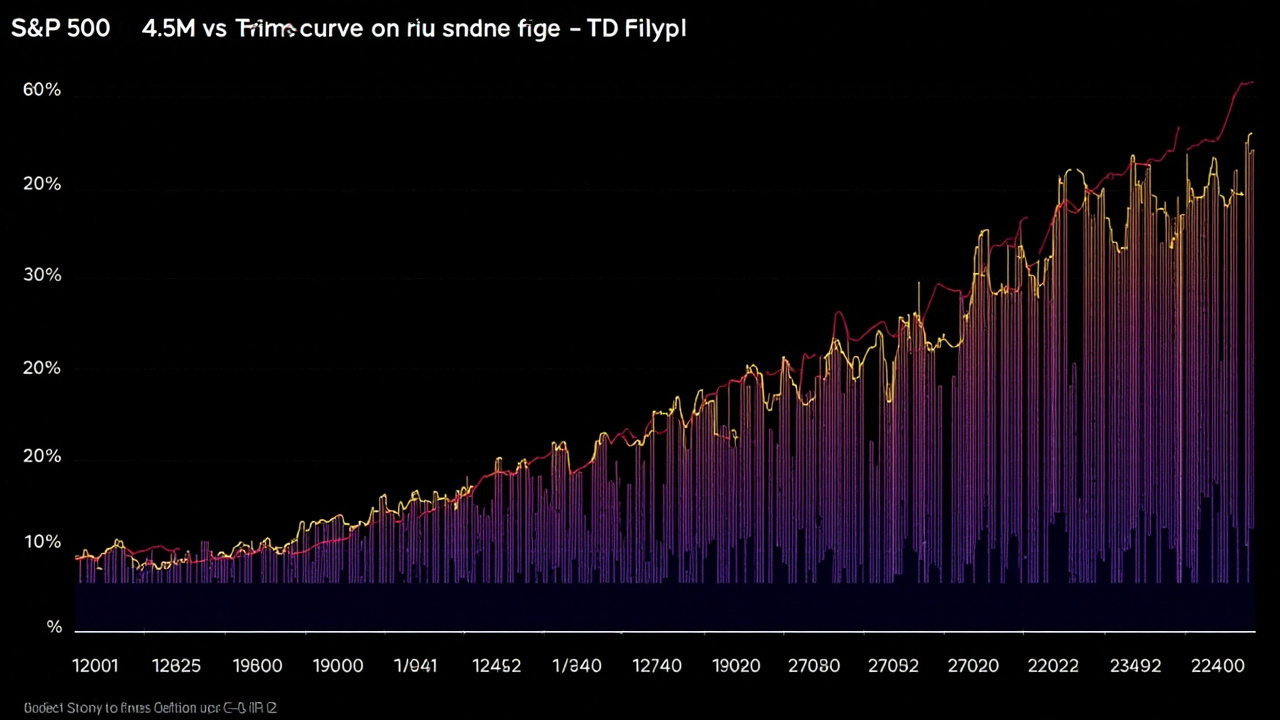
Pick the wrong index fund and your retirement gap can reach three times. Not a little — three times. This isn’t scare talk; it’s real numbers.
You open your broker APP, see S&P 500 and Nasdaq 100 as options, hesitate for five seconds, then click one by gut feel. Or you don’t think much about it at all, because a friend said buy this or that, because some finance blogger said Nasdaq 100 is hotter so you follow along. You think it doesn’t matter which you pick — they’re both US stocks, both indices.
But it’s exactly this “it doesn’t matter” mindset that could cost your retirement several million NTD. Even more painful: it’s not that you picked wrong; it’s that you don’t know you picked wrong. You diligently contribute every month thinking you’re being responsible with your money, but 20 years later you open the account to find that thinking for one more minute back then would have given you a completely different result.
Standard definitions first
S&P 500 tracks the Standard & Poor’s 500 Index, covering the 500 largest US-listed companies by market cap, spanning 11 industries including IT, financials, healthcare, consumer, energy, and industrials. It is currently the most widely referenced US equity benchmark in the world.
Nasdaq 100 tracks the 100 largest non-financial companies listed on the Nasdaq exchange, with tech stocks making up over 50% long-term, including Apple, Microsoft, Nvidia, Amazon, and Meta — a highly concentrated index of tech and growth companies.
Translating the gap between these two definitions into plain language: S&P 500 is a balanced lunch box with meat, vegetables, and rice; Nasdaq 100 is an entire plate of steak. It’s great when you’re doing well, but when your stomach is bad it can hurt you to the point of speechlessness.
Account 1: the 20-year final gap
Suppose you are a Taiwan office worker earning NT6,000 per month on DCA — around the average DCA amount per SITCA statistics. From 2003 through 2023, full 20 years, you never added a single cent more, never a single cent less, never paused.
**If you buy an ETF tracking the S&P 500, based on the S&P 500’s roughly 9.8% annualized total return over the past 20 years, your account would have about NT1.44M, the account tripled.
If you buy an ETF tracking the Nasdaq 100, same 20 years, same monthly NT7M.
Here’s the gap: same 20 years, same principal, just by choosing a different index the account differs by over NT$2M. That’s where the headline “3x gap” comes from — not that the principal is 3x, but that the final wealth gap puts your retirement living standard a whole level apart.
Account 2: the worst-case test
But I must show you the worst case clearly. In the 2000 dot-com bubble, the Nasdaq 100 dropped nearly 83% from peak — yes, 83%; the S&P 500’s maximum drawdown in the same period was about 49%. If you had gone all-in on Nasdaq 100 in early 2000, how long would recovery take? The answer is nearly 15 years — until 2015 to fully return to the 2000 high. S&P 500? About 7 years to recover.
In the 2008 financial crisis, the S&P 500 dropped about 57%, the Nasdaq 100 about 54%; the two were similarly brutal, but S&P 500 recovered slightly faster.
In the 2022 rate-hike storm, the Nasdaq 100 fell 33% for the year, the S&P 500 fell 19%. Your account shrinks by a third in a single year — what does that feel like? You diligently saved NT$6,000 each month, but every month your account evaporated more than you saved. That feeling drives many people to stop or even redeem at the worst moment.
This is the Nasdaq 100’s biggest hidden cost — not transaction fees, not management fees, but its volatility amplitude causes ordinary people’s mindset to collapse at the critical moment, leading to the worst possible decision.
5底层 rules
Rule 1: Volatility amplitude determines whether you can hold through the full cycle
An index’s volatility amplitude is not just a number; it’s the psychological threshold of whether you can hold through the full investment cycle. FSC data shows the average holding period of Taiwanese fund investors is in fact not long; many choose to redeem when the market drops hard. This behavior alone wipes out the long-term compounding advantage.
So picking an index is not picking who goes up the most, it’s picking the one you can still hold through the worst.
Rule 2: Look at volatility vs return across the full cycle
Nasdaq 100’s long-term return is 3% to 4% higher than S&P 500, but its volatility is also 30% to 50% higher. This risk premium is worth it on a 20-year horizon, but only if you can hold through 30%, 50%, or even 80% drawdowns without stopping or redeeming.
Most retail investors can’t.
Rule 3: Adjust core ratios by age
There’s no standard answer, but there’s a universal principle:
- Ages 25–35: Can tolerate higher volatility, recommended 70% Nasdaq 100 + 30% S&P 500, or skip Nasdaq and do 80% S&P 500 + 20% bonds
- Ages 35–50: Family and mortgage pressure; recommended 50% S&P 500 + 30% Nasdaq 100 + 20% bonds
- Ages 50–60: Approaching retirement; recommended 60% S&P 500 + 20% Nasdaq 100 + 20% bonds
- Ages 60+: Capital preservation priority; recommended 40% S&P 500 + 20% Nasdaq 100 + 40% bonds

Rule 4: Diversify using core + satellite
Don’t put all your retirement money on a single index. The core position (70% to 80%) uses a broad index like S&P 500 to capture stable market returns; the satellite position (20% to 30%) uses Nasdaq 100 or sector-specific ETFs to seek excess return.
The biggest benefit of this structure is when Nasdaq 100 drops 33%, your overall account only shrinks 10% to 15%, which is psychologically more bearable.
Rule 5: Tech concentration risk
Tech makes up over 50% of Nasdaq 100, with the top 10 holdings (Apple, Microsoft, Nvidia, Amazon, Meta, Google, etc.) often exceeding 40%. That means more than half of your Nasdaq 100 money is concentrated in a handful of companies. When tech faces antitrust, AI bubble burst, or geopolitical shocks, the drawdown will be very severe.
How to use this logic to pick an index
Ask yourself three questions first:
- Can I tolerate a 30% one-year loss without flinching? If not, anchor on S&P 500.
- Do I have 15+ years of investment horizon? If not, don’t go all-in on Nasdaq 100.
- Do I have a stable cash flow to keep contributing? If not, anchor on S&P 500.
After answering, allocate via the core + satellite framework, don’t go all-in. This is not about maximizing returns; it’s about making sure you can hold through the worst.
Why Taiwanese investors pick wrong especially often
Taiwan’s financial media and YouTube channels tend to over-cover high-growth topics like “Nvidia”, “AI”, and “tech stocks”, giving Taiwanese investors an overly glamorized impression of Nasdaq 100. All you see are the up years; no one tells you how investors endured 15 years of waiting after the 83% crash in 2000.
And Taiwanese investors have a special psychology: when they win, they take credit; when they lose, they blame the market. This psychology is particularly dangerous when betting on high-volatility indices — when Nasdaq 100 fell 33% in 2022, many people refused to admit they picked wrong, so they “held on a little longer” and lost more.
The most dangerous thing is never that you picked the wrong index; it’s that you’re unwilling to adjust after picking wrong.
This article is for financial education purposes only and does not constitute investment advice. All investments carry risk, past performance does not guarantee future returns, and actual outcomes may differ materially from the calculations in this article due to market changes, FX volatility, and personal execution. Before making any investment decision, please evaluate your personal financial situation and risk tolerance, and consult Taiwan-licensed financial advisors or accountants.
Disclaimer: This article shares investment and financial concepts and information, and does not constitute any specific investment, tax, or legal advice. Markets carry risk; invest with caution and make independent judgments based on your own risk tolerance, consulting professional advisors as needed.
Tags
S&P500, Nasdaq 100, Pension, Risk Diversification, Volatility, 2000 Dot-Com Bubble, 2022 Rate Hike, Stock-Bond Ratio, Asset Allocation, Portfolio, US Stock ETF, Long-Term Investing
Comments