
Opening: That Night, He Thought He Had Reached the Pinnacle of His Life
Many people think a monthly salary is the starting point of life, but they don’t realize it’s actually a trap that you’ll spend the rest of your life paying off.
The story starts the day Xiaocheng received his first NT$50,000 paycheck. It was a Friday evening, raining in Taipei. He almost ran into the MRT station, clutching that thin payslip tightly. From the Xinyi District he squeezed onto the southbound line, back to the small apartment he shared with his girlfriend Xiaoya in Banqiao. The moment the door opened, Xiaoya was in the kitchen cooking dinner. Without saying a word, Xiaocheng gently but ceremoniously placed that thin payslip in the center of the dining table — like setting down a trophy.
NT$50,000 — for a 28-year-old with no background, who’d come up from Yunlin to hustle in Taipei for three years — was a number earned through countless overtime nights, endless meeting reports, and almost servile smiles for clients.
That night, they didn’t cook — they ordered the most expensive pizza and beer for delivery, and opened the 591 real-estate site for the first time. Not just to browse like before — they seriously went through every listing under NT$3,000,000 for a first home. They talked about the future home’s decor style, about getting a corgi named Qianjin. That night they talked until 3 a.m., until the rain outside stopped.
Xiaocheng lay in bed watching Xiaoya sleeping beside him, his heart full of an unprecedented sense of solidity. He felt he was cruising at high speed on the right track. But he was completely unaware that what made him happy wasn’t that the money itself had grown — it was that he finally looked like a successful person in other people’s eyes — and that perception was the most expensive mistake of his life.
Chapter 1: Lifestyle Creep — The Hidden Price of a Promotion and Raise
After getting the raise, his life did have some small but pleasant changes. The first month, Xiaocheng took Xiaoya to the high-end steakhouse they’d walked past countless times but always turned away from at the door menu. He swiped the card with more swagger than ever before.
The second month, he retired his iPhone 8 with the cracked screen and battery that wouldn’t last half a day — and upgraded to the latest model. The third month, he started picking business lunches over NT$150 instead of the eternal pork-rice box. Life really did seem to be upgrading.
But by the eve of payday in the fourth month, he looked at the balance in his online banking — NT15,000 left. He lay awake until 1 a.m., scrolling back through the entries in his expense-tracking app one by one, and realized that NT$40,000 difference had already been quietly eaten up by the new lifestyle.

The real tragedy isn’t that you don’t have enough money — it’s that you think you’ve upgraded, when in reality you’ve just been silently taken over by a more expensive lifestyle.
Chapter 2: You Think You’re Moving Forward — But You’re a Hamster on a Wheel
Xiaocheng later got promoted, then raised again, with his salary crawling from NT65,000. He moved to a slightly bigger apartment, bought a used domestic car, and sent his parents an extra NT$5,000 a month for filial support. On the surface everything was getting better — but five years later, looking back, he realized that apart from a few extra certifications and a few more wrinkles, the number in his account was almost identical to what it had been five years before.
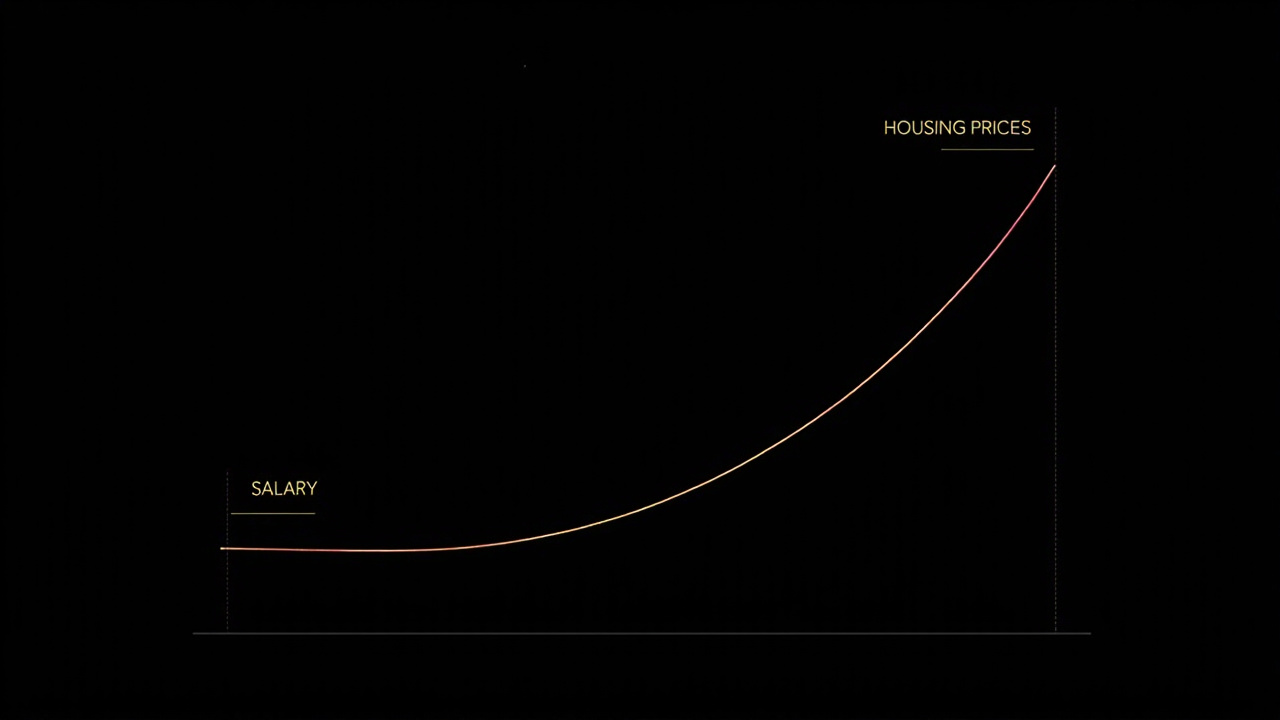
That’s the cruelest part of the promotion-and-raise scam: the return it gives you is always linear, but the growth of housing prices, inflation, and the cost of living is compounding. No matter how fast you run, you can’t outrun the exponential swell of expenses. By the time you’ve finally climbed to what looks like a higher position and looked up, the target you’d been chasing has flown off into the sky again.

He thought back to that night five years ago, when he and Xiaoya were excitedly looking at apartments on 591 — back then, NT600,000, and he doesn’t even dare look. The dream of back then — he can’t even afford the parking space in the ancillary facilities now.
Promotion and raise make you think you’re wrestling with fate, but in reality you’re just running harder on a wheel that’s speeding up.
Chapter 3: The Cruelest Scam in This Society Is Called Promotion and Raise
It took Xiaocheng five years to truly understand: the four characters “promotion and raise” were never a path to financial freedom — they are the pacifier society uses to soothe you. It makes you believe that effort will be rewarded, that good performance will be seen, that endurance will lead to the day that belongs to you.
But the truth is — the boss’s generosity has an upper limit, while your desires are unlimited. When you use a higher salary to buy a higher-class life, and then use that higher-class life to match an even higher salary, you get locked into a cycle that can never stop spinning.

Real awakening has never been “I need to work harder.” It’s been “I need to refuse to join this game from the very start.” Once you see through the essence of promotion and raise, you’ll start asking: can I sell one unit of time multiple times? Can I let money work for itself? Can I build a cash-flow system that doesn’t depend on my boss’s mood?
Chapter 4: What Did the People Who Saw Through the Scam Choose Differently?
Xiaocheng’s colleague A-Ming figured this out three years earlier. A-Ming also clocked in and out on time every day — but after work, he did three things:
- He automatically transferred 30% of his salary into an indexed ETF account and never touched it. Five years on, this money had grown enough that he dared to quit and try what he really wanted to do.
- He used skills learned on the job to take freelance projects, then reinvested the freelance income into a second passive-income stream. His income structure was “salary + side hustle + investment” — three legs.
- He insisted on living in a small apartment, driving an affordable car, and keeping his consumption desires under 50% of his income. Five years later, he had saved up his first pot of gold.
Five years later, Xiaocheng is still waiting for his next promotion; A-Ming is already planning to quit at 40 and start his own business. Same starting line — endpoints a hundred thousand miles apart.
Conclusion: Stop Believing That “Effort Will Be Seen”
The cruelest scam in this society isn’t promotion and raise — it’s “making you believe that promotion and raise is the answer.” It trades your effort, your time, your youth, for a check that can never catch up with inflation and housing prices.
Next time you hear your manager say “we’ll consider a raise at year-end,” ask yourself three questions:
- If I get a 20% raise, will my lifestyle upgrade by 20% too?
- Will this payslip still be able to buy what I want today, five or ten years from now?
- Have I built a second or third income stream that doesn’t depend on this salary?
Real wealth has never been on that payslip — it’s in what you do after work.
This article is an adapted story and a summary of viewpoints, for reference only. Every financial and career decision comes with risks — please assess carefully according to your own situation and consult a qualified financial advisor when necessary.
Disclaimer: This article shares investment and financial-management concepts and information, and does not constitute any specific investment, tax, or legal advice. Markets involve risk; invest with caution. Please make independent judgments based on your own risk tolerance and consult a professional advisor.
Tags
升職加薪騙局, 薪資陷阱, 消費升級, 存錢失敗, 臺北生活, 物價上漲, 房價, 貧窮循環, 上班族覺醒, Financial Freedom
Comments