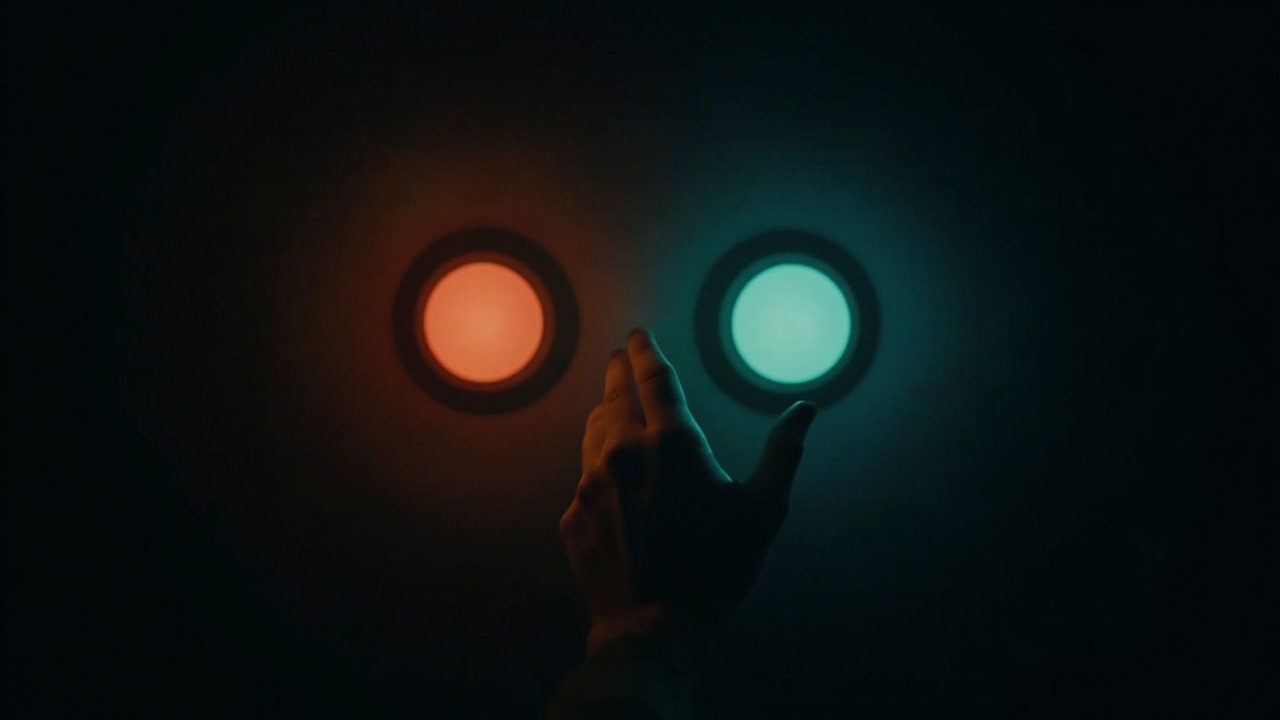
Friend, let’s start with a heartbreaking choice.
Imagine two buttons in front of you: press the red button and NT100 million, but also a 50% chance of getting nothing. Which would you press?
Don’t answer too quickly. I’ll tell you — most people choose red. NT$1 million safe in hand, right?
But do you know how the people who actually keep money and make it work for them think? They’re not braver; they just run the numbers: the expected value of the green button is NT1 million. They find ways to take that button apart, package it, and sell it to people who can bear the risk.
This is the first secret I want to tell you: the watershed between poor and rich has never been how much is in your pocket right now — it’s what price tag you’ve put on pain and uncertainty. If you can’t bear the momentary pain of possibly getting nothing, you’ll only ever get that NT100 million.
Today I’m not going to talk about the 36 money-saving stratagems, nor the 72 variations of dollar-cost averaging. I’m going to talk about something deeper and more ruthless. After we finish, you’ll find that those people who earn less than you but still buy a house, or who seem to effortlessly save up their first pot of gold, aren’t more willing to suffer than you — they just understand one word better — the pricing power of pain.
Ready? Let’s switch gears and get to know money all over again.
First Layer: Consumption Isn’t Labor, It’s Buying a Band-Aid for the Soul
Let’s dissect the most everyday, most fatal behavior first — consumption.
Have you ever had this experience: you work overtime until late at night, the client has put you through 800 rounds, you’ve revised the proposal a dozen times, and finally the client says “the first version was better after all.” You close the laptop and feel completely drained. At that moment, almost involuntarily, you tap open a shopping app and order something you don’t really need but have had bookmarked for days — maybe a retro Bluetooth speaker, a pen rumored to give you god-tier writing, or an absurdly expensive skincare set.
The package arrives, you tear it open, and for an instant you feel great — like a cold cola on a hot day, like finally exhaling after holding your breath forever. You call it “treating yourself.”
But here’s the cruel truth: that’s not treating yourself; that’s buying yourself a band-aid for the soul. What you’re spending isn’t money — you’re buying a cheap placebo called “calm.”
Your brain is too smart and too lazy. It has discovered a quick fix for pain — spend money. Got yelled at at work? Spend money. Felt inferior to someone? Spend money. Felt lonely? Spend money. Every time you spend, the brain gets a little dopamine, temporarily covering the discomfort.
But here’s the problem: this band-aid doesn’t cure the wound; it just covers it, and the dosage gets weaker every time. The first NT3,000 buy to make you happy for one day; later, a NT$30,000 purchase can only keep you happy for an afternoon.
That’s why you keep earning more but your account keeps emptying — because you’re not exchanging money for things, you’re exchanging money for an emotional antidote, and the underlying emotional illness isn’t something shopping can cure.
Let me change the example — let’s not talk about cars and bags, let’s talk about something sneakier. Have you noticed many people get hooked on a hobby called “collecting”? Blind boxes, sneakers, mechanical watches. I have a friend with an entire wall of blind boxes at home, each costing several hundred dollars; together that wall is worth a small car. Every time he buys a new release he posts it with the caption “today’s happiness.”
But once, drunk, he told me the truth: “Honestly, the happiness ends the moment I open it. Then I just stare at the little figure and feel empty inside. But when a new one comes out I still can’t help myself, because not buying it feels like I’m missing out, and that feeling is unbearable.”
See, he’s not buying that little figurine anymore; he’s buying the security of “not missing out,” the belonging of “I have one too.” That sense of security is essentially fear — fear of being left behind by trends, fear of having nothing to talk about with friends, fear of not living interestingly enough.
So the next time you want to “treat” yourself, can you stop for three seconds and ask yourself a really shameless question: “Right now, do I actually need this thing, or am I just feeling uncomfortable and looking for someone, something, some way to kill time?” Switch your consumption from “emotional venting mode” to “problem-solving mode.” When you feel uncomfortable, go for a run, get some sleep, or call a friend to rant — the cost is almost zero. The money you save is what you actually earn.
Second Layer: The Highest Form of Saving Is Strategic Waste
Okay, some of you will say: then I’ll stop buying, I’ll save, I’ll be cheap, I’ll turn myself into a miser, that’s gotta work, right?
Sorry, but if all you can do is save, you’ll most likely end up a poor person with money, or an exhausted accountant of your own life.
I’ve seen too many people like this. They bounce between three apps comparing delivery fees to save two dollars; their mantra is “every bit counts”; they stay up until 2 a.m. on Singles’ Day, calculating discounts more seriously than the math section of the college entrance exam, and end up with a year’s supply of paper towels and detergent piled on the balcony like a small warehouse; in summer they won’t turn on the AC and break out in heat rash, in winter they wrap themselves in blankets shivering rather than turning on the heater; at the market they haggle over half a dollar until both parties are red in the face.
And then what? Then the small amount they painstakingly saved might be wiped out by a single ill-advised friend’s investment tip; or more commonly, in some emotional late-night breakdown they go on a revenge-spending spree, blowing half a month’s salary on a completely unnecessary big dinner, or on some “battle armor” dress that ends up hanging unworn in the closet forever.
This way of saving isn’t personal finance — it’s tactical saving and strategic waste. Why? Because you sold your most valuable asset — your time and your experience — at a rock-bottom price. Those twenty minutes you spent comparison-hunting coupons, if you’d used them to learn a new skill or think about how to raise your work efficiency, the long-term return could be tens of thousands of times those two dollars.
Real masters save strategically, and waste strategically too.
Let me share my own story. When I first started working my income was tiny, but every month, no matter what, I would earmark 15% of my income for something that drove everyone around me crazy — I’d go to the most expensive coffee shop in the city for a coffee, or spend a night at a five-star hotel I couldn’t actually afford, or attend an industry talk with an outrageous ticket price.
My coworkers said I was putting on airs, said I was a poser. But only I knew what I was doing.
In that outrageously priced coffee shop I overheard people at the next table talking about “Series A, business model” — I wrote down those terms and looked them up later; a month later when I went to interview for a new job I could discuss industry trends with the interviewer.
In that five-star hotel executive lounge I watched how real rich people talk, how they dress, how they interact. My aesthetics, my conversation, my horizons all quietly leveled up during that one piece of strategic waste.
What was I buying? I was buying information asymmetry and entry tickets to a circle.
This is the highest form of saving: pull money saved from your consumption account and slam it into your leverage account. What is leverage?
- Knowledge is leverage — it makes one hour of your work worth ten hours of someone else’s;
- Network is leverage — it lets you know about opportunities others don’t;
- Health is leverage — it lets you work ten more years and enjoy ten more years of compounding;
- Aesthetics is leverage — same ability, better-looking people get more opportunities.
So stop agonizing over those two-dollar delivery fees. That half hour of your time, if you use it to think “how can I negotiate an extra NT$2,000 at my next raise review,” your whole world changes. Spend money on things that make you more expensive, not on things that make you look more expensive. The former is investment; the latter is consumption. One character of difference; worlds apart.

Third Layer: The First Investment You Should Make Is in Your Pain Tolerance
Alright, mindset adjusted, money saved. What’s next? Investing — buy funds, stocks, ETFs, let the money work. Right? Right — but not deep enough.
Here’s a view that might flip your worldview: before you buy any stock or any fund, the first and most ruthless investment you should make is in your own pain tolerance.
What is pain tolerance? It’s how much discomfort, uncertainty, and embarrassment you can calmly endure.
Let me give you an example.
Have you ever bought a fund? Have you ever lived this scene — you confidently buy into a star fund, the next day it drops 1%, you think “no big deal, normal fluctuation”; the third day it drops another 2%, you start to panic a little; the fourth day it drops 3% more, you completely collapse, you can’t sleep that night, your brain screams “it’s over, my hard-earned money is gone.” So on the fifth day you can’t take it anymore, you grit your teeth and sell. The sixth day it rallies 5%.
Do you feel like the market is out to get you? You’re the legendary “reverse indicator.”
It’s not the market targeting you; it’s that your pain tolerance is too low. You can only handle 1% swings, and when volatility exceeds that threshold, your brain sounds the alarm and forces you to flee.
Investing is essentially a pricing game on volatility. The people who eventually make money aren’t smarter than you; they can tolerate volatility you can’t — when you’re scared out of your wits, they calmly add to their position.
This pain tolerance isn’t just for investing; it seeps into every pore of our lives:
- You don’t dare ask your boss for a raise because you can’t bear the embarrassment and shame of being rejected — so you can’t bear it, so you keep accepting that salary you’re not happy with;
- You don’t dare quit the job that’s killing you to try what you truly love because you can’t bear the insecurity of having no stable income — so you can’t bear it, so every Sunday night you fall into deep Sunday-night work anxiety;
- You don’t dare speak up and share your view in a public setting because you can’t bear the risk of being laughed at — so you can’t bear it, so your ideas stay ideas, and your talent only you know about.
Look at where your ceiling is — it’s right at the tick mark of your pain tolerance. If your tolerance is only 50 degrees, the moment life hits 51 degrees you call the alarm, you collapse, you retreat back into your safe zone. And wealth has never lived in the safe zone.
How do you raise this pain tolerance? Here are two wild-but-effective methods, personally tested.
First: actively seek out small suffering to deliberately train your embarrassment muscles.
Are you afraid of talking to strangers? Good — go to the market and chat with every vendor, even if it’s just asking “is this fresh?”
Are you afraid of rejection? Go ask ten people a question you know they’ll refuse, like “can you lend me NT$100?” After being rejected once, tell yourself “oh, that’s all it was, I didn’t lose any meat.” After being rejected a hundred times, you’ll find your embarrassment muscles have been forged like iron. When that day comes, asking your boss for a raise? Easy. Confessing to someone you like? Bring it on.
Face doesn’t exist once you stop caring about it.
Second: build your psychological bulletproof vest.
Why do poor people often make decisions that look stupid in the short term, like borrowing from loan sharks, or selling something important for a few hundred dollars? Because their lives have no redundancy — they’re walking a tightrope with no safety net below; the slightest gust can blow them off.
So you absolutely must build your emergency fund. This isn’t just money; this is your psychological bulletproof vest. When you have three months of living expenses sitting in your account, your mindset changes: when the boss yells at you, you talk back, because you know you won’t starve; when you see an opportunity that needs long-term investment but offers rich return, you dare try it, because you know you can afford to lose.
Those three months of living expenses lift your pain tolerance from “starving tomorrow” to “no job for three months and still okay.” That upgrade makes every single one of your decisions calmer, more rational, and more far-sighted.

Fourth Layer: Think on a Ten-Year Scale; Use Systems, Not Willpower
Finally, let’s talk about “ten years” — thinking on a ten-year scale.
It sounds harsh, but here’s a critical footnote: never try to outlast ten years on willpower alone. Willpower is a consumable, like a phone battery, draining down to red as you use it. The people who can stick with something for ten years aren’t more willpowerful than you — they’ve designed a system that pushes them forward, with barely any willpower required.
Let me break it down.
Want to build an exercise habit? With willpower you’ll say “I swear from tomorrow I’ll run five kilometers every day.” Result? You run for three days, it rains on the fourth, you say “forget it, rest day,” and then there is no then.
But if you design a system? Put your running shoes in the most visible spot by the door so you see them the second you open it; join a running group that meets at a fixed time each week, with a red-packet penalty for latecomers; share your run data to your social feed so people can like it. See that? Environment, social pressure, feedback — those forces push you to run; you never have to tell yourself “I need to run” every day.
Same for wealth. Auto-transfer is the most basic system design. But that’s just step one; let’s design more thoroughly:
Design your money environment. Is your phone full of shopping apps? Are your subscriptions all about what to buy next? Are the influencers you follow all showing off cars and trips? You’re soaking yourself in a chamber of consumer poison — if you don’t bleed, who will?
You need to actively detox: turn off all notifications from those shopping apps, even bury them in a folder on the last page of your phone to add friction; unfollow the influencers who make you anxious and competitive, follow people who teach genuinely useful things — business logic, self-management, long-term investing.
Design your social environment. Do you have a few friends who, every time you meet, only want to talk about “where have you been lately, what did you buy, which restaurant’s good”? That’s a classic bragging-game circle. Consciously move closer to people playing the asset game — the ones who talk about “how much passive income this month,” “what book are you reading lately,” “how to raise work efficiency.” Not to make you utilitarian, but because environment shapes people drop by drop.
There’s a saying: you are the average of the five people you spend the most time with. Look at who those five people are; are they helping you build assets or helping you burn them?
Design your feedback system. Why are games so addictive? Because they have instant feedback — you slash once, the monster’s HP drops, damage numbers fly above its head, the experience bar ticks forward. Saving and investing have too long a feedback loop — you slave away saving for a month, the account grows by NT$3,000, you feel nothing, it’s boring, and it’s hard to stick with.
So design your own feedback: turn your savings goal into an image — say you want to save up to see the Northern Lights in Iceland — print out a photo of the aurora and stick it on your fridge, your bedside, your desk, every day, every day. Then every time you save NT1,000 into a jar called “Iceland Fund.” As the jar fills, you can touch the beads, you can see them slowly pile up, and the feeling is completely different.
You don’t need to persist — you’re being pulled by desire.
Ten years isn’t a chasm you cross on willpower; it’s a rope you can slide across using systems, environment, desire, and habit. Once you lay the track at the start, let time do the rest.
Closing: A Letter of Challenge to the Self You’ll Be in Ten Years
Alright, we’ve covered a lot — from emotional spending to strategic waste, from pain tolerance to life-system design. I know your head is full right now; you might think “this is too much, there’s too much to change.”
But I want to tell you: you don’t need to do all of it. Pick one or two that resonate most and start. But let me add a counterweight — don’t pick the one or two that are easiest; pick the one or two that make you most uncomfortable. Because the place that makes you most uncomfortable is where your pain tolerance is lowest, which is also where your life’s biggest fatal weakness lies.
- Most afraid of talking about money with people? Then this week go find one person and ask them to pay back the few hundred dollars you lent them. Not for the money — to practice bearing the pain of awkwardness;
- Most afraid of looking at your own bills? Then tonight export all the spending records from every app and look at them line by line, even if your shame makes you sweat. This is to practice bearing the pain of truth;
- Most afraid of boredom? Then right now put your phone aside, turn off every screen, just sit there for 15 minutes doing nothing, feeling that boredom crawl over your whole body like little bugs. This is to practice bearing the prelude pain of deep work.
Finally, I want to say one thing to you: ten years from now, you won’t thank yourself for just reading this article today — because reading was too easy, painless and itchless. Ten years from now you’ll only thank the version of you that started acting today, the you who, even though scared, in pain, unsure, feeling it was too hard, still gritted your teeth and took that one small step forward.
This piece isn’t a guide; it’s a letter of challenge. I’m issuing it to you — do you dare accept?
Starting today, starting this second, refuse to play the bragging game others have set up, exit the exhausting complex game of one-upmanship, and start playing your own game. The name of this game is “Life Upgrade,” and it has only one rule: deliberately, gently but firmly, keep raising your own pain tolerance.
When you no longer fear embarrassment, you gain courage; when you no longer fear uncertainty, you gain wisdom; when you no longer fear boredom, you gain focus. When you have courage, wisdom, and focus, do you think money is still a problem?
Don’t be anxious, and don’t compare. From now on, only compete with yourself — be able to endure a little more pain than yesterday’s you. Ten years from now, we don’t need the cliché of meeting at the summit. Ten years from now, when you have the底气 to walk away anytime from anyone you don’t like, any place you don’t like; when you have the ability to calmly say “no” to toxic people and toxic things; when you’re living as the person you most want to be — that moment is the summit of your life.
Now close this article and go do that one small uncomfortable thing. Right now. Immediately. We’ll meet at our respective summits ten years from now.
Disclaimer: This article shares personal opinions and is for mental-construction purposes only; it does not constitute any investment, consumption, or financial advice. Investing carries risk; please carefully assess your own situation before making any decision.
Tags
痛苦定價權, 情緒消費, 戰略性浪費, Emergency Reserve, 痛苦耐受力, 系統設計, 複利紀律, 指數基金, 期望值思維, 槓桿思維, 環境設計, 自我升級
Comments