
Opening: The Diversification You Think You Have Is Just Another Form of Concentration
Open the brokerage account of any ordinary investor, and you’ll most likely see this picture: over a dozen stocks, the page spanning consumer, tech, financials, pharma, and every kind of thematic ETF under the sun. At first glance, assets blanket the entire market, risk has been broken into tiny pieces, and the sense of security is maxed out.
But the moment the market wobbles, almost every position in the account drops in lockstep—none of them can stand on its own. What’s even more frustrating is that even if one of those holdings doubles, its contribution to the overall account is barely noticeable—your principal has been split into countless fragments, and no matter how you roll them, they never become a snowball big enough to weather the storm.
This is the “fake diversification” trap that traps the vast majority of people. There’s a centuries-old debate in the investment world: between diversification and concentration, which is the real wealth code? On one side, the founders of modern portfolio theory used mathematical models to prove that a portfolio of low-correlation assets can reduce volatility without sacrificing returns. On the other side, great investors bluntly say “diversification is protection against ignorance; people who really understand investing will focus their energy on a few quality names.” The two views look diametrically opposed, but behind them lies the truth the crowd keeps missing—diversification and concentration have no absolute winner; they only have what’s right for you.
Chapter 1: The First Trap—Quantity Overload Dilutes Your Returns
The most common rookie mistake when entering the market is being driven by every news flash. See a hot name and want in, hear a recommendation and blindly buy—before you know it, your account is littered with a dozen or even twenty-plus positions. Your principal is infinitely fragmented, each position takes a tiny share, and even if you pick a winner, the returns get sapped dry by all the mediocre holdings.
It’s like slicing a cake into dozens of pieces—each slice is meaningless; no matter how you taste them, you never taste the real sweetness. The essence of this trap is treating “diversification” as “buying lots of names,” without ever asking: do these holdings actually offer differentiated hedging logic against each other?

Diversification has never been about stacking up quantity—it’s about different assets forming a hedge during market swings—when one falls, another can counter-trend hold up, smoothing the overall portfolio’s volatility.
Chapter 2: The Second Trap—Looks Diversified by Sector, but Highly Correlated in Reality
Many retail investors spread their picks across multiple industries, not realizing they’ve bought “people on the same boat.” For example, simultaneously holding a tech bellwether, a tech ETF, and a tech-themed fund—three seemingly different vehicles, but the underlying assets are heavily overlapping, and any market tremor produces strikingly similar drawdowns.
It’s like preparing three different umbrellas, only to find they’re all made of the same material—when the typhoon hits, they all break. True diversification must drill down to the underlying asset logic, see past industry labels, and identify differences in business model, cash-flow structure, and policy sensitivity.

Chapter 3: The Third Trap—Capital-Scale Mismatch Forces Diluted Concentration
For small-capital investors, spreading NT10,000 per name. When one of those positions needs to be held long-term across a cycle, an NT$10,000 position simply can’t survive the drawdowns along the way. You’ll be shaken out at the bottom, then watch it double when it rebounds.
This is the mismatch between capital size and strategy. True concentrated investing means making big bets on a few opportunities you’ve vetted—and that requires not just vision, but capital depth and psychological resilience. A retail investor copying a master’s concentrated position is no different from a grade-schooler playing a pro match.

Diversification is the weapon; capital size is the arm strength. Pick the wrong weapon, and no amount of effort will help.
Chapter 4: How Do You Pick the Right Weapon for Your Stage?
Investing is never a one-or-the-other multiple-choice question—it’s a dynamic balance matched to your stage.
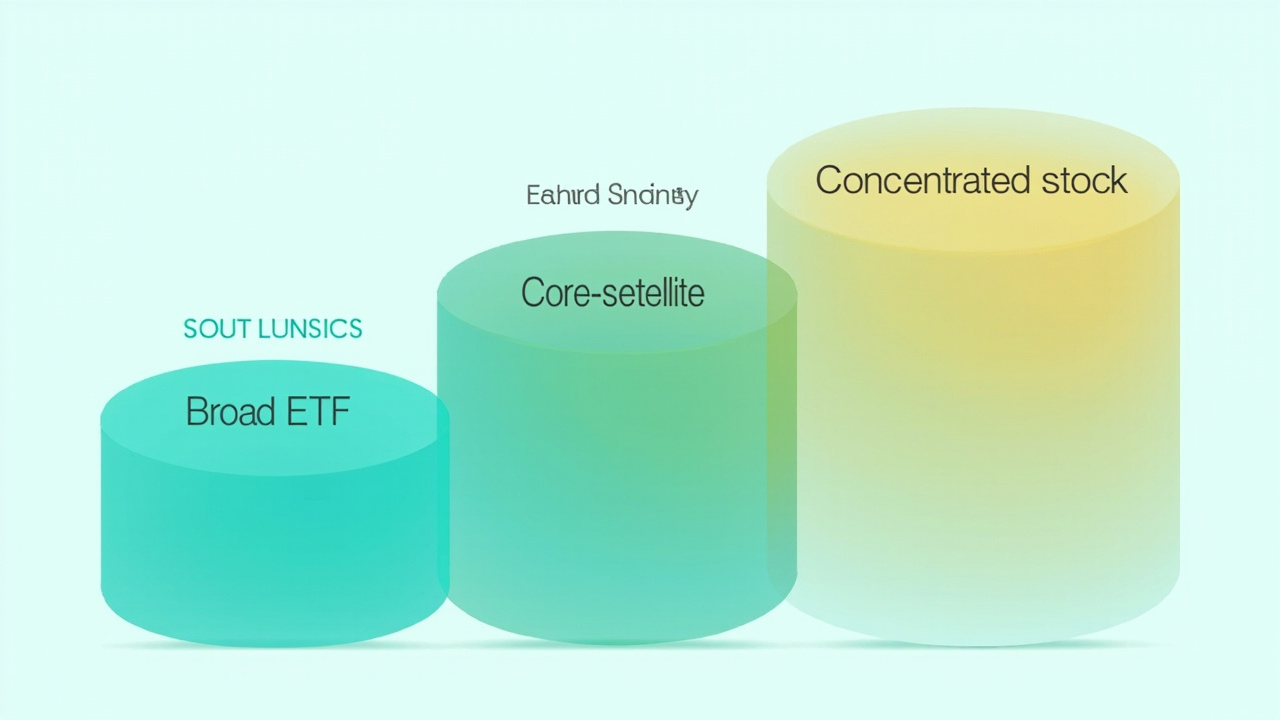
Tier One: The just-starting small-capital investor (NT$100,000–500,000)—should center on broad-index ETFs, paired with two or three low-correlation asset classes. The goal at this stage isn’t to make big money, but to “survive several market cycles.”
Tier Two: The mid-stage investor with some savings (NT$500,000–3 million)—can start using a “core + satellite” strategy: 70% in broad-index and bond ETFs, 30% in individual stocks or themes you’ve truly researched.
Tier Three: The well-capitalized advanced investor (NT$3 million and up)—only at this stage do you actually earn the right to talk about “concentrated bets.” What you need at this stage isn’t more names—it’s deeper insight and stronger stress tolerance.
The real value of diversification has never been about maximizing returns—it’s about reducing human interference—so that you live long enough to be rewarded by the market.
Conclusion: Stop Treating “Buying Lots of Names” as Diversification
The essence of diversification is a portfolio of low-correlation assets—it’s the weapon that matches your capital size and psychological makeup. Buying ten homogeneous tech stocks isn’t diversification—it’s putting your eggs in the same basket ten times.
Before opening your brokerage account next time, ask yourself three questions first:
- Is there actually a hedging logic between these holdings?
- Can my capital size support this level of diversification?
- At my current stage, should I diversify or concentrate?
Investing has never been about the more the better—it’s about the right the better. Once you see this, you can climb out of the “fake diversification” trap.
This article organizes investment viewpoints and case studies for reference only and does not constitute any buy or sell recommendation. Investing involves risk; past performance does not guarantee future results. Please assess carefully based on your own risk tolerance and consult a qualified financial advisor when necessary.
Disclaimer: This article shares investment and financial concepts and reference information. It does not constitute any specific investment, tax, or legal advice. Markets involve risk; invest with caution. Please make independent judgments based on your own risk tolerance and consult a professional advisor.
Tags
Diversification, Investment Traps, Asset Allocation, 集中投資, Portfolio, 散戶投資, Investment Psychology, 投資心法, Fake Diversification, 雞蛋放不同籃子
Comments