
I have to be honest with you. Five years ago I thought that as long as I worked hard enough, put in enough overtime, and learned enough different skills, my life was set. What happened? Last year, a friend of mine — law school graduate, three years of bar exam grinding, finally passed — was working at a firm that started using AI to review contracts. The AI did in 2 hours what used to be a week’s work for an intern. His boss said straight out: “We’re not hiring this year.” He froze in the meeting room.
This is not an isolated case. If you’ve been following the news lately, you’ve seen a term suddenly popping up: “Agentic AI.” Sounds sci-fi, right? Let me rephrase and you’ll get it: In the past, AI was the assistant that chatted with you and helped you look up information. Now AI is the virtual employee that does the work for you — operates your computer, fills in your forms, replies to your emails, writes your code. It keeps working while you sleep. Think it’s still far away? No — it’s right in front of you.
Today I want to talk about three things: first, why the path of living off a salary is being hollowed out from under us; second, if there’s truly no going back, where should we put our money now; third, what should our kids actually learn so they don’t get eliminated.
1. The First to Be Hit Is Not Blue-Collar — It’s White-Collar
Have you noticed that the people feeling the squeeze first over the past two years are not the factory operators but the white-collar workers sitting in the office? Travel agents, real estate brokers, legal assistants, call center staff — even coders.
What’s the common thread? They are all “bridges” — the people who connect you to information, to services, to products. Travel agents help you compare prices. Real estate agents help you find homes. Legal assistants help you look up precedents. But now? AI can in seconds query ticket prices from hundreds of airlines worldwide, then book your ticket, fill in your itinerary, and complete your visa form. The bridge in the middle no longer needs you.
Economists call this “information asymmetry.” To put it bluntly: “You know too little, I know too much, so you have to pay me.” But AI has made that kind of “knowing” worthless.
Globally, the services that charge fees for organizing information, process handling, professional document processing, and transaction matchmaking add up to trillions of dollars. Right now that cake is being eaten away by AI, one bite at a time, faster than anyone expected.
In 2023, people were still saying “AI will replace repetitive jobs first.” What happened in reality? The first to feel the chill were high-paid white-collar workers. In January this year, Anthropic launched an AI Agent platform. To put it simply: you give it a task, and it can break it down, operate across software on its own, find information on its own, fill in forms on its own. You just say, “Help me organize this month’s contracts,” and it opens Excel, opens email, and gets it all done. The market reacted instantly — the value of many positions in law, accounting, and customer service is going to be wiped out.
Even more absurd: even programmers are starting to panic. Three or four years ago, everyone was saying “go learn to code.” Now? Silicon Valley has eased back on developer hiring. Why? Because AI doesn’t need rest, doesn’t take leave, doesn’t get emotional, and writes code not half bad. What are you competing with?
2. Why Is the “Living off a Salary” Path Being Hollowed Out From Under Us?
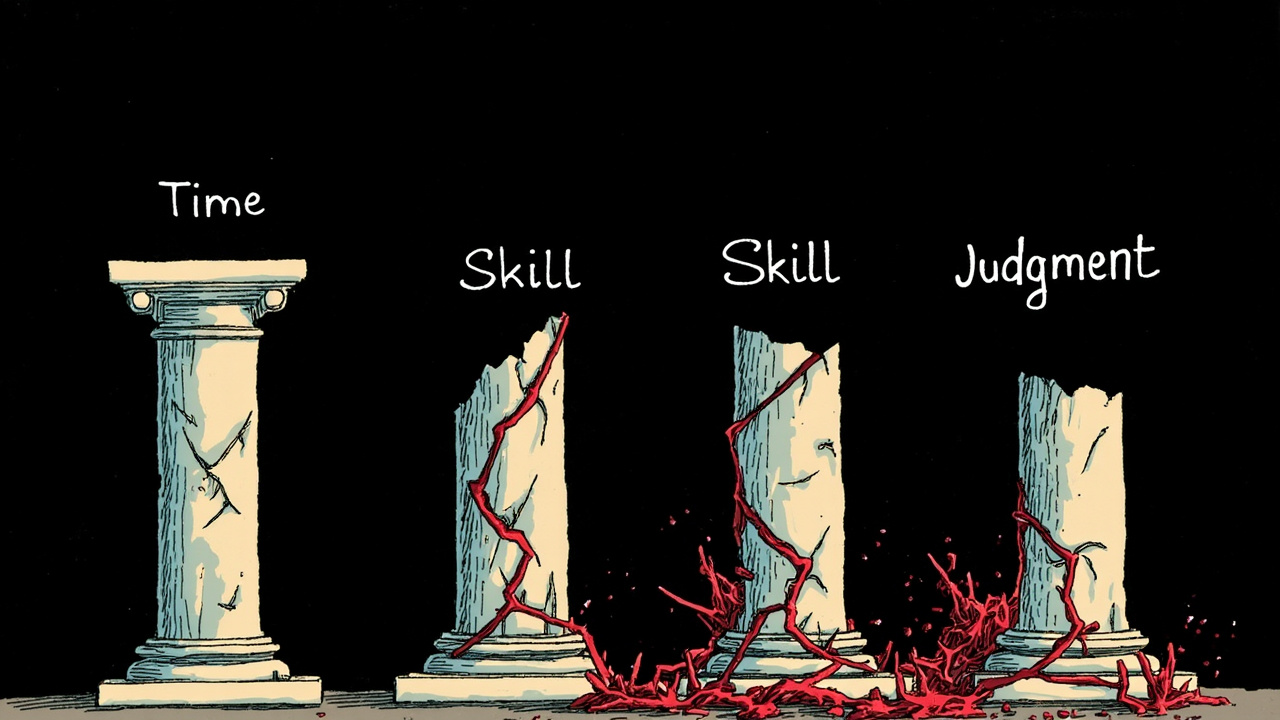
The traditional salary economy is built on three assumptions:
- Your time is scarce. The boss has to trade one hour of your time for one hour of work, so they have to pay you a salary.
- Your skills are scarce. Lawyers, accountants, and engineers need years of training, so they are valuable.
- Your judgment is scarce. Managers, executives, and analysts are paid high salaries because of experience and intuition.
But AI is dismantling these three assumptions one by one:
- AI doesn’t sleep, doesn’t take leave, doesn’t complain, so its time is not scarce.
- AI has read every precedent, contract, financial report, and paper in the world, so its skills are not scarce.
- AI finds patterns in massive data tens of thousands of times faster than humans, so its judgment is not scarce.
Once all three assumptions are dismantled, the path of “trading time for money” will fundamentally narrow. This does not mean white-collar workers will disappear overnight; it means the “premium” on being a white-collar worker will compress quickly — your salary will stagnate or even fall, while your workload will rise because you now have to coordinate with AI.
3. So Where Should We Put Our Money? Three New Directions
Since the “salary” path is getting narrower and narrower, where should ordinary people put their money now?
Direction 1: Global asset allocation. Stop putting 100% of your assets into Taiwan’s real estate and Taiwan stocks. In the AI era, the wealth shift will be cross-border. US stocks, global ETFs, and even some crypto assets should be on your allocation radar. Diversifying country risk is more critical than diversifying single-stock risk.
Direction 2: Cash-flow assets that “grow” on their own. High-dividend ETFs, quality REITs, bond-income funds — these assets have one thing in common: they keep making money for you while you sleep. In the AI era, the biggest luxury is not a higher salary — it is money that works while you sleep.
Direction 3: Invest in your own “AI-cannot-replace” abilities. This is the most important point. AI can replace “execution,” but it cannot replace “judgment,” cannot replace “taste,” cannot replace “cross-domain integration,” cannot replace “understanding of human nature.” Invest money in your communication skills, your international perspective, your aesthetic sense, your leadership — these things will only become more valuable in the AI era.
4. What Should Our Kids Learn? Three Abilities That Won’t Be Eliminated
What about our kids then? What should they learn so they won’t be eliminated? Three directions, none can be missing:
Ability 1: The ability to converse with AI. This is like having to learn to use a computer 20 years ago, or to go online 10 years ago. People who can’t use AI will be eliminated by the times, just as people who can’t use computers are today. From a young age, let your child learn to use AI tools to learn, to create, to solve problems — it is the most basic survival skill.
Ability 2: The ability to integrate across domains. AI is great at single-domain work, but it is not good at connecting things from different domains. The most valuable person in the future is the “T-shaped talent” — deep in one domain, yet able to horizontally integrate other domains. Art students should know a little coding, engineering students should know a little psychology, business students should know a little aesthetics.
Ability 3: Understanding of people. AI can mimic dialogue, but it cannot truly understand loneliness, cannot truly comfort sorrow, cannot truly build trust. Psychology, philosophy, literature, art — these disciplines that make people “people” will become more important in the AI era than ever before.

5. The 3-Year Window: Three Things You Should Do Right Now
The so-called 3-year window does not mean you’ll be unemployed in 3 years. It means from now until 2027-2028 is the last window for ordinary people to complete an identity transition. Miss it, and you’ll find that no matter how hard you try, your salary won’t go up — but the cost of living keeps rising.
The first thing to do right now: audit your job. Ask yourself three questions: (1) How much of my time at work is “execution”? (2) Of that “execution,” how much is something AI can do? (3) Can I shift the rest of my time toward “things AI cannot do”? If more than 70% of your work is execution, you need to start transforming in the next 3 years.
The second thing to do right now: start building assets that “make money while you sleep.” You don’t have to do it all at once. Start with NT$5,000 a month and turn part of your money into cash-flow-generating assets. Three years from now, you’ll find that this cash flow eases your mind more than your base salary.
The third thing to do right now: turn AI into your tool, not your opponent. Starting today, spend 30 minutes a day learning a new function of an AI tool. You don’t have to become an AI engineer — you have to become “the person in the office who’s better at using AI than everyone else.” That is the most practical moat for the next 3 years.

6. Conclusion: It Is Not AI That Took Your Job — It’s That Your Mind Is Still Stuck in the 1990s
AI is not the enemy — it is a tool. But tools always redistribute power — those who can use them get more; those who can’t, get eliminated. From the plow in the agricultural age, to the steam engine in the industrial age, to the computer in the information age — every time, it was the same.
This time, the biggest difference is: speed. Past technological revolutions took 30 years to transform an industry. This one might take only 3. That’s why we say “3-year window” — not fearmongering, but the rhythm of this era.
Stop thinking “find me a stable job.” In this era there is no stable job, only stable abilities, stable assets, stable learning habits.
Starting today, spend 30% of your time learning AI tools, shift 20% of your income into cash-flow assets, and put 50% of your energy into abilities AI cannot replace. These are the most practical three things an ordinary person can do in this 3-year window.
In 3 years, you will thank the present you — or you will regret not starting earlier.
This content reflects the author’s personal observations and career advice on AI trends, and is not investment advice. The AI industry is evolving rapidly; the time predictions mentioned in this article are industry-discussion views and may differ from actual conditions. When making investment decisions, please carefully assess your own risk tolerance and consult a qualified financial advisor.
Disclaimer: This article shares investment and financial concepts and compiled data. It does not constitute any specific investment, tax, or legal advice. Markets carry risk; invest with caution. Please judge independently based on your own risk tolerance and consult a professional advisor.
Tags
AI 取代白領, Agentic AI, 律師助理, 程式設計師, 信息不對稱, 薪水族危機, Passive Income, Asset Allocation, Lifelong Learning, 程式設計, AI 工具, 創業機會, 職場生存
Comments