
What Is Sell Put? Why I Choose to Be an “Options Landlord”
💡 Reading time: ~12 minutes | Best for: Complete beginners who want to understand US stock options selling strategies
Hi, I’m Little Otter.
I’m 28, living in Taoyuan, Taiwan. No finance degree, no MBA, no million-dollar portfolio. What I do have is a Firstrade brokerage account, a laptop, and a set of trading rules I built the hard way — with my own money and my own mistakes.
In January 2026, I officially started trading US stock options. Here’s my scorecard through mid-June:
| Metric | Value |
|---|---|
| Completed trades | 13 |
| Win rate | 92.3% (12 wins, 1 loss) |
| Net realized P&L | +$1,219 USD (~NT$38,497) |
| Main strategy | Sell Put |
At this point you might be thinking: “92% win rate? Sounds too good to be true.”
It’s not. And I’ll show you the less-flattering side too — behind that 92% is a single trade that cost me $6,060 and nearly wiped out every dollar of profit I’d made before.
But those stories come later. In this first article, I want to answer one question in the simplest possible terms:
What is Sell Put — and why did I choose this strategy?
1. First, the basics: what are options?
Before we talk about Sell Put, we need to know what an option is.
An option is a contract that gives you the right to buy or sell a stock at a specific price on or before a future date.
Note: it’s a right, not an obligation. The buyer can choose whether to exercise it. The seller, however, has an obligation to honor the contract if the buyer exercises.
There are two basic types of options:
- Call: the right to buy a stock at an agreed price
- Put: the right to sell a stock at an agreed price
And for each type, you can be either the buyer or the seller:
| Trade | Your role | What you’re hoping for | Time is your |
|---|---|---|---|
| Buy Call | Insurance buyer | Stock rallies hard | Enemy ⏳❌ |
| Buy Put | Insurance buyer | Stock crashes | Enemy ⏳❌ |
| Sell Call | Insurance seller | Stock doesn’t rise past a level | Friend ⏳✅ |
| Sell Put | Insurance seller | Stock doesn’t fall below a level | Friend ⏳✅ |
What I do is the bottom two — I run an insurance company and collect the premiums.
Sell Put is my main strategy. It accounts for 11 of my 13 trades.
2. The “landlord collecting rent” analogy for Sell Put

The best way to explain Sell Put isn’t through financial jargon. It’s a landlord story.
Imagine you’re a landlord
You spot an apartment (a stock) you like. You think it’s worth 1,000,000 in your local currency, but you’re not in a rush to buy. You’d love to grab it if it dips to 850,000.
A real estate agent (the market) says to you:
“Will you sign a contract with me? If this apartment falls below 850,000 within the next 45 days, you buy it at 850,000. As compensation for signing, I’ll pay you 30,000 up front. Win or lose the deal, the 30,000 is yours.”
You think about it:
- 850,000? That was the price I wanted anyway ✅
- The 30,000 signing fee is non-refundable ✅
- If the apartment never drops to 850,000? I do nothing and keep 30,000 ✅
- If it drops? I get the apartment at the price I wanted, and the 30,000 comes off my cost ✅
You sign.
That’s Sell Put.
In option terminology:
| Analogy | Options term |
|---|---|
| Apartment | Stock (e.g. NVDA, GOOG) |
| 850,000 | Strike price |
| 45 days | Expiration date |
| 30,000 signing fee | Premium |
| Apartment falls below 850,000 | Stock price drops below strike (ITM, In The Money) |
| Apartment never drops to 850,000 | Stock stays above strike (OTM, Out of The Money) |
3. A real Sell Put trade: NVDA $175
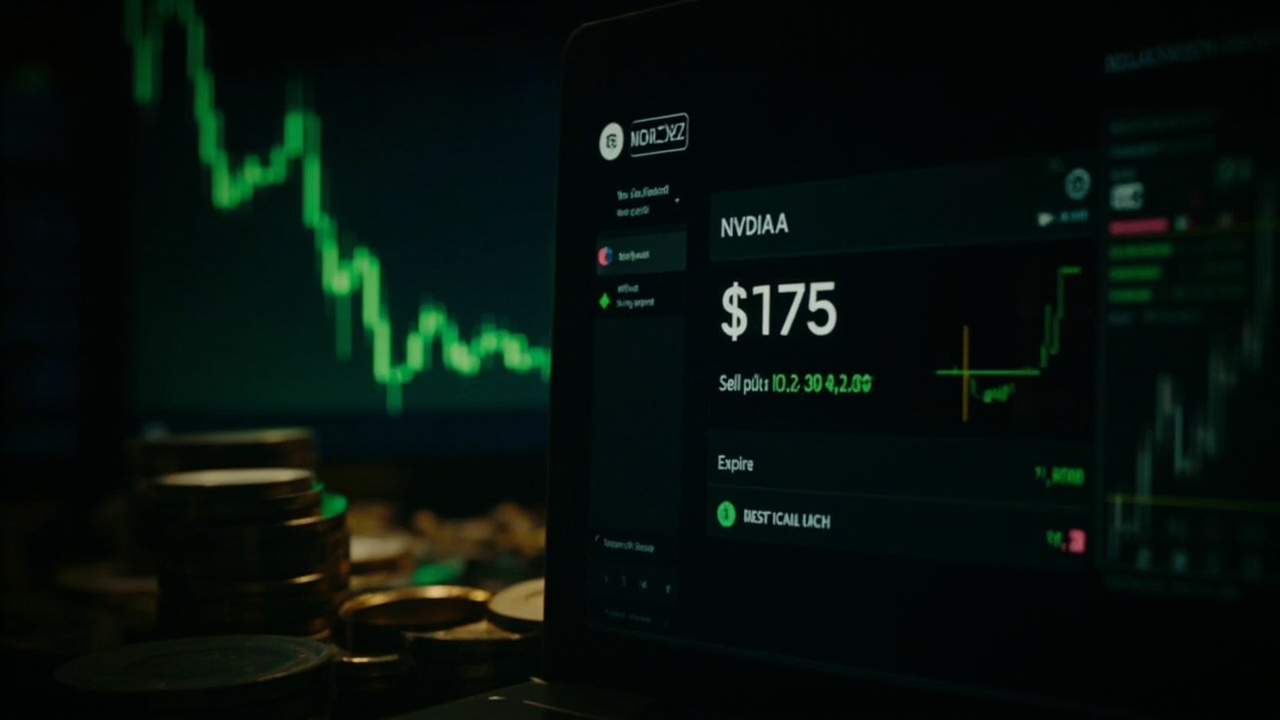
Let me walk you through a real trade.
On March 17, 2026, NVDA (Nvidia) was trading around $195. Here’s what I did:
| Item | Detail |
|---|---|
| Strategy | Sell Put |
| Underlying | NVDA |
| Strike | $175 |
| Contracts | 3 (= 300 shares) |
| Expiration | 2026/05/01 (45 days out) |
| Premium | $6.25/share |
| Total income | $1,875 ($6.25 × 300 shares) |
I signed this contract with the market:
“If NVDA falls below $175 before May 1, I will buy 300 shares at $175. In exchange, you pay me $1,875 right now.”
What happened over the next 45 days?
Nothing.
NVDA stayed above $175 the whole time. On May 1, the option expired and the contract was voided automatically.
Result:
- ✅ Full $1,875 premium in my pocket
- ✅ I never had to buy any stock
- ✅ $41.7 of automatic income per day ($1,875 ÷ 45)
This is the best-case scenario for an options seller — open the trade, do nothing, collect money when time runs out.
4. The two possible outcomes of a Sell Put

Every Sell Put ends in one of two ways:
Outcome A: Expires OTM (stock > strike) → You win 🎉
The option expires worthless. You keep the entire premium with zero further action.
This is my favorite outcome, and it’s the most common one for Sell Put sellers. Of my 13 trades, 2 ended exactly this way — no action needed, full premium collected.
Outcome B: Expires ITM (stock < strike) → You get assigned 📦
You’re obligated to buy the stock at the strike price.
For example, if NVDA drops to $160 by expiration on my NVDA $175 Sell Put, I have to buy 300 shares of NVDA at $175.
My real cost per share: $175 − $6.25 (premium already collected) = $168.75/share.
Sounds like a loss? Think again — if $175 was the price I was willing to pay for NVDA anyway, I just bought the stock I wanted at a discount, and I still pocketed $1,875 in premium on top.
So the rule of Sell Put is: the strike you choose must be a price you’d genuinely be happy to own the stock at.
5. Why I choose the sell side, not the buy side
This is the question I get most often.
The answer: because time is on the seller’s side.
Time decay (Theta Decay)
An option’s value has two parts:
- Intrinsic value — the gap between the stock price and the strike price
- Time value — how many days are left until expiration (more time = more value)
Every day, time value erodes. This is called Theta Decay.
For the buyer, theta is a silent killer — the option you bought is depreciating every day. For the seller, theta is a faithful employee — the option you sold is earning you money every day.
This is why I can do nothing after I open a trade — time is working for me.
The statistical edge
According to historical data from CBOE (Chicago Board Options Exchange), roughly 60%–80% of options expire worthless (OTM).
That means: most of the time, the insurance the buyer paid for is never used, and the premium the seller collected is pure profit.
Of course, this isn’t a guaranteed win. In that other 20%–40% of cases, sellers can face massive losses. That’s why risk-management discipline is essential — and that’s the entire focus of the next article.
My six-month verification
| Metric | Value |
|---|---|
| Total trades | 13 |
| Expired OTM (full premium) | 2 ($4,500) |
| Closed early at profit | 10 |
| Losses / Roll Outs | 2 |
| Win rate | 92.3% |
For 92% of my trades, theta decay was indeed on my side. But the 8% hurts — later I’ll dedicate a whole article to dissecting that $6,060 loss.
6. The risks of Sell Put: don’t look only at the upside
I don’t want you to think Sell Put is a no-risk business. It has very real risks:
Risk 1: Theoretically unlimited loss
A stock can fall to $0. If you Sell Put at $175 and the stock drops to $100, your loss is $75 per share (after premium). On 3 contracts, that’s $22,500.
Risk 2: Margin pressure
Sell Put requires collateral. Take NVDA Sell Put $175 × 3 contracts as an example — the margin requirement is around $52,500. That money is locked up until expiration; you can’t touch it.
If your account runs short, the broker will force-close your position (margin call) — usually at the worst possible moment.
Risk 3: Black-swan events
Earnings shocks, geopolitical flare-ups, sudden negative news — any of these can crater a stock 10%–20% overnight.
My May experience was a small black swan. After I Sold Put on NVDA at $223, the stock kept falling, and I was forced to roll out — losing $6,060.
So let me say it again: Sell Put is not a risk-free strategy. You need strict risk-management rules.
7. Who is Sell Put right for?
Based on my six months of real-world experience, Sell Put suits the following kind of person best:
✅ It’s right for you if:
- You have idle capital: at least $30,000 USD (margin requirement)
- You have patience: you’re comfortable with the “open the trade and wait 45 days” rhythm
- You have discipline: you can stick to your stops, free from greed or fear
- You’ve done your homework on the underlying: the stock you Sell Put on is one you genuinely want to own
- You want steady cash flow: you prefer “small monthly rent” over “one big win”
❌ It’s not for you if:
- You want to get rich quick: Sell Put yields roughly 1%–3% per month. It won’t make you a fortune overnight.
- You can’t stomach losses: options trading guarantees losing trades. If you can’t handle a red number on your screen, this isn’t for you.
- Your capital is too small: with under $10,000 USD, Sell Put is too stressful because the margin ratio is too high.
- You don’t have time to learn: options are far more complex than stocks. You need to keep studying Greeks, volatility, and market structure.
8. What do you need to get started?
If you’ve made it this far and you’re still interested, here’s the basic gear you’ll need:
| Item | Recommendation |
|---|---|
| Brokerage account | Firstrade (no commissions, Chinese interface, beginner-friendly) |
| Starting capital | At least $30,000 USD |
| Knowledge prep | Understand Call/Put, strike, expiration, premium |
| Mindset prep | Accept that “most of the time, nothing happens” |
| Risk rules | Set stop-loss standards before you place your first trade |
9. What’s next in this series?
This is the first article in the “Options Trading Classroom” series. Here’s the order I’ll be covering for the rest of the six-month experience:
- ✅ What is Sell Put? (this article)
- 📝 My iron-clad risk-management rules — how to avoid being wiped out by a single trade
- 📝 Theta / Delta / Vega primer — the Greeks in plain English
- 📝 How Taiwanese get started with US options — opening an account, funding, margin
- 📝 Monthly performance reports (Jan–Jun recap)
- 📝 Real case breakdowns (including that $6,060 loss)
Every article will come with my real trade data — no edits, no美化 (makeup). Wins and losses, all on the table.
Final words
Someone once asked me: “You don’t come from finance. Why are you brave enough to trade options?”
My answer: Options don’t need genius. They need discipline.
It’s a business where you can calculate risk mathematically, earn returns with time, and control losses with discipline. If you’re willing to learn, build rules, and execute them strictly — you don’t need to be a Wall Street trader to survive in this market.
In six months, I made $1,219 USD. Not much. But I’m still here, and the lessons were worth far more than $1,219.
See you in the next article.
📌 A note from Little Otter: If this article helped, feel free to bookmark or share it. Drop a comment with any questions — I’ll do my best to reply. Remember: options aren’t gambling. They’re a rent-collection business run on discipline.
Disclaimer: This article is a personal trading experience share, not investment advice. Options trading carries high risk and may result in total loss of principal. Please fully understand the risks and consult a professional before investing.
Comments