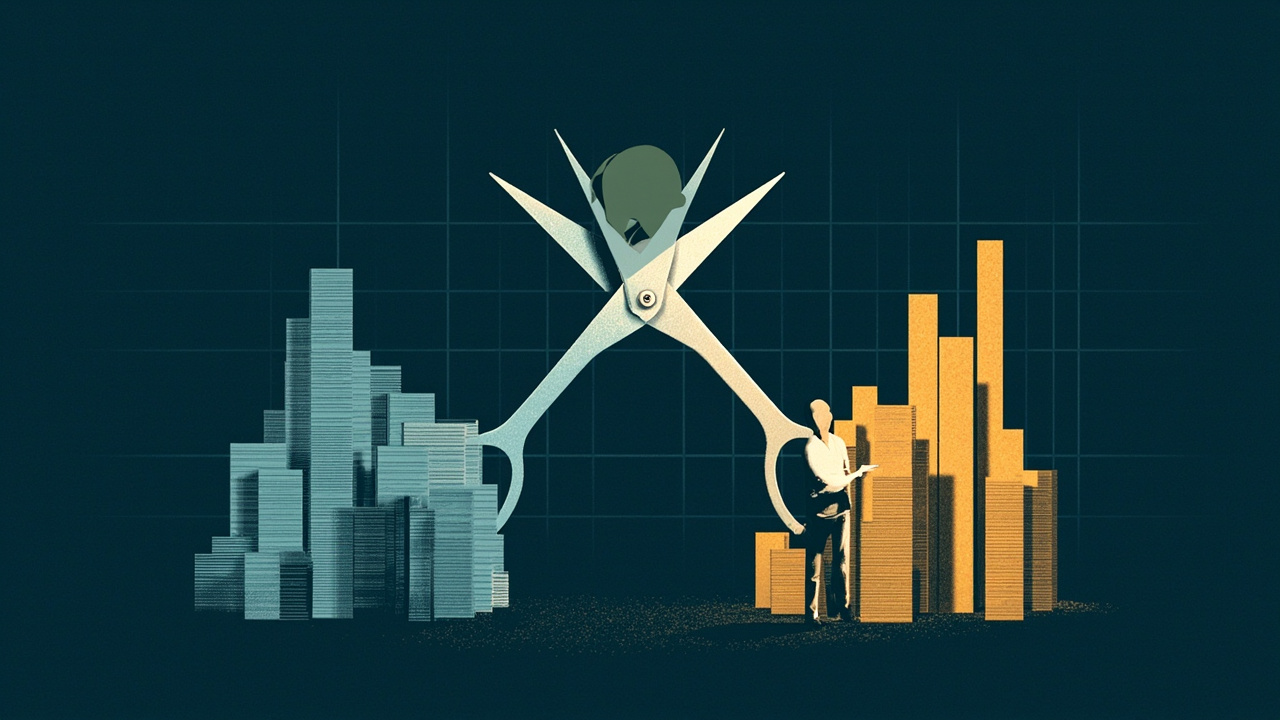
Why do you stay up burning the midnight oil, only to have the government skim a huge chunk off your paycheck before it even lands — while that guy on the corner driving the sports car officially draws a one-dollar “symbolic salary”? While you’re still nursing the pain of that cold May tax bill, the rich are buying luxury cars through the company account and writing off the depreciation against tax. This isn’t a movie plot. This is the most brutal, and most hidden, Tax Shear Difference of modern capitalism.
Back in the agrarian and industrial eras, “work hard, pay your taxes on time” was absolutely the right value set. But in an age of central banks printing money like there’s no tomorrow and asset prices going vertical, the obedient working class is being plundered twice: with the left hand, the government drains heavy taxes; with the right, inflation dilutes your purchasing power. The rich, meanwhile, use a three-punch combo of companies, debt, and assets to legally extract themselves from the tax net.
If reading this just dropped a stone into your stomach — congratulations, you’re waking up from a collective hypnosis. Next, I’ll break down the underlying logic that has run for decades, and give you 3 completely legal counter-steps you can start executing today.

1. What Is the Tax Shear Difference? The Truth About Punitive Taxation on Earned Income
Tax Shear Difference describes a brutal structural phenomenon: the poor and middle class shoulder the heaviest tax burden, while the rich use the design of the system to push their taxes toward zero. Its roots were planted the day the Industrial Revolution created the wage system.
Governments don’t produce anything themselves, so they have to coerce taxes out of the economy. And the easiest target to tax is the wage earner. Every extra dollar you earn forces your employer to withhold more income tax; the harder you grind overtime, the higher your marginal rate jumps, and you fall into the next tax bracket. That’s exactly why you feel like the more you earn, the less you keep.
The second blade of the scissors is even more cruel: inflation. Whenever a crisis hits, the government prints money to bail itself out, cash gets thinner, assets get more expensive. The cash you earned from overtime sits in your account doing nothing, and ten years later it might only have 60% of its old purchasing power. The rich, meanwhile, have long since swapped cash for stocks, real estate, and bonds — the things that go up in price — effectively passing inflation on to the people holding cash.
So you’re not just paying one tax — you’re being punished twice: visible tax + inflation tax. That’s also why our elders taught us from childhood to dutifully pay our taxes. That education was a product of the industrial age. Its job was to manufacture obedient cogs for the factory — it was never, ever designed to teach us how to get rich.

2. Capital Gains vs. Earned Income: The Core Secret of How the Rich Legally Avoid Tax
To fight back against the Tax Shear Difference, you first have to internalize a concept: not all income is created equal. Income splits into two big buckets — Earned Income and Capital Gains — and the tax rates they face are worlds apart.
Earned income is the money you trade your time for. Salary, overtime pay, license allowances — it all counts. Across the world’s tax codes, it’s the most heavily taxed category, because it’s the easiest to track and the hardest to hide. Every dollar you earn has to be reported to the tax authority by your employer before it even hits your account.
Capital gains is the money that comes from assets appreciating. Buying a property that goes up, holding stocks passively, bond interest, ETF dividends — the essence of this money is “the asset makes money for you”, and in most countries it enjoys a far lower tax rate than earned income, sometimes zero tax at all. This is why the rich get exponentially richer: every dollar they earn doesn’t get skimmed by the government first.
And the scariest gap comes after: borrowed money is completely tax-free. This is a giant loophole baked into every tax code on the planet. When you borrow ten million from the bank, that money is a “liability” in accounting terms — it has to be paid back, so it’s not taxable income. This is exactly why listed-company bosses don’t take a salary — they just pledge their stock to the bank and borrow money to live on — borrowed money you can spend freely, with interest that’s still tax-deductible, essentially a free cash flow.

3. Currency Devaluation Pays Off the Rich Man’s Debt: How Inflation Is the Poor’s Invisible Heavy Tax
A lot of people go their whole lives unable to answer this: “I owe the bank ten million, in thirty years I still pay back ten million — where did the difference go?” The answer: it was quietly eaten by inflation.
Run a simple calculation: assume 2.5% annual inflation. In thirty years, ten million dollars in nominal terms is only worth about 4.7 million in real purchasing power. In other words, you thought you borrowed ten million, but you only really borrowed the real value of 4.7 million. The other 5.3 million got diluted by the government’s money printing and inflation.
This is the most classic strategy in finance — using Other People’s Money (OPM) to build wealth. You take a low-interest loan to buy a property that will appreciate, and the tenant’s monthly rent pays your mortgage. Thirty years later the loan is paid off and you’ve pocketed a free asset. You barely put in any of your own money — the bank and inflation footed the bill.
Look at the poor, on the other hand. Stashing money in the bank at 1% interest while inflation eats 2.5% — that’s a real loss of 1.5% a year. That’s not saving, that’s slow bleeding. The rich are the borrowers (enjoying the inflation dividend), the poor are the savers (bearing the inflation penalty). That’s the cruelest design in the game.

4. Spending Through the Company: How the Rich Use Business Expenses to Offset a Luxury Life
You think those big bosses driving luxury cars and eating Michelin dinners are actually living off their after-tax salary? Wrong. Almost every top-tier consumption gets booked through the company account.
When you buy a million-dollar luxury car with your post-tax salary, that car is your asset, and every year you still owe fuel tax and license tax. But when the rich set up a company to buy the car, it becomes a corporate asset — and the depreciation, fuel, maintenance, and insurance are all deductible against the company’s income tax. It amounts to the government subsidizing the rich’s luxury life.
This is the bluntest face of the Tax Shear Difference: the poor buy their lunch out of their own pocket, the rich expense their steak to the company. On the surface, you and they pay the same tax. But in practice, their real disposable income is far higher than yours, because the base on which they need to pay tax was already a symbolic one dollar to begin with.
So the real question was never “should I be tax planning?” It was “how do I legally set up my own business entity and convert my living expenses into legitimate operating expenses?” This isn’t encouragement to evade tax. This is legal tax planning — it’s what every small and medium business owner in this country does every single day.

5. 3 Legal Counter-Moves Against the Tax Shear Difference: A Financial Transformation You Can Start Today
Theory over. Here are 3 completely legal, immediately executable steps. No need to quit your job, no need to already be rich, no need to be born into money.
Step 1: Build Your Micro Business Entity
Starting today, don’t just exist in this world under the identity of “an individual”. Run a side hustle after work, freelance, do e-commerce — even if you only make NT$5,000 a month, you should open a studio or a micro-company. Once you have a business entity, your computer, transportation, communications, and training costs can all convert into legitimate operating expenses. Deduct expenses first, pay tax on what’s left — the net profit is what the government gets to skim.
Step 2: Build the Credit Score Banks Love
Now that you know “borrowed money isn’t taxed”, the ability to get low-cost capital becomes incredibly important. People who never get a credit card and only use cash are actually high-risk clients in the bank’s credit bureau eyes — with no repayment history, the bank has no way to judge whether you’ll pay them back.
The right way to do it: apply for 1-2 credit cards, pay them off in full every month, never carry a revolving balance, and build your credit score through 1-2 years of stable repayment. When you need big money down the road to buy a home or an asset, you’ll qualify for the lowest rates, and put the bank’s money to work for you.
Step 3: Cherish Your Salary, Use It as the Foundation of Credit Leverage
A lot of people will walk away from this thinking “going to work is for suckers.” Wrong. Until you have stable passive income, that fixed salary is your most important weapon. Banks in Taiwan love lending to salaried employees with steady payroll and labor + health insurance — it’s the key foundation for getting low-interest mortgages and expanding your financial leverage.
So the correct sequence is: hold down the job to build credit → use credit to borrow cheap money → buy inflation-resistant core assets → let the cash flow those assets produce gradually replace the salary. This isn’t speculation. This is the financial path the rich never talk about, but quietly execute every day.

Closing: Rip Off the “Pay Your Taxes Obediently” Label, and Become the Master of Your Money Starting Today
A cold society has no sympathy for ordinary people who mindlessly pay heavy taxes and let inflation eat their wealth. The dividends of the era always reward the minority who see through the rules. The poor pay taxes, the rich avoid them — this isn’t a moral question, it’s a design outcome. You can choose to keep complaining, or you can choose to start treating yourself as a company, starting today.
Take a deep breath and audit your current finances: drowning in credit card debt, paying sky-high income tax every year? Make a plan to kill it right now. If you carry no debt and aren’t getting hammered on tax, congratulations, you have a clean financial canvas — starting today, take on good debt, set up a company, buy assets that appreciate, and put money to work on the battlefield for you.
Don’t let the hard-earned sweat of your labor sleep in the national treasury, only to be devoured by inflation and an unjust tax system. Wake up your idle capital right now and turn it into a loyal soldier of your finances.
If you found this breakdown useful for rewiring your financial thinking, drop a like and share it with that friend who is still nursing the pain of their tax bill. Drop a comment too: which bad debt do you most want to wipe out first? Or which expense do you most want to legally deduct? Let’s master the rules of this game together.
This article touches on financial/investment advice. Please evaluate based on your own circumstances and consult a professional financial advisor.
Comments