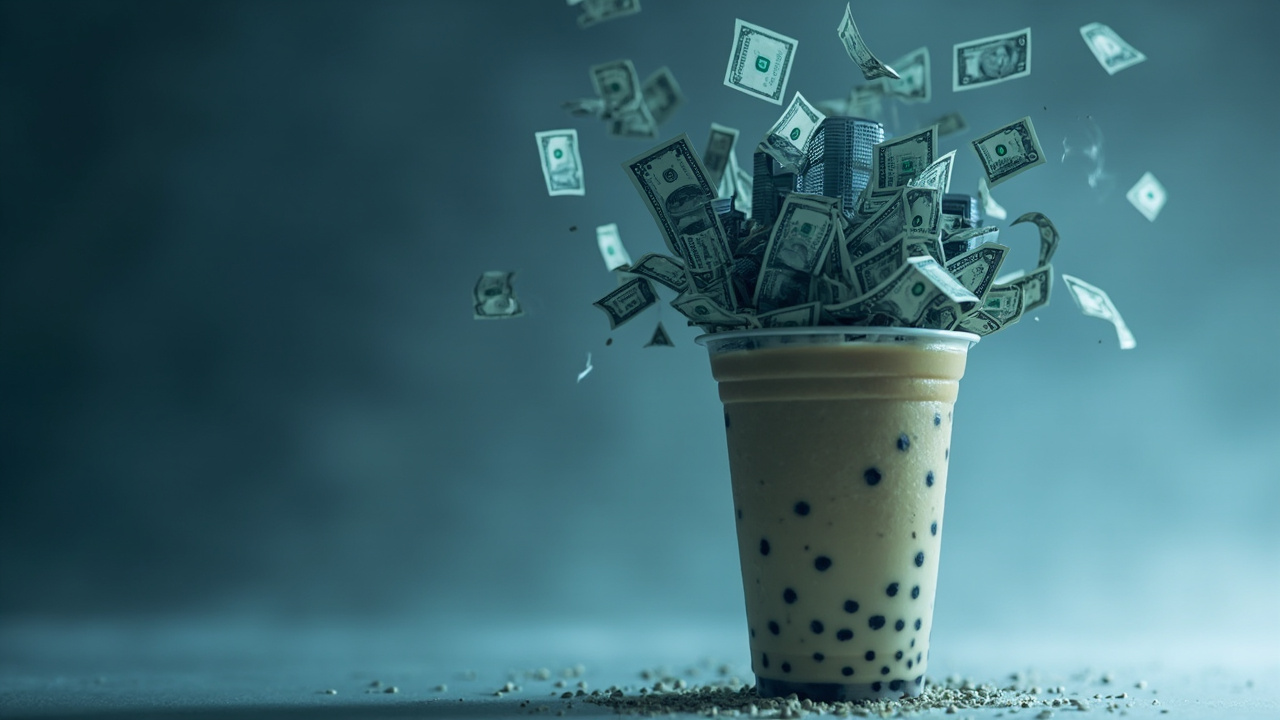
So you finish your lunch box at noon, and a bubble tea feels like the obvious reward?
That tiny NT100,000.
The Latte Factor, coined by famed American financial advisor David Bach, is the invisible culprit behind modern poverty. The Latte Factor refers to those tiny purchases that happen every day or every week: convenience-store coffee, bubble tea, streaming subscriptions, taxi fares, convenience-store oden… Each one is too small to sting. But once you fuse them with the compound interest of time, they turn into a giant beast that devours your future.
In this article, we’ll do the real math and show you exactly how much wealth you could pile up over 30 years by skipping one drink a day. We’ll also dissect the spending traps Taiwanese young people fall into most often, and finish with three painless rules rich people swear by. By the end, you’ll see that real financial freedom never comes from grinding overtime - it starts with putting down that bubble tea.

1. NT5.14 Million After 30 Years of Compounding - The Latte Factor in Real Numbers
Let’s run a brutally simple, real-life calculation.
Say you grab a NT65 oolong macchiato. **Just on drinks, you’re spending NT4,200 a month and NT$50,400 a year - already matching or exceeding the take-home pay of an average office worker for an entire month of work.
But that’s only the surface number. The real disaster starts once you add compound interest to the money game.
If you invested that NT720,000. After 20 years it balloons to NT5.14 million fortune**.
NT$5.14 million in many second- and third-tier cities outside Greater Taipei is already enough to cover the entire down payment on a cozy two-bedroom apartment, or to outright buy a mid-range resale home in cash. What you’re really drinking every day isn’t milk tea - it’s brick by brick of a house.
Your brain is wired with something called money-perception blind spots - once an amount drops below a certain threshold, it automatically shuts off the financial-risk alarm. That’s exactly why the seemingly reasonable mental trick of “treating myself with a NT$60-70 drink” is turning into a black hole that drains every drop of your hard-earned sweat.

2. The Three Hidden Spending Traps Taiwanese Young People Keep Overlooking
Beyond daily bubble tea and pricey coffee, the day-to-day life of Taiwanese office workers is littered with poison disguised as candy. Each purchase is small, but together they quietly corrode your financial foundation.
2.1 Ride-Hailing, Streaming Platforms, Gym Memberships - The Subscription-Style Invisible Vampires
Our first fan, AJ, is an engineer in Taipei’s Neihu Technology Park. He earns over NT100,000. When I asked him to lay out his last three months of credit-card statements, the truth made even him gasp.
On top of his daily bubble tea, he had these lethal money habits: the MRT was too tiring, so he regularly took taxis to and from work, burning thousands every month on fares; he subscribed to at least 5 streaming services to chase dramas and music, with auto-debits silently siphoning money for three years; and he signed up for a premium gym membership at NT$1,500 a month that he visited fewer than three times a year.
These subscription-style purchases, which masquerade as quality-of-life upgrades, are textbook high-frequency, small-amount Latte Factors. None of them hurts in isolation, but together they can easily devour the year-end bonus you waited a whole year to collect.
2.2 Cheap Online Shopping and the “Broke but Glamorous” Trap - The Vicious Cycle of Emotional Spending
Our second fan, Xiaoling, works in an office in Taipei’s Xinyi District. She shows up polished and put-together every day, but after rent she has almost zero savings. On top of high-end coffee and food-delivery afternoon tea, she had a far sneakier trap - the late-night online shopping habit she fed by endlessly scrolling her phone.
Whenever work scolded her or her mood tanked, she’d frantically clear her cart on the MRT: a NT200 cheap pair of earrings, a NT$500 promo makeup set. In isolation each number really does look small, and she figured it was her breathing room in a high-pressure city.
But those bargain clothes warped and faded after only a couple of washes, so she fell into a cycle of repeat buying - and the total wasted on cheap junk in a single year would have been enough to buy into a stable dividend-paying financial-holding stock on the Taiwan Stock Exchange, quietly pocketing NT$6,000 a year without lifting a finger.
Xiaoling’s story is the quintessential “broke but glamorous” trap of a new generation of Taiwanese young people - using an extremely fragile financial state to prop up a vanity of appearances.
2.3 The Convenience-Store “Just a Little Won’t Hurt” Effect
Taiwan has the world’s highest density of convenience stores, and that is another brutally lethal trap.
Most of us know this scene: you only went in to withdraw cash or grab a cheap pack of tissues, but as you pass the oden machine that always radiates a deadly aroma, you spot the counter sign flashing “buy two get a coffee discount,” and before you know it you’ve piled on a few extra snacks. You went in planning to spend just NT200-300 poorer, convinced you scored a deal.
This “just a little won’t hurt” effect, carefully engineered by marketing psychologists, builds a deep-rooted conditioned reflex: whenever work stress spikes or your mood sinks, you trade a quick hit of dopamine for snacks, and the real pressure is still there - except now the cash in your pocket is genuinely gone.

3. Consumerist Poison vs Real Financial Freedom - The Mindset Flip That Changes Everything
We know we should be saving, so why do we still spend?
Because today’s culture is aggressively nudging you to consume now. Your social feeds are nothing but glossy, curated lives; influencers unbox the latest hot product every day. That environment gives you a dangerous illusion: as if not buying the trend means you’re some backwards loser who doesn’t know how to enjoy life.
So you drain tomorrow’s savings to snag the newest iPhone. You’d rather survive on a soon-to-expire convenience-store microwaved bento every day than surrender the vanity of looking put-together.
But the brittle self-esteem built on a consumerist trap won’t save you when you suddenly get sick and need medical bills, or when your company layoffs hit you out of nowhere. That tens-of-thousands-dollar designer bag and those pricey daily drinks will absolutely never convert into emergency cash.
Real financial freedom has never come from how much you spent today; it comes from the savings that can shield you in any storm. Savings are not cold math on a screen - they are your power to walk away from a bad situation whenever you choose - and that is exactly what the viral “F*** You Fund” on the internet is about.
There’s an even more corrosive thought: “Even if I scrimp and save my whole life, I could never afford a bathroom in Taipei.” If you truly believe that poison, you’re burying your last hope of climbing the class ladder with your own hands, trapped in the poverty cycle at the bottom forever.

4. Three Painless Rules to Flip Your Finances - Track for Three Days, Delay 24 Hours, Ladder Up the Substitutions
The Banknote Power Lab has never been about teaching you to torch your current life in the name of saving. The real rich-person rule is to spend with intention, not to be dragged around by your desires. These three moves have been battle-tested by countless wealthy people - they absolutely work in the real world.
4.1 Rule #1: Track for Three Days - Wake Up Your Sleeping Financial Awareness
Listen up: I only need you to track for three days, not some anti-human years-long slog.
During those three days, use a phone budgeting app or a pocket notebook and log every single expense - even the NT$10 micro-purchases. After day three, find a quiet spot and lay all those tiny line items out on paper.
When you see the dense wall of receipts with your own eyes, that intense visual shock will instantly wake up your dormant financial alertness. This is the first key to change, and the starting line of every financial turnaround.
4.2 Rule #2: The 24-Hour Delay-Gratification Rule - Sever the Impulse-Spending Neural Link
When you spot the latest sneakers or a blind-box toy that lights up your brain and the urge to smash that checkout button is screaming, force yourself to stop immediately and ask: “If I still want this just as badly 24 hours from now, I’ll buy it then - and that’s not late.”
Something magical usually happens in that 24-hour cooldown window - more than 80% of the time, by the next day you’ve completely forgotten about it and realize the thing wasn’t half as cool or necessary as you thought. This simple cooling mechanism instantly severs the impulse-spending neural link.
4.3 Rule #3: The Painless Ladder-Up Substitution Method - The Real Secret of Why the Rich Keep Getting Richer
If you absolutely need that daily coffee to start working, we’re not going to force you onto tasteless plain water. Swap the NT55 convenience-store Americano. Or buy a big bag of decent drip coffee for NT15**.
Just that one tiny substitution saves you nearly NT$100 a day.
Then auto-transfer that money through your banking app into a dedicated savings account. Do NOT link a debit card to this account, and do NOT enable any online transfer features. Lock the money into a “deposit only, never withdraw” sealed state. Once it piles up to NT$10,000-20,000, move it into a steady index fund.
It will start working for you 24/7 in the market without sleeping - and that is the real compound-interest secret behind why rich people keep getting richer.

Closing: Starting Today, Reclaim the Financial Steering Wheel of Your Life
Skipping one drink a day won’t move you into a luxury villa tomorrow, but what it does give you is a priceless, powerful sense of control over your own life.
When you can override your own spending impulses, you have already beaten countless peers - the regular people who drift with the consumerist current and become easy marks for the system. When you watch your savings number slowly climb and finally punch through NT$100,000 from a few thousand, you’ll notice your inner confidence growing: when your boss makes unreasonable demands, you’re no longer the social weakling who has to bow your head and swallow it, terrified that quitting means you can’t pay rent.
Savings are not cold math on a screen - they are the power to walk away from a terrible situation whenever you choose, and the seed capital that lets you swing for the fences when a life-changing opportunity shows up.
Stop falling for the consumerist poison that tells you to “live in the moment and indulge now.” Those lines exist purely to siphon the cash from your pocket into someone else’s vault. Take a hard look at every single expense - whether it’s the daily bubble tea or the streaming subscription you never even open - and use the counterattack rules you learned today to reclaim absolute command of your life and your money.
Even saving just NT$100 a day is a huge win. When these tiny changes compound into a startling fortune, you will be deeply grateful to the version of yourself who chose to resist a momentary urge and delay gratification.
If this article helped you, please share it with the friends around you who complain about being broke every day yet keep buying bubble tea - it might just completely change the trajectory of their lives. Got any money questions or thoughts? Drop them in the comments below - I’d love to discuss them with you.
This article contains financial/investment advice. Please assess based on your own situation and consult a professional financial advisor.
Comments