Apple Computers Just Got More Expensive on 6/26: 20% Global Hike, Where’s the Cheapest Place to Buy?
June 26, 2026 | Aciemind | Wealth Awakening
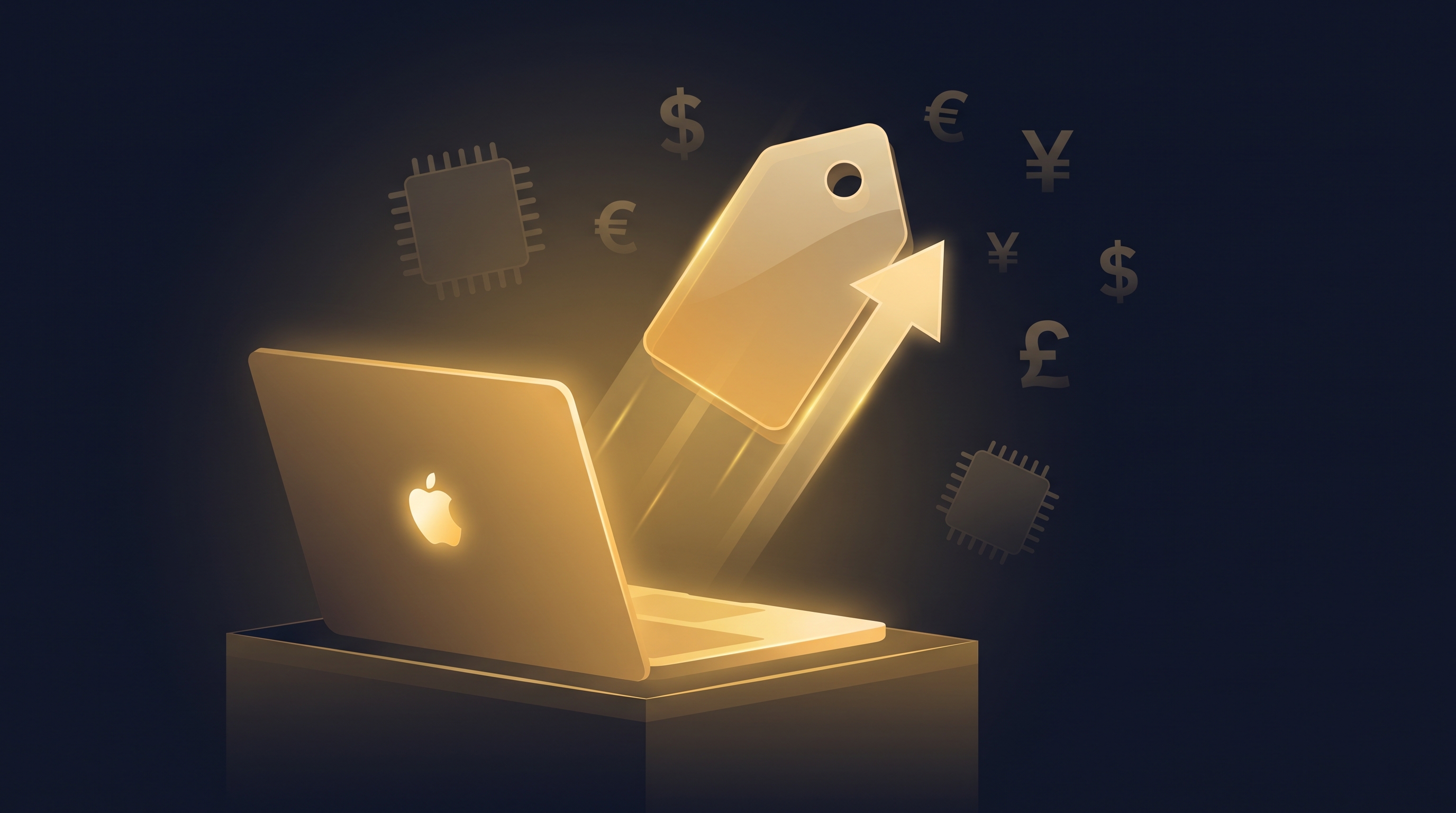
One-line summary: Apple quietly refreshed Mac and iPad pricing before the US market open on 6/25. MacBook Air jumped from 1,299 (+18.2%), MacBook Pro 14" from 1,999 (+17.7%). Average increase across the line: 18-20%. Tim Cook called it a “100-year flood.”
This isn’t Apple’s first price hike, but it’s the first one delivered with such moral certainty.
1. What Did Apple Do on 6/26? The Full Price Hike List
Apple’s US online store went offline briefly in the early hours US Eastern time on 6/25, and came back with new Mac and iPad pricing. iPhone is unchanged for now, but Apple’s statement hints “further price increases may still come.”
US Apple Store (effective 6/25):
| Product | Old Price (USD) | New Price (USD) | Increase |
|---|---|---|---|
| MacBook Neo | $599 | $699 | +16.7% |
| MacBook Air (512GB) | $1,099 | $1,299 | +18.2% |
| MacBook Pro 14" Entry | $1,699 | $1,999 | +17.7% |
| iPad Pro 11" | $999 | $1,199 | +20.0% |
| iPad Air (128GB) | $599 | $749 | +25.0% |
China Apple Store (effective 6/25):
| Product | Old Price (CNY) | New Price (CNY) | Increase |
|---|---|---|---|
| MacBook Neo | ¥4,599 | ¥5,499 | +19.5% |
| MacBook Air | ¥8,499 | ¥9,999 | +17.6% |
| MacBook Pro 14" | ¥13,499 | ¥15,999 | +18.5% |
| iPad Air | ¥4,799 | ¥5,999 | +25.0% |
MacBook Air entry jumped from ¥8,499 to ¥9,999 — right at the 10,000 RMB psychological barrier. MacBook Pro 14" entry went up a full ¥2,500 in one shot. iPad Air posted the biggest increase at 25%.
This is a global synchronized price hike. Hong Kong’s Wen Wei Po confirmed: “Apple computers will rise about 20%,” affecting multiple markets. Anyone opening Apple Store today sees new prices — Taiwan included (Apple Taiwan’s online store has also updated).

2. Why Now? From Micron’s 84.9% Gross Margin to Cook’s “100-Year Flood”
Apple held out for an entire year.
Starting Q4 2025, DRAM and NAND spot prices kept climbing. Morgan Stanley’s January supply-chain report warned: “Apple had originally locked in relatively favorable NAND supply through long-term agreements until early 2026, but those contracts are expiring one by one — new negotiations are underway.”
Cook’s response at the time was: “We will do our best to protect customers from price increases.”
What was this “hold the line” really about?
- 2023 memory winter: Micron’s gross margin dropped to negative territory. Apple took advantage to sign long-term contracts at low prices, stockpiling cheap inventory.
- Second half of 2025: That cheap stockpile gradually depleted. Apple was forced to buy at market-high prices.
- June 2026: Contracts nearly all expired. New procurement prices are 3-4x what they used to be. Apple can no longer absorb it.
Cook laid it bare in a late-June interview: “This is like a 100-year flood. In 40+ years, I have never seen anything like this in any industry.”
And on the day before Apple’s announcement (6/24), Micron released a quarterly report that stunned the entire market:
- Revenue $41.46B (+346% YoY)
- Adjusted gross margin 84.9% (crushing Nvidia’s 75%, Meta’s 81.9%)
- Q4 revenue guidance up to $50B
- 16 long-term agreements locking in $22B in cash
- HBM supply tightness to last beyond 2027
In other words: Apple’s price hike isn’t Apple’s problem — it’s Micron’s “structural pricing power” being directly passed on to consumers. The “AI memory super-cycle” we wrote about yesterday walked straight into your shopping cart today.
Worse, Counterpoint Research estimates: each iPhone’s cost will rise ~$200. That means the September iPhone 18 lineup will likely follow suit. If you’re the type who “waits for the next one,” this time you may wait for a more expensive next one, not a cheaper one.
3. Global Price Test: Where’s the Cheapest Place to Buy the Same Mac?
This is the hardest part of the article — I took MacBook Air (512GB) and MacBook Pro 14" (entry) post-hike prices across major markets, converted to USD for comparison.
FX rates as of 2026/6/26: 1 USD ≈ 30.23 TWD; 1 HKD ≈ 3.86 TWD; 1 JPY ≈ 0.196 TWD; 1 CNY ≈ 4.20 TWD; 1 SGD ≈ 22.50 TWD.
MacBook Air M5 (512GB / 16GB) Post-Hike Price
| Market | Local Price | USD Equivalent | vs. US |
|---|---|---|---|
| 🇺🇸 USA (baseline) | $1,299 | $1,299 | 0% |
| 🇸🇬 Singapore (est) | SGD 1,749 | $1,302 | +0.2% |
| 🇭🇰 Hong Kong (est) | HK$10,799 | $1,379 | +6.1% |
| 🇨🇳 China mainland | ¥9,999 | $1,389 | +6.9% |
| 🇹🇼 Taiwan (est) | NT$42,362 | $1,401 | +7.9% |
| 🇯🇵 Japan (est, incl. 10% tax) | ¥218,800 | $1,419 | +9.2% |
| 🇦🇺 Australia (est) | AUD 2,099 | $1,450 | +11.6% |
| 🇪🇺 Germany (est, incl. 19% VAT) | €1,399 | $1,610 | +23.9% |
MacBook Pro 14" M5 (Entry) Post-Hike Price
| Market | Local Price | USD Equivalent | vs. US |
|---|---|---|---|
| 🇺🇸 USA (baseline) | $1,999 | $1,999 | 0% |
| 🇭🇰 Hong Kong (est) | HK$16,599 | $2,119 | +6.0% |
| 🇦🇺 Australia (est) | AUD 3,099 | $2,140 | +7.1% |
| 🇹🇼 Taiwan (est) | NT$64,782 | $2,143 | +7.2% |
| 🇸🇬 Singapore (est) | SGD 2,899 | $2,158 | +7.9% |
| 🇯🇵 Japan (est, incl. tax) | ¥338,800 | $2,196 | +9.9% |
| 🇨🇳 China mainland | ¥15,999 | $2,223 | +11.2% |
| 🇪🇺 Germany (est, incl. VAT) | €2,199 | $2,530 | +26.5% |
Three Key Findings
Finding 1: The US is always the cheapest starting point.
Whichever table you look at, the US domestic price sets the baseline. This isn’t just about exchange rates — it’s Apple’s internal “Pricing Tier” system. Apple divides the world into four pricing tiers (Tier 1 = US baseline; Tier 2 = HK, Singapore, Taiwan, Canada; Tier 3 = Europe, Japan; Tier 4 = China, India, Brazil). The gap between tiers is ~5-15%, then add VAT, import duties, shipping — and you get the cross-border arbitrage you see today.
Finding 2: Taiwan sits in the middle, but with Education Pricing it can crack the global top three.
Take MacBook Air: Taiwan’s NT3,310** (MacBook Air education price was NT39,260 post-hike), putting Taiwan slightly cheaper than the US. This is a small, overlooked silver lining for Taiwan Mac buyers.
Finding 3: Japan is the priciest in Asia; Europe is the priciest globally.
Japan’s yen has been weak for a long time plus the 10% consumption tax means Apple has hiked MacBook prices in Japan twice this year. Over the past few years, MacBook Air alone rose from ¥115,280 to ¥218,800 — a ~90% jump. Europe doesn’t even need explanation: 19% VAT + import duties, and MacBook Pro 14" in Germany is nearly 27% more expensive than in the US.
If you travel, have friends abroad, or can buy cross-border, US + Education discount + Trade-in is still the cheapest combo globally. But for most people, the arbitrage is too small to bother.
⚠️ Important Caveats
- The post-hike prices above for non-US markets are estimates based on Apple’s official 17-20% hike rate. Some markets haven’t been updated yet; actual numbers should be confirmed at the local Apple Store.
- Cross-border purchases involve customs duties, warranty issues, and after-sales service. The “savings” might not be real.
- Education discount requires student/teacher/staff status, and Apple is getting stricter about cross-border use.

4. Three Action Paths: Buy Now, Wait for iPhone 18, or Skip?
The price hike has happened, but your decision hasn’t. Let me break it into three scripts.
Script A: Buy Now (for “my laptop dies today” people).
- Buy immediately. Don’t wait for the September iPhone 18 launch. Apple explicitly hinted “further price increases may still come.” Waiting will only cost more.
- If you have student/teacher/staff status, use the education discount. It’s legit, Apple-official, and saves 6-10% with zero effort.
- Payment: Apple zero-interest installments + credit card rewards = another 1-3% saved.
Script B: Wait Until September (for “old laptop can hold out 3 more months” people).
- Apple launches the iPhone 18 lineup in September (including the rumored foldable iPhone). Mac products usually get a “Education Discount + Back-to-School Gift Card” promo (this year, up to $150 USD gift card).
- Risk: If iPhone 18 raises prices, Mac likely goes up again too. Cook has telegraphed this.
- Strategy: Add the Mac you want to your cart now, keep watching US Apple’s Trade-in valuations and Education Discount promos. Strike when September hits or on Black Friday.
Script C: Skip This Generation (for “just want to upgrade, not urgent” people).
- The 2027 M6 MacBook Pro is expected to use 2nm process with major efficiency jumps. If you only do documents, web, coding, your current laptop can hold out another year.
- The real cost savings isn’t “wait for a price drop” — it’s “confirm your actual need.” A lot of the time we’re drawn to new product glow, not solving real problems.
- Rule of thumb: Can your old laptop still do 80% of what you need? If yes, waiting is the right call.
Closing: Price Hikes Are Symptoms. “Structural Price Hikes” Are the Signal.
On the surface, Tim Cook raised Apple’s prices. Underneath, Micron’s 84.9% gross margin gave Micron pricing power that gets passed straight to your wallet.
Yesterday we wrote about “Micron using $22B in long-term agreements to lock the memory wall into contracts.” Today Apple tells you, via Cook’s “100-year flood,” that the cost of those contracts still has to be paid by someone.
That someone is you.
Save this article. Next time iPhone 18 hikes, next time you complain about Apple getting more expensive, next time you ask “should I wait for the next generation” — open this and look again at the line from Micron’s 84.9% to your shopping cart.
You’ll see: Apple isn’t raising prices. The AI memory super-cycle is raising prices. Apple is just the messenger.
Disclaimer: This article is for educational and informational purposes only and does not constitute investment advice. Prices are based on the Apple Store in each market as of 2026/6/26. Exchange rates are estimates at the time of writing. Cross-border purchases involve customs duties, warranty, and after-sales service considerations — please evaluate based on your own situation. Investing involves risk, and you should make decisions based on your own risk tolerance.
Comments